
Ryan Pronunciation: Common Slips and How to Avoid Them
The real pronunciation test for a name rarely happens in a naming book. It happens in ordinary public life: a teacher reading the class list on the first morning of school, a nurse calling a child from the waiting room, a coach checking attendance, a grandparent repeating the name back after seeing it written for the first time. Ryan tends to do well in those moments because it looks familiar, sounds contemporary, and gives the speaker a clear place to put the stress almost immediately. That matters more than parents sometimes expect. A name can be handsome on paper and still create daily friction if the rhythm feels uncertain. Ryan does not have that problem very often.
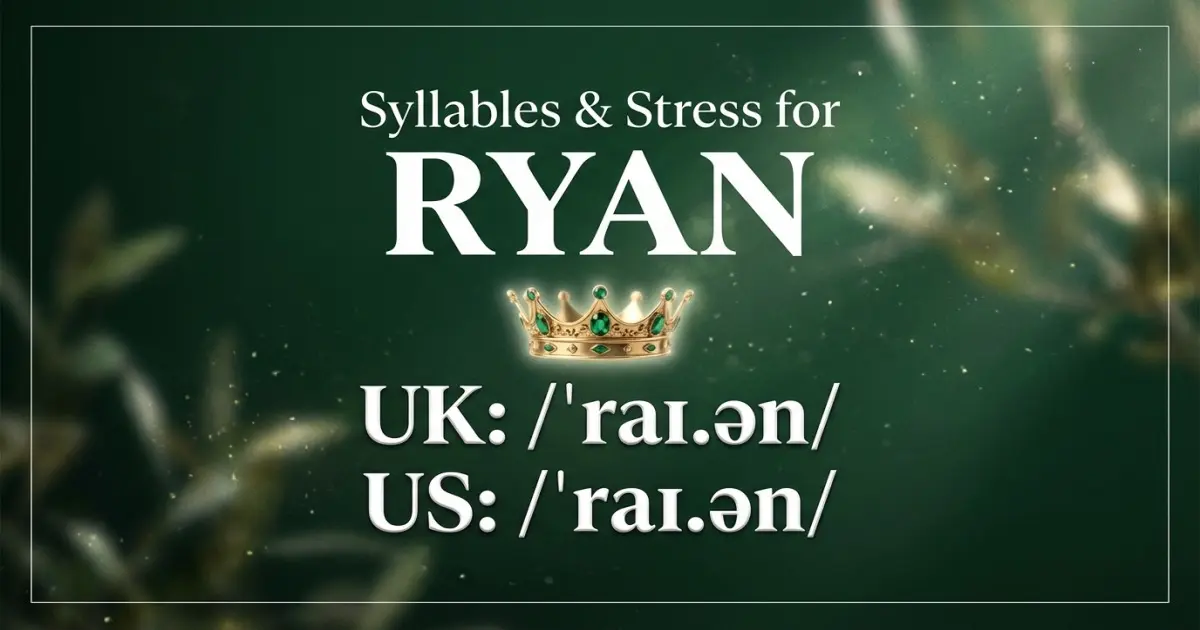
Part of the reason is structural. Ryan is pronounced RY-uhn, with two syllables and the main emphasis on the first. In standard reference form, both US and UK pronunciation are commonly given as /ˈraɪən/. That shared pattern gives the name unusual stability across English-speaking settings. Even though some people may say it more quickly and make it sound almost compressed, the underlying shape remains the same: a bright opening syllable, followed by a lighter, reduced ending. The sound is simple, but not flat. It is one of those names whose ease comes from good internal balance.
How Ryan is actually said when real people say it aloud
| Element | Phonetic Detail | Quick Tip |
|---|---|---|
| Standard pronunciation | RY-uhn | Say it in two beats, with the first syllable carrying the stress. |
| IPA (US) | /ˈraɪən/ | The opening rhymes with my or sky, then relaxes into a lighter second syllable. |
| IPA (UK) | /ˈraɪən/ | The standard UK reference form matches the US one, which keeps Ryan highly portable. |
| Syllable count | 2 syllables | Do not force it into one blur or over-separate it into three beats. |
| Primary stress | First syllable | The strongest energy belongs on Ry, not on the ending. |
| Ending sound | Reduced second syllable | Let the final part stay light instead of pronouncing it like a full, heavy word. |
Why Ryan sounds so natural in everyday English
At the most practical level, Ryan works because its rhythm is cooperative. The first syllable opens with the diphthong in rye, a bright vowel glide that English speakers recognize instantly. Then the second syllable reduces into a softer, less stressed ending. In phonetic terms, this is a very friendly English pattern: strong front half, lighter back half. Names built this way are often easy to hear, easy to repeat, and easy to remember. Before focusing only on syllables and stress, it helps to step back into the fuller frame of Ryan meaning.
The IPA /ˈraɪən/ makes that visible. The stress mark tells you right away that the emphasis comes first. Then the name moves from the open diphthong into a reduced unstressed syllable. That reduction matters. English speech relies on reduced syllables constantly, and names that use them well tend to sound fluent rather than stiff. Ryan is a good example. It begins clearly and ends gently.
Why the first syllable gives Ryan its identity
The opening Ry is where Ryan does most of its work. It is the memorable part, the stressed part, and the piece listeners catch first in noisy real-life settings. This is one reason the short form Ry feels so natural as a nickname. The strongest part of the full name already lives there.
Why the ending keeps Ryan from sounding abrupt
If Ryan ended after the first syllable, it would sound much sharper and more incomplete. The second syllable softens the profile. It gives the name a more human, more conversational landing. That matters because Ryan’s meaning may be grander than its sound, but the sound itself stays approachable. The light ending is a big part of that approachability.
Where Ryan can go wrong in the mouth, and why it happens
Most pronunciation issues with Ryan are not dramatic mistakes. They are more often timing issues. Because the name is so familiar, speakers tend either to compress it too much or to over-articulate it when they are trying to be careful.
Do not flatten Ryan into a one-syllable blur
The most common drift is turning Ryan into something so compressed that the second syllable nearly disappears. In fast speech, some people say it in a way that sounds close to Ryin as a single unit. That is understandable in casual conversation, but the reference pronunciation still works best as two syllables: RY-uhn. You want the second part to be light, not absent.
Do not over-hit the ending
The opposite mistake is making the second syllable too heavy, almost as if the name were ry-AN or RY-an with full weight on both parts. That makes the name sound more rigid than natural English speech usually does. Ryan should feel like one smooth movement with a clear first beat and a lighter tail.
Do not let the first vowel drift away from the sound of “rye”
The opening syllable should rhyme with words like my, sky, and try. If that sound shifts too far toward a flatter or rounder vowel, the name begins to lose its familiar identity. The simplest cue is to hold onto the sound of rye and let the rest of the name fall naturally behind it.
Ryan across accents changes less than many parents expect
One practical advantage of Ryan is that the standard US and UK reference pronunciations are the same: /ˈraɪən/. That does not mean every speaker sounds identical. Accent always colors pacing, vowel quality, and the degree of reduction in the second syllable. But it does mean the underlying frame is unusually stable.
What may shift slightly in natural speech
Some speakers make the second syllable very light, almost disappearing into the first. Others articulate it a little more clearly. In some accents, the first diphthong may sound broader or narrower. These are normal accent textures, not competing official pronunciations.
What stays fixed in almost every version of Ryan
The first syllable remains stressed. The opening still sounds like rye. The name stays a two-syllable structure, even if casual speech compresses it slightly. This is why Ryan travels so well. It can be said by people from different English-speaking backgrounds without losing its basic identity.
Ryan belongs to a sound family that is simple, but not dull
Many parents understand pronunciation best by comparison. Ryan belongs to a very comfortable English sound family: stress-first, diphthong opening, reduced second syllable. This is one reason it feels so socially easy. It does not require unusual consonants, hidden stress, or careful explanation before most people can say it.
At the same time, Ryan is not dull in the mouth. The opening glide gives it motion, and the lighter ending gives it softness. That small internal contrast keeps the name memorable. It sounds contemporary, but it is not brittle. It sounds familiar, but not shapeless.
Practice lines that make Ryan settle into the ear
The easiest way to feel the pronunciation is to say it in natural phrases rather than in isolation:
- Ryan, it’s your turn.
- This is Ryan.
- Can Ryan come too?
- Ryan James Carter.
These lines help keep the first syllable bright and the second one light. If the name starts sounding too compressed, slow down slightly and restore the second syllable. If it starts sounding too formal, relax the ending again and let the name move naturally.
Why Ryan is one of those names people usually get right after hearing it once
The strongest thing about Ryan’s pronunciation is not that it is impossible to mishear. Very few names are. The strongest thing is that once someone hears it once, they usually understand the pattern and can repeat it correctly. That makes Ryan a low-friction name in school, work, and ordinary introductions.
That ease is a big part of the name’s staying power. Ryan sounds polished without sounding formal, familiar without sounding tired, and modern without sounding flimsy. The first syllable gives it brightness, the second gives it ease, and the whole pattern fits comfortably inside everyday English. Ryan does not rely on unusual sound to be memorable. It relies on clarity.
How Ryan Sounds in Practice: FAQ
How do you pronounce Ryan correctly?
Ryan is commonly pronounced RY-uhn. It has two syllables, and the main stress falls on the first syllable. The standard IPA in both US and UK reference form is /ˈraɪən/.
Is Ryan really two syllables?
Yes. In standard pronunciation, Ryan has two syllables. In fast speech, some people compress it so the second syllable becomes very light, but the reference form still works best as a two-syllable name.
Is Ryan pronounced differently in British and American English?
In standard reference form, no major difference is usually given. Both US and UK pronunciation are commonly represented as /ˈraɪən/. Accent may slightly affect pacing or vowel texture, but the core pattern stays the same.
What is the most common pronunciation mistake with Ryan?
The most common issue is compressing the name too much so it nearly sounds like one syllable, or making the second syllable too heavy. Ryan sounds most natural when the first syllable is clearly stressed and the ending stays lighter.