
Rose Pronunciation: Syllable Guide and Easy Stress Tips

The real pronunciation test for Rose happens in ordinary life, not in a dictionary. It happens when a teacher reads the class list on the first day of school, when a nurse calls a name in a waiting room, or when someone hears it once and repeats it back without hesitation. Rose is one of those names that tends to pass that test beautifully. It is short, familiar, and shaped by sounds that most English speakers already know. Official data shows the name remained established in the United States in 2024, and that continuing visibility matters because familiar names usually become phonetically stable in public life. People know what they are hearing almost before they think about it.
But Rose is not simple in a dull way. Its pronunciation works because it compresses a great deal of elegance into one syllable. It begins with a resonant opening consonant, moves through a rounded vowel glide, and finishes on a voiced z sound that gives the name polish and firmness. That final detail matters more than many people realize. Rose is not just soft. It closes with definition. That is one reason the name feels both graceful and composed when spoken aloud.
What Rose Clarifies the Moment It Is Said
| Element | Phonetic Detail | Quick Tip |
|---|---|---|
| Everyday pronunciation | ROHZ | Say it as one clean syllable, not two, and let it finish clearly. |
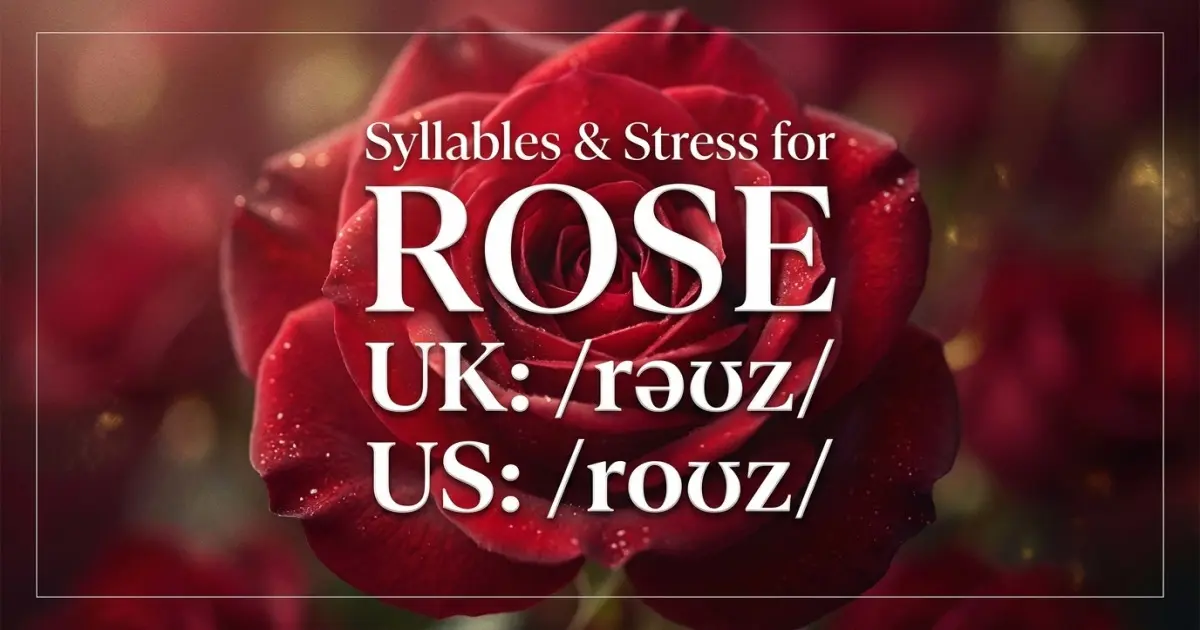
| US IPA | /roʊz/ | The middle vowel glides like the sound in go or show. |
| UK IPA | /rəʊz/ | The British version begins slightly more centrally, but it still lands very close to ROHZ in everyday speech. |
| Syllable count | 1 syllable | Rose is compact and self-contained, so do not stretch it into two beats. |
| Stress pattern | Full stress on the single syllable | Because Rose is monosyllabic, the entire name carries the emphasis at once. |
| Key consonants | Opening /r/, closing /z/ | The beginning should feel smooth, and the ending should feel lightly voiced rather than abrupt. |
| Most common drift | Weakening the final consonant or flattening the vowel | Keep the ending audible and let the vowel stay rounded. |
How Rose Holds Its Shape in a Single Syllable
Rose is pronounced as one syllable: ROHZ. That sounds straightforward, but one-syllable names depend heavily on precision. With a longer name, one slightly weak sound can be absorbed by the rest of the structure. With Rose, every sound matters. The name has to begin cleanly, travel smoothly through its vowel, and finish with enough energy that it does not collapse into softness. Before focusing only on syllables and stress, it helps to step back into the fuller frame of Rose meaning.
Why the vowel gives Rose its elegance
In American English, the central vowel movement is /oʊ/, a glide that begins more open and moves toward a rounded oo-like position. This is the sound heard in words such as go, home, and stone. In British English, the supplied IPA /rəʊz/ reflects a very similar overall shape, though the starting point can be a little more central. In everyday use, both remain close to the familiar ROHZ sound.
This glide matters because it keeps Rose from sounding flat. A flat vowel would make the name feel dull or clipped. The movement inside the vowel is part of what makes the name feel polished. It opens and narrows in a small, contained way, which gives the single syllable more texture than a simpler vowel would.
Why the final consonant matters more than many people expect
The ending of Rose is /z/, a voiced fricative. A fricative is a sound made by forcing air through a narrow channel, and voiced means the vocal cords are active while the sound is made. In practical terms, the final z gives Rose a gentle buzz rather than a hard stop. That is part of why the name sounds refined. It closes cleanly, but not harshly.
If the final consonant weakens too much, the name can sound unfinished. If it is overhardened, the name can lose some of its natural grace. Rose sounds best when the z is audible but controlled, like a polished ending rather than a hiss.
Why Rose Sounds Slightly Different Across Accents but Never Becomes Unclear
Rose is a good example of a name that shifts texture across English accents without losing its identity. The supplied U.S. IPA is /roʊz/ and the supplied U.K. IPA is /rəʊz/. That difference is real, but it is not disruptive. Most listeners would still describe both versions as ROHZ in ordinary life.
US Rose: rounder and slightly fuller at the start
In American English, the vowel often begins a little more directly on the rounded o-like sound. That can make the name feel a touch fuller or more straightforward. The whole syllable tends to sound firm, smooth, and self-contained.
UK Rose: slightly softer in the opening movement
In British English, the supplied /rəʊz/ suggests a slightly more central starting position before the vowel glides toward the rounded end. In practice, this gives the name a slightly softer or more delicate opening texture. The identity of the name does not change. Only the surface contour does.
That stability is one reason Rose travels so gracefully. It can be spoken in different English accents without ever sounding like a different name. It adjusts, but it does not break.
Where Rose Can Go Slightly Wrong in Everyday Speech
Rose is easy to say, but because it is so short, even small shifts can change the impression it makes. Most pronunciation issues are minor, yet they are worth noticing because they reveal what keeps the name balanced.
Mistake pattern one: letting the ending disappear
The most common issue is failing to give the final z enough presence. A weak ending can make the name sound less precise than it should. Rose does not need a heavy ending, but it does need a clear one. The sound should taper, not vanish.
Mistake pattern two: flattening the vowel too much
Another drift is reducing the vowel glide so much that the name loses its rounded movement. Rose should not sound cramped or pinched. The vowel needs a little space inside it, because that internal movement is part of the name’s elegance.
Sound neighbors that help people get Rose right
If someone is unsure, it can help to compare Rose loosely to the sound in rows, while remembering that Rose is the name form built on the flower word. It may also help to remember what Rose is not. It is not two syllables. It is not roh-se. It is not a soft vanishing breath. It is a single rounded syllable that closes with a voiced finish. Once the sound pattern is clear, some shortenings stop feeling optional and start feeling natural, and the clearest map is in Rose nicknames.
That is why the name sounds so composed. It begins gently, but it does not drift away.
How to Practice Rose Until It Sounds Natural Every Time
One-syllable names often become clearer when practiced inside full sentences, not in isolation. Rose is a perfect example of that. Once it appears in normal speech, its balance becomes obvious. The name should move quickly, but never carelessly.
Simple practice lines for Rose
- Rose is waiting by the door.
- I saved a seat for Rose.
- Did Rose already call back?
- Rose will be here after lunch.
Say these aloud and listen for the same pattern each time: one syllable, rounded vowel, clear ending. The name should feel smooth, not hurried. Because Rose is so short, the best pronunciation is often the calmest one.
How to know you are saying Rose well
You are probably pronouncing Rose correctly if three things happen at once: the name stays one syllable, the vowel remains rounded and slightly gliding, and the final z is audible without becoming harsh. Once those pieces are in place, the sound does exactly what the name needs it to do: feel polished, simple, and complete.
That is the real achievement of Rose as a spoken name. It proves that brevity does not have to mean thinness. In a single syllable, Rose manages to sound gentle, finished, and memorable all at once. That is not accidental. It is a sign of a name built with unusual precision.