
Remington Name Meaning: A Timeless Choice with Meaningful Roots

Remington is a name that sounds as though it was built from geography and then polished by society. Its meaning, settlement on a riverbank, does not point first to a private emotion or a moral quality. It points to habitation. A place where people stopped, built, stayed, and made a life at the edge of moving water. That gives the name an unusual core idea. It is not only about landscape. It is about settlement within landscape. The riverbank is motion, change, passage, trade, weather, crossing. The settlement is structure, continuity, belonging, and return. Put together, Remington carries one of the oldest human tensions inside a very modern-sounding name: how to build something lasting beside what never stops moving.
That tension helps explain why the name feels so current. In present-day American naming, many parents want names that sound substantial, versatile, and socially confident without being antique in a fragile way. Remington answers that wish by sounding inherited rather than invented. It has the broad shoulders of an English surname, the portability of a place-derived name, and the flexibility of a modern unisex choice. Yet beneath the style sits a more interesting idea than trend alone. Remington suggests permanence near motion, residence near flow, identity formed at the edge of change. That is why the name can feel both stately and contemporary at once.
Remington's U.S. popularity rank over time, 1955–2024
Popularity statistics are based on official data from the Social Security Administration baby name records.
Remington: A Strong and Distinguished Unisex Choice
Remington behaves as a name with a fluid identity that still feels stable, showing meaningfully visible lanes across both sides of the chart. Its widespread appeal likely suggests how its professional sound and “riverbank” meaning make the name feel open across all lanes in modern naming culture .
The chart indicates that while its peak adoption for boys was in 2019, the girls’ lane has reached new peaks in 2021. Its rhythmic three-syllable structure carries a sense of confident clarity that travels exceptionally well.
Remington, in One Grounded Portrait
| Key Facts | Information | Quick Insight |
|---|---|---|
| Name | Remington | Long enough to feel formal, but familiar enough in sound to move easily through modern life. |
| Primary gender use | Unisex | Official data shows real use for both sexes, though the current U.S. pattern leans more strongly male. |
| Primary origin | English | Its English origin helps explain the name’s surname strength and place-name texture. |
| Primary meaning | Settlement on a riverbank | This is a meaning about habitation and terrain, not abstract virtue, which gives the name unusual depth. |
| Pronunciation | REM-ing-tun | The strong opening keeps the name grounded; the softer ending keeps it socially usable. |
| IPA | US /ˈrɛmɪŋtən/; UK /ˈremɪŋtən/ | The American and British forms are almost identical, signaling a stable spoken identity. |
| Syllable count | 3 | Three syllables give Remington room to sound formal and substantial without turning ornate. |
| U.S. standing (2024) | No. 519 for girls and No. 287 for boys | The ranking confirms broad gender reach, but also shows that today’s usage is markedly stronger for boys. |

Why Remington Feels Like More Than a Surname
Some names borrowed from surnames feel purely social. They sound tailored, well-dressed, and a little elevated, but emotionally thin. Remington avoids that problem because its underlying meaning is vivid. Settlement on a riverbank gives the name a physical and historical imagination. It evokes one of the oldest kinds of place-making: building near water because water makes life possible, even while it also brings risk, movement, and unpredictability. A name with that root naturally acquires more weight than a surname that simply signals lineage or occupation.
That weight is one reason the name works as a first name at all. Modern parents are often drawn to surname names because they sound socially confident, but the strongest examples also contain some deeper narrative that helps them feel inhabitable. Remington does. It suggests a place where people stopped long enough to become a community. The idea of settlement matters here. A riverbank alone would be scenery. A settlement on a riverbank is society. The name therefore holds both environment and human purpose. It is a surprisingly complete picture.
There is also a psychological appeal in the name’s balance of stability and motion. Many place-derived names do one thing only. They give you field, hill, wood, or town. Remington quietly adds a dynamic element. The river implies movement, travel, exchange, and change over time. The settlement implies decision, rootedness, and continuity. This makes the name feel stronger than a merely pastoral choice and more humane than a purely martial one. It is a place-name meaning, but it is not passive scenery. It is inhabited geography.
Settlement is the hidden strength inside Remington
Names that mean beauty or grace can be lovely, but names built around settlement can feel more durable because they imply structure. Remington does not merely describe terrain. It describes a human response to terrain. That gives it a different kind of dignity. It sounds like a name associated with making order, staying put, and building something that lasts.
The riverbank keeps the name from feeling rigid
At the same time, the riverbank prevents the name from becoming static. Water changes course, carries stories, and links places together. So while Remington sounds established, it does not sound trapped. This is one reason the name can feel both traditional and modern. It is settled, but never still.
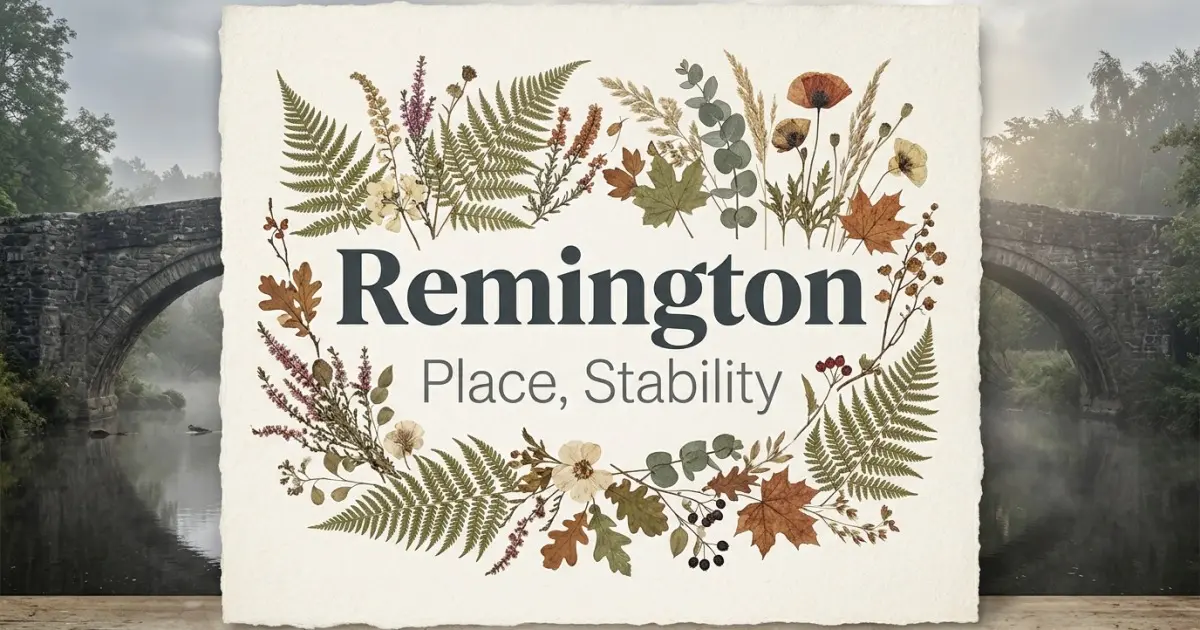
Remington’s English Bones and the Rise of the Surname First Name
Historically, Remington makes sense inside a well-established English naming pattern: a place name becomes a surname, then eventually becomes a first name. Naming books repeatedly describe English surnames and place-derived forms as following the contemporary trend of using last names as first names. They say this explicitly for names such as Bradley, Brent, Audley, Henderson, Murphy, Bowden, Henley, Blakely, Huntley, and many others. Remington belongs naturally to that same stream. It has the shape of a place-derived surname that modern families have felt comfortable lifting into first-name use.
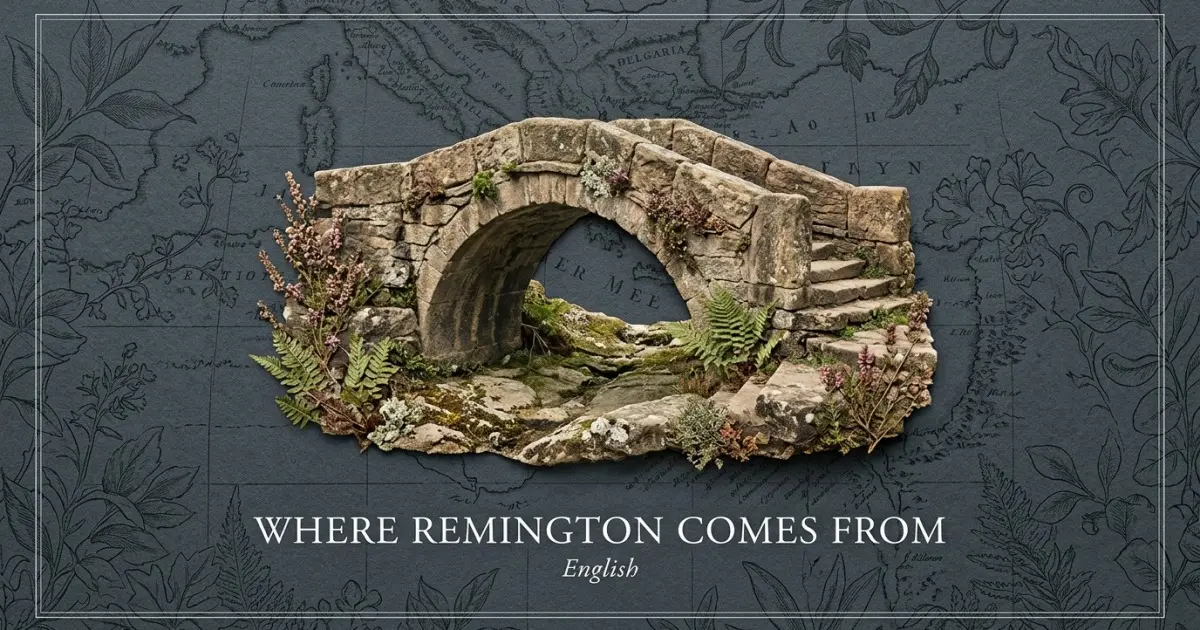
That broader pattern matters because it prevents Remington from feeling isolated or eccentric. It sits alongside a large family of English-origin names that began in landscape, settlement, or lineage and later entered the given-name field. This is one reason the name sounds intuitively right to many ears even if they have never studied its history. The grammar is already familiar. English-speaking culture has become deeply comfortable with surname names that imply town, meadow, clearing, hill, bank, or inherited locality. For more names shaped by the same tradition, explore related names by origin.
The attached naming references make another useful point: many of these names first lived as place names, then surnames, then first names. That sequence helps explain Remington’s tone. It sounds established because it has already passed through social life before arriving in the nursery. It was not coined for charm. It was inherited from use. Even if listeners do not know the full historical arc, they hear that inherited quality in the name’s structure.
That inheritance also helps the name carry authority. Compared with softer modern inventions, Remington feels less delicate and more publicly ready. It sounds like a name that could belong on a brass plate, a class register, a byline, or a sports roster. Yet because it is now used for girls as well as boys, the authority no longer belongs exclusively to one gender expression. The surname base gives the name its social strength; the current naming climate gives it freedom of placement.
How Remington Sounds: Strong Front, Soft Landing
Phonetically, Remington succeeds because it distributes its weight well. The first syllable, REM, is immediate and grounded. It opens with a liquid r, which gives the name movement, but the short vowel and following consonant keep it from floating. The middle, ing, is transitional, and the final syllable, tun, softens the line just enough to make the whole name livable in daily speech. This is one of those names that sounds bigger than it is because the syllables are well built.
The pronunciation also helps explain the name’s unisex potential. Remington does not lean heavily on either overt softness or overt hardness. Its opening is firm, but not blunt. Its ending is reduced and relaxed, but not delicate. The name therefore avoids sounding excessively tailored in one direction. For boys, it can read strong, formal, and expansive. For girls, it can read confident, modern, and slightly unexpected. The phonetics support both interpretations.
Three syllables also matter here. In modern naming, three-syllable surname names often feel more versatile than shorter ones because they leave room for both the full form and obvious short forms. Remington has enough length to feel substantial, but it does not become unwieldy. It is easier to imagine across age than some faster, sharper surname names because the rhythm has internal balance. This is not a one-note punch of a name. It has contour.
Why the opening makes Remington memorable
The stressed first syllable gives the name clarity and recall. Listeners know immediately where the emphasis belongs, which helps Remington feel more anchored than names with shifting or uncertain stress. That is a practical advantage as well as a stylistic one.
Why the ending keeps Remington usable
The final -tun is subdued in ordinary speech. That matters because it lets the name retain gravity without becoming stiff. Remington sounds substantial, but it does not sound ceremonial. The reduced ending makes it easier to say in repeated everyday use, which is one reason the name feels less cumbersome than its length on paper might suggest.
Remington in Modern Style: Unisex on Paper, Uneven in Practice
Official Social Security Administration (SSA) data places Remington at No. 287 for boys and No. 519 for girls in 2024. That is one of the most interesting facts about the name. It confirms what the ear already suspects: Remington is genuinely unisex in modern use, but the balance is not equal. The name is considerably more established for boys at present. That does not diminish its female usage. It simply defines the social reality more clearly. To continue browsing names with a similar gender identity, see more gender-neutral name ideas.
This pattern is typical of many surname names. They often begin with strong use among boys, then expand into female use once the style becomes associated with broader modern confidence rather than solely with masculine inheritance. Remington appears to be living inside that development. It retains enough surname stiffness to remain more common for boys, but it also has enough rhythmic smoothness and modern familiarity to work for girls. In other words, the form is flexible even if the usage pattern is not perfectly symmetrical.
That asymmetry shapes how the name is perceived. On a boy, Remington may feel like a polished, upscale surname choice with room for easy shortenings. On a girl, it may feel more unexpected, more fashion-aware, and more deliberately contemporary. Neither reading is wrong. They simply reveal how the same structural name can shift tone when culture distributes it unevenly by gender.
There is also a broader social factor at work. Naming guides have observed that modern families are increasingly open to names used across genders, especially when those names began as surnames or place names. Remington fits that movement well. It is less overtly gender-coded than floral names, and less sharply masculine than some older occupational surnames. That makes it plausible in both directions while still sounding fully like itself.
Remington and the Question of Associations
One of the more useful principles found in naming advice is that people do not respond to names in the abstract. They respond through associations: celebrities, fictional characters, family members, political figures, old classmates, or brands. That matters with Remington because it is one of those names that can carry strong personal associations before anyone even thinks about its literal meaning. Some listeners will hear refinement. Others will hear Americana. Others will simply hear a modern surname choice with a polished edge.
The attached references make a broader point that is worth applying here: parents are wise to think about the public life of a name as well as its definition. Names can pick up tone from fiction, public personalities, and cultural memory. Remington is a good example of a name whose social presence may affect perception as much as its place-name origin does. That does not make the name unusable. It makes it vivid. And vividness is often what helps a name remain memorable once it leaves the page and enters conversation.
Still, the deeper meaning gives Remington a stabilizing center. A name with merely borrowed prestige can feel hollow over time. A name rooted in settlement and riverbank does not. Whatever associations come and go, the underlying image remains one of human dwelling at the edge of movement. That is strong enough to outlast passing reference points.

What Remington Opens Up Next
Middle names that keep Remington balanced
Because Remington already sounds long, tailored, and socially visible, the best middle names often either simplify the line or introduce a quieter classic note. The trick is deciding whether to sharpen the surname strength or soften it with warmth. If you want the full pairing logic behind that contrast, see middle names for Remington.
Nicknames that make Remington more intimate
Three-syllable names invite shortening, and general naming advice notes that close friends and family often reduce longer names to one strong syllable or a familiar form. Remington offers several natural paths, which is part of what makes it so socially adaptable. To see how those different moods shorten in real life, explore nicknames for Remington.
Pronunciation that sounds larger than it is
REM-ing-tun is stable, easy to teach, and nearly identical across American and British IPA in this run. That gives the name a useful advantage: it looks formal on paper but behaves simply in speech. If you want the full sound pattern behind that rhythm, read how to pronounce Remington.
Why Remington Holds Together as a Modern Name
Remington succeeds because it gives modern parents more than one thing at once. It offers the polish of a surname, the depth of a place meaning, the flexibility of unisex use, and the practical clarity of a name that speaks almost exactly as it looks. More importantly, it offers a central image that is richer than many fashionable names manage to hold. Settlement on a riverbank is not only picturesque. It is civilizational. It is where movement meets dwelling, where flow meets structure, where the need to travel meets the need to remain.
That is why the name carries more gravitas than trend alone would suggest. It imagines a life built beside change rather than sheltered from it. It suggests adaptability without rootlessness, permanence without stagnation, and confidence without brittle display. In literary terms, Remington feels like a name that knows the river will keep moving and chooses to build anyway. That is the deepest appeal hidden inside its polished English surface. Remington does not merely sound established. It sounds like establishment earned at the edge of motion, and that is why Remington can feel both contemporary and enduring at the same time.