
Reagan Name Meaning: Its Roots, Symbolism, and Lasting Identity

Reagan is one of those names that sounds smaller than the idea inside it. On the page and in speech, it is quick, tidy, and modern: two syllables, no ornament, no visible strain toward grandeur. Yet its core meaning is “little king,” and that tension is what gives the name its staying power. It does not wear royalty like a robe. It wears it like a clean line. Official Social Security Administration (SSA) data places Reagan at No. 244 for girls and No. 1571 for boys in the United States in 2024, which already hints at how the name now lives in public: recognizably unisex in structure, but currently much more visible on girls. That modern usage pattern makes the name feel contemporary. Its meaning makes it older and more layered than it first appears.
The real interest of Reagan lies in that contrast between scale and sound. “Little king” is not a bombastic meaning. It is a compact one. It suggests stature in miniature, authority without heaviness, rank translated into something nimble and wearable. That may be why the name works so well in the present moment. Many parents want names that feel strong without sounding severe, unisex without sounding blank, and polished without becoming cold. Reagan answers all three desires at once. It has the clean, surname-based energy that modern naming has loved for years, but it also carries a core image far older than fashion: rulership reduced to a human size.
Reagan's U.S. popularity rank over time, 1913–2024
Popularity statistics are based on official data from the Social Security Administration baby name records.
Reagan: A Strong Surname with Shared Visibility
Reagan behaves like a name with shared visibility without full balance, maintaining its primary strength as a feminine choice with a meaningful secondary track for boys. Its widespread appeal likely stems from a taste for “strong surname-style names” that carry a professional and confident feel .
The chart indicates that while one side is dominant, its structure makes it feel open to all genders in modern naming culture. Meaning “little king,” its simple two-syllable rhythm travels exceptionally well.
What the quick facts already reveal about Reagan
| Key Facts | Information | Quick Insight |
|---|---|---|
| Name | Reagan | The name feels brisk and contemporary, but its meaning reaches back into older Irish ideas of rank and lineage. |
| Primary gender usage | Unisex | Its sound stays neutral enough to move across gender lines, even though current usage is much stronger for girls. |
| Primary origin | Irish | The Irish background matters because it gives Reagan more depth than a purely modern surname-style choice would have on its own. |
| Core meaning | Little king | This is a meaning of contained authority: confident, elevated, but not oversized or theatrical. |
| Pronunciation | RAY-gun | The strong opening and softened ending make the name sound crisp without sounding hard-edged. |
| IPA | /ˈreɪɡən/ | The pronunciation is highly legible in English, one reason the name has moved so easily into first-name use. |
| Syllable count | 2 | Two syllables give Reagan speed, clarity, and the streamlined quality many parents now favor. |
| U.S. girls’ rank (2024) | No. 244 | For girls, Reagan is familiar enough to feel current while still avoiding the saturation of the very top tier. |
| U.S. boys’ rank (2024) | No. 1571 | For boys, the name is much rarer now, which preserves its unisex legitimacy while making it feel more selective. |

Reagan turns royalty into something compact and modern
“Little king” is a particularly interesting kind of name meaning because it does not read like pure status. The word “king” carries obvious associations with command, hierarchy, and rank, but the modifier “little” changes the atmosphere. It brings the image closer. It reduces distance. Instead of a monumental ruler, the name suggests a smaller, more personal form of authority—someone who carries presence without needing to dominate the room. That nuance is one reason Reagan often feels so wearable. The meaning is strong, but it is not inflated.
Why “little king” sounds more human than “king” alone
A direct royal title can sometimes feel too forceful in a first name. It can sound like aspiration in capital letters. Reagan avoids that problem. The diminutive idea inside the name softens the status without erasing it. What remains is a child-sized form of dignity: confidence, bearing, and a certain inner uprightness. It is easier to imagine a real person growing into that than into a name that sounds purely imperial.
This is especially important in a modern naming climate where parents often want strength without harshness. A name that means “little king” does not have to be read literally to be effective. It gives the child a sense of centeredness, a suggestion of composure and self-possession. That is a subtler and more durable kind of power than mere grandeur.
Reagan’s meaning has edge without heaviness
There is another advantage here. Because Reagan is short and surname-shaped, its meaning might easily have been emotionally neutral. It is not. “Little king” gives the name symbolic substance. That makes it feel less like a fashionable shell and more like a name with internal architecture. Even when people do not know the exact etymology, they often hear in Reagan some version of authority: not pomp, but command. The sound and meaning reinforce one another.
This is why Reagan can feel at home on very different personalities. It can suit someone lively and energetic, someone self-contained and poised, or someone warm and quietly capable. The name does not lock the child into regal drama. It offers a cleaner, more portable version of stature.
How Reagan grew from Irish surname roots into a modern first name
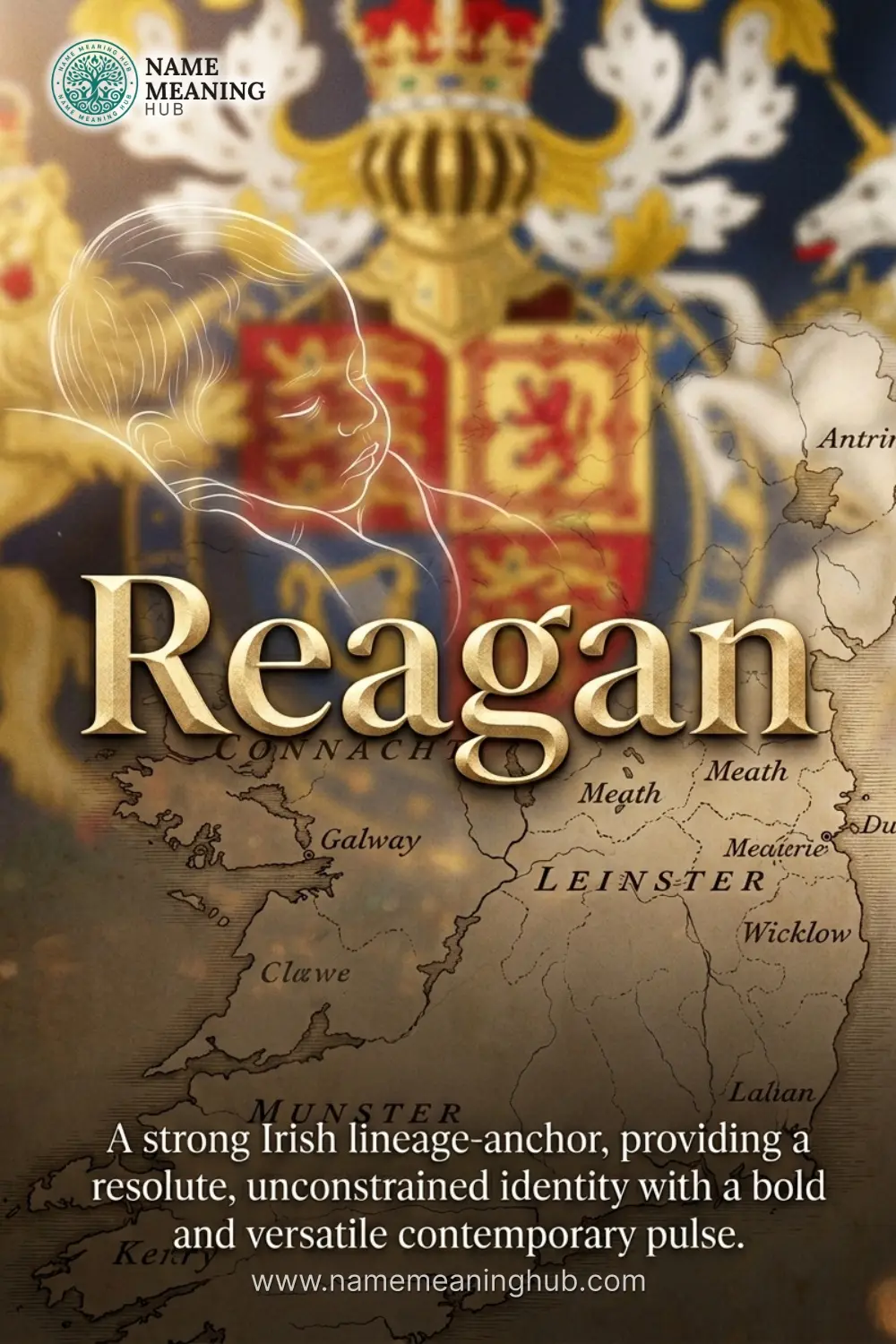
Project naming guides are especially useful here because they show that Reagan does not come into first-name use as a random modern invention. One guide describes Reagan as an Irish and English form of the Irish surname O’Riagain, connecting it to the Gaelic element rí, meaning king, with a diminutive ending that supports meanings such as “little king” or “little royal one.” Other project sources describe Reagan or Regan as a surname that later moved into first-name use, which helps explain the name’s modern sound profile. It is part of the now-familiar migration of surnames into the given-name space, but it arrives with older Irish material already inside it.

Why the surname-to-first-name shift matters for Reagan
Surname names often appeal because they sound structured, current, and socially fluent. They can feel polished without becoming ornate. Reagan has exactly those advantages. Yet unlike some surname choices that risk sounding empty once the style trend fades, Reagan carries a meaning strong enough to give the name lasting substance. Its Irish root system keeps it from feeling purely decorative or invented.
This makes Reagan more resilient than many names that rose alongside the surname trend. It sounds modern because of its form, but it sounds meaningful because of its origin. Parents are not choosing only a fashionable shell. They are choosing a compact Irish name with built-in rank and lineage.
What the alternate meaning tradition adds to Reagan
Project sources also record a more complicated secondary tradition around the name. Some guides connect Reagan or Regan with meanings such as “spontaneous,” “impulsive,” “rash,” or even “angry,” and one source links this branch to a Gaelic root associated with impulsiveness. That matters because it reminds us that names with long histories rarely travel in only one straight line. Meanings can split, overlap, or shift depending on region, spelling, and source tradition.
For a modern meaning page, the controlling meaning remains “little king,” and that is clearly the strongest and most useful core. Still, the alternate tradition adds texture. It suggests that Reagan has not always been read only through nobility. It has also been heard through force of temperament. That actually fits the name’s clipped sound better than one might expect. Reagan is not airy. It has forward motion in it. Even when parents are drawn to the royal meaning, the name’s briskness keeps it from becoming overly polished.
Reagan belongs to the unisex present, but not symmetrically
Official 2024 U.S. ranking data makes Reagan especially revealing as a modern unisex name. At No. 244 for girls and No. 1571 for boys, the name is clearly still used on both sides, but not with equal force. That imbalance tells an important story about contemporary naming. A name can remain structurally unisex even while culture temporarily favors it much more strongly in one direction. Reagan is now one of those names.
Why Reagan works so well in the unisex space
Phonetically, Reagan is almost ideal for this category. It is neither overtly soft nor heavily rugged. The opening Ray- is bright and open, while the final -gun closes the name with enough firmness to keep it from drifting. That combination helps the name stay neutral in shape even when usage leans female in the present. It also gives Reagan a quality many unisex names need in order to last: it sounds complete without needing gendered decoration. To compare tone, familiarity, and fit across similar names, explore modern unisex names.
That completeness is part of the appeal. Reagan does not sound like a nickname, and it does not need feminizing or masculinizing help to become legible. It can stand on its own in many settings. This is one reason it has remained in circulation rather than becoming an entirely one-sided fashion name.
What current rankings suggest about Reagan’s social feel
For girls, Reagan now occupies an attractive zone: recognizable, contemporary, and still distinct from the most overused choices. It sounds tailored and current without trying too hard. For boys, its rarity gives it a different kind of appeal. It becomes more selective, more unusual, and perhaps a little sharper because of how little it is used now compared with girls.
This split gives parents two quite different naming experiences with the same name. On a girl, Reagan often reads as modern and confident. On a boy, it reads as rarer and more deliberately chosen. In both cases, the core meaning still works, but the social texture changes with the current ranking environment.
Reagan sounds controlled, and that is part of its meaning
Pronounced RAY-gun, Reagan succeeds because it wastes very little motion. It opens clearly, peaks early, and then settles. The sound is compact, but not abrupt. The first syllable is brighter than the meaning might lead you to expect, and that brightness matters. It prevents “little king” from sounding heavy or feudal. The second syllable grounds the name again. The result is one of the cleanest sound shapes in the contemporary unisex field.
The consonants do useful work too. The initial R gives the name movement rather than hardness. The g in the middle adds structure. The final n closes it quietly instead of striking. There is no fricative hiss, no ornament, no excessive flourish. This helps Reagan feel current in a very specific way: it sounds efficient without sounding cold.
That phonetic efficiency supports the name’s broader identity. A name meaning “little king” could have sounded old-fashioned or ceremonious if built differently. Reagan instead sounds contemporary, almost managerial in its neatness. That is part of why the name has adapted so well to first-name life. It can carry authority without sounding trapped in the past.
Reagan stands near other ruler names, but feels more portable
The project books place Reagan among a wider Irish field of names linked to royalty, nobility, or rulership. Names such as Ryan and Rory also appear with king-related meanings, while other guides place Reagan in royalty and nobility categories. That family resemblance matters. It shows that Reagan belongs to a larger naming pattern in which rank language becomes personal naming material. But Reagan differs from many of its neighbors in how cleanly it fits the modern ear.
How Reagan differs from other “little king” names
Compared with Ryan, Reagan feels slightly more tailored and less universally worn. Compared with Rory, it feels more surname-shaped and less overtly Celtic in the ear. Compared with royal-title names or highly aristocratic choices, it feels far more portable. That portability is one of its greatest strengths. It carries a noble meaning, but it does not sound like a costume.
This may be why Reagan continues to appeal in families looking for names that are confident but not ceremonial. It offers the symbolic force of rulership without requiring the child to bear a name that sounds theatrically powerful every time it is spoken.
Why Reagan feels more modern than many Irish classics
Irish-origin names can travel in very different ways. Some retain visibly Gaelic spelling and stronger pronunciation barriers outside Ireland. Reagan does not. It has already crossed into English with a highly legible form. That makes it especially useful for parents who want Irish roots without Irish friction. The name sounds familiar quickly, but still holds a distinct cultural backstory. If you want to expand your shortlist within this origin, browse names from Irish tradition.
In practice, this means Reagan can sit comfortably beside both modern surname names and older Irish lineage names. It is one of the few names that can bridge those two worlds without seeming confused about itself.
Where Reagan naturally opens next
Middle names can either soften Reagan’s edge or intensify its tailored strength
Because Reagan is so compact and surname-like, the middle name has unusual power to shift the full impression toward warmth, modern sharpness, or something more traditionally gendered. If you want the full pairing logic behind that contrast, see middle names for Reagan.
Nicknames often grow from affection rather than necessity
At only two syllables, Reagan does not require shortening, but it still invites smaller forms that can make it sound friendlier, younger, or more intimate. To see how those different moods shorten in real life, explore Reagan nicknames.
Pronunciation is one of Reagan’s practical advantages
The stress pattern is clear, the sound is stable across accents, and the name is immediately workable in English, all of which help explain its durable appeal. For the detailed stress pattern, accent notes, and IPA, see Reagan pronunciation guide.
Why Reagan still feels larger than its size
Reagan lasts because it contains an unusual proportion of meaning inside an unusually controlled form. “Little king” gives it stature without pomp. Its Irish surname roots give it lineage without heaviness. Its modern sound gives it polish without emptiness. And the alternate tradition of impulsive or spontaneous force adds just enough energy to keep the name from feeling overly smooth.
That is the real elegance of Reagan. It never sounds as large as the idea it carries, and that is exactly what makes it persuasive. It takes rank and cuts it down to living size. It takes royalty and makes it modern. It takes an old Irish inheritance and lets it move easily through contemporary life. In that sense, Reagan does not only mean “little king.” It demonstrates the deeper art of naming itself: how to make power small enough to belong to a person, and still large enough to be felt.