
Raelynn Pronunciation: Easy Breakdown and Speaking Tips

The real pronunciation test for Raelynn usually happens in motion. A teacher reaches the next name on a roll sheet and has about one second to decide whether the spelling wants to be split in two, softened into something airy, or spoken cleanly from the front. A receptionist says it into a crowded waiting room. A barista reads it off a cup and makes a quick guess. In those moments, Raelynn succeeds because the answer is simpler than the spelling first suggests. Once you hear the first beat clearly, the rest of the name follows without strain.
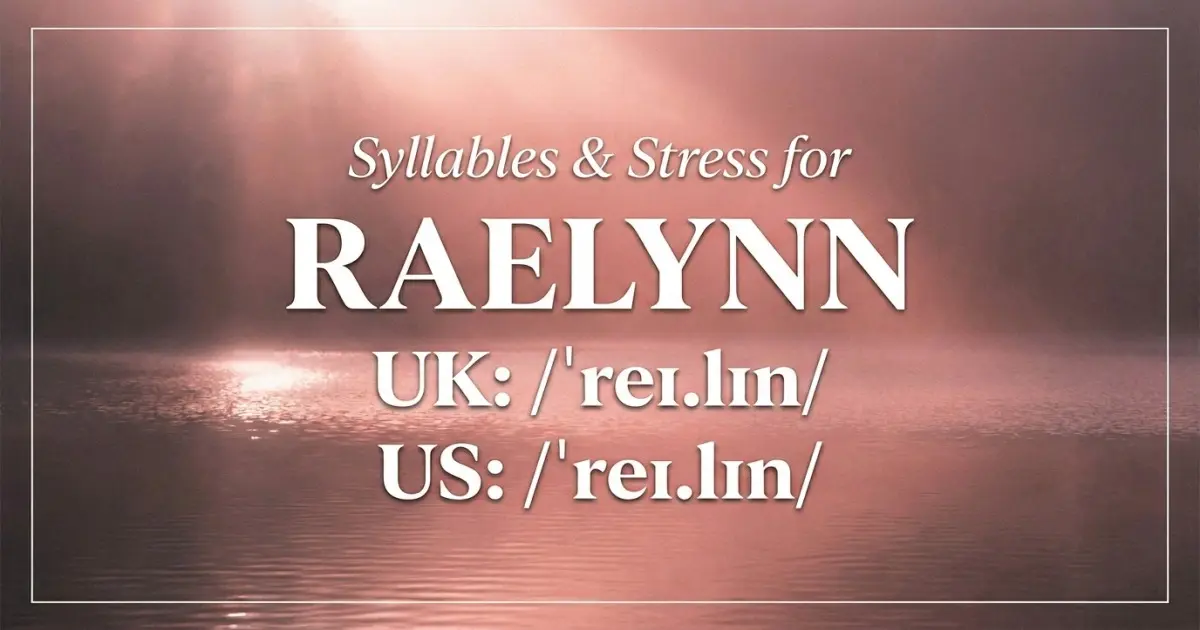
That first beat matters because Raelynn is not a drifting, breathy name. It is a compact two-syllable name with a bright opening and a shorter second step: RAY-lin. Official pronunciation guidance for this run gives the same IPA in both U.S. and U.K. English: /ˈreɪlɪn/. That shared target is useful. It means the name’s basic structure is stable across major English-speaking settings. Raelynn may look like a modern combination, but in speech it behaves very cleanly: strong start, light finish, no hidden syllable, no complicated accent split.
What Raelynn is actually saying when spoken aloud
| Element | Phonetic Detail | Quick Tip |
|---|---|---|
| Everyday pronunciation | RAY-lin | Say it in two beats, with the first syllable clearly carrying the name. |
| IPA (US) | /ˈreɪlɪn/ | The stress mark at the front shows that the energy belongs on RAY, not on the ending. |
| IPA (UK) | /ˈreɪlɪn/ | The U.K. pattern matches the U.S. one here, so the name stays stable across accents. |
| Syllable count | 2 syllables | Think of it as two steps only: RAY / lin. |
| Stress pattern | Primary stress on the first syllable | If the second syllable gets too much emphasis, the name starts sounding heavier than it should. |
| Opening vowel | /eɪ/ as in “ray” or “day” | The bright long vowel is the key to the whole name’s sound and meaning-image. |
| Ending sound | Short lin with /lɪn/ | Keep the ending quick and light rather than stretching it into a dramatic -lynn. |
Raelynn works because the first syllable carries the light
Phonetically, Raelynn is a front-led name. The first syllable does nearly all the emotional and acoustic work. RAY opens brightly, using the long /eɪ/ vowel that English speakers already associate with names that sound clear, warm, and easy to project. That is a large part of why the name feels so socially usable. You hear the identity of the name almost immediately. Pronunciation lands more fully when the name’s roots and history are already in view, so begin with Raelynn meaning.
The two-beat architecture inside Raelynn
Break the name down once: RAY / lin. The first syllable is stressed and fully formed. The second is shorter, lighter, and supportive. This matters because many modern names with double n endings or familiar -lynn spellings can tempt speakers into overvaluing the second half. Raelynn sounds best when that temptation is resisted. The second syllable exists to complete the line, not to compete with it.
The consonants also help. The initial r keeps the opening fluid rather than hard-edged, while the l in the second syllable is a liquid consonant that lets the name glide into its finish. But the short vowel in lin prevents the ending from becoming too soft. So the name has brightness at the front and control at the back. That balance is one reason it works so well in real speech.
Why the ending should stay neat, not dramatic
Because the spelling includes -lynn, some speakers instinctively want to linger on the ending. In practice, that usually makes the name sound more decorative and less natural. Raelynn is not meant to bloom at the end. It is meant to land. The strongest pronunciation keeps lin short, clean, and secondary. Think of the second syllable as the place where the name settles, not the place where it expands.
That is especially important if the family wants the name to sound modern rather than ornate. A clipped ending preserves the name’s current, conversational energy.
Where people usually bend Raelynn out of shape
Most pronunciation errors with Raelynn do not come from deep difficulty. They come from overreading the spelling. Because modern combination names often invite people to guess how much of the visual structure should be heard, speakers sometimes try to honor every letter too evenly. With Raelynn, that instinct usually works against the name.
The over-stressed ending
The most common mistake is letting the second syllable become too heavy, so the name sounds closer to ray-LYNN in a way that pulls attention away from the opening. That version is understandable, especially because Lynn is already familiar as an independent name. But it changes the personality of Raelynn. Instead of sounding bright and quick, the name starts sounding more segmented and more deliberate than everyday speech usually wants. Because the strongest energy lands early, the shorter forms often grow from the opening of the name, and that pattern is easier to see in Raelynn nicknames.
The easiest fix is to remember that the first syllable holds the stress. Once RAY is allowed to lead, the second half naturally shortens into place.
The too-flat, two-equal-parts version
Another mistake is giving both syllables almost equal weight, as though Raelynn were simply two stacked name-parts rather than one spoken unit. This often happens when someone is trying to be especially careful. But names like this need hierarchy. If both halves are equally strong, the name loses the clean beam-like motion that makes it work. Raelynn should feel as though it opens first and settles second.
There is also a smaller visual trap in the spelling Rae. Because the name begins with a sequence of letters that people may associate with “Rae” as a standalone name, some speakers momentarily treat the full form like a doubled construction: Rae-Lynn with almost formal separation. In slow explanation, that can be acceptable. In natural speech, though, the better pronunciation is more integrated: RAY-lin.
How Raelynn behaves across accents and neighboring names
One of the strongest practical features of Raelynn is that it does not split into major accent variants. For this run, both U.S. and U.K. pronunciation are given as /ˈreɪlɪn/. That means the name’s rhythm, stress, and core vowel quality are effectively aligned across both systems. Accent color may still shift slightly, but the basic shape remains intact.
Why U.S. and U.K. English stay close here
The reason is structural simplicity. Raelynn does not rely on a rhotic ending, a tricky consonant cluster, or a region-sensitive vowel contrast at the close. Its whole identity sits in the initial stressed syllable, and English speakers on both sides of the Atlantic already know how to say that sound. Once the opening RAY is secure, the second syllable causes little trouble.
This makes the name highly portable. It can move through English-speaking settings without requiring two separate pronunciation instructions, which is an underrated strength in a modern name.
Names nearby can still pull the ear in the wrong direction
Raelynn does live near several sound-neighbors that can distort first impressions. Raelyn, Raylene, Raegan, and other modern Rae- names may make people expect a longer or more elaborate second half. Names ending in -lynn more generally can also encourage speakers to overvalue the final syllable. That is why it helps to remember that Raelynn is tighter than some of its neighbors. It is not trying to be three beats long, and it is not asking the ending to do more than close the name.
In short: keep the opening bright, keep the ending tidy, and do not let the visual familiarity of Lynn overpower the name’s actual spoken rhythm.
How to practice Raelynn until it sounds natural
The best way to learn Raelynn is not by isolating the syllables over and over, but by dropping the name into real speech. Names sound most natural when they are tested in the kinds of sentences where people actually hear them.
Three easy practice lines for Raelynn
Try these aloud:
- “Raelynn, your table is ready.”
- “This is Raelynn from third period.”
- “Raelynn will call you back after lunch.”
Each sentence checks something slightly different. The first tests public calling rhythm. The second checks classroom clarity. The third tests whether the name still sounds natural in fast adult speech. If the name feels clumsy, the usual problem is that the second syllable is receiving too much attention. Bring the weight back to RAY, and let the ending follow.
A simple mouth-feel shortcut for Raelynn
If IPA is not your preferred tool, remember the name this way: bright strike, soft landing. RAY is the bright strike. lin is the soft landing. That is the whole shape. Once the mouth learns that pattern, the name becomes easy to say without sounding rehearsed.
That is one of Raelynn’s practical strengths. It looks like a modern, emotionally charged name, but it behaves simply in speech. It gives off warmth without demanding complicated pronunciation work, and that is a major reason names like this stay in use.
Common Questions About the Sound and Stress of Raelynn
How do you pronounce Raelynn in everyday English?
The standard everyday pronunciation is RAY-lin. The first syllable carries the stress, and the second should stay shorter and lighter.
How many syllables does Raelynn have?
Raelynn has two syllables: RAY and lin. Thinking of it as a two-beat name helps preserve the right rhythm.
What is the most common pronunciation mistake with Raelynn?
The most common mistake is over-stressing the second syllable and making the name sound too segmented. Raelynn sounds best when the first syllable clearly leads.
Do U.S. and U.K. English pronounce Raelynn differently?
For this pronunciation target, the U.S. and U.K. IPA are the same. Accent color may vary slightly, but the structure remains stable: bright first syllable, short second syllable.