
How to Pronounce Quinton: An Easy Sound-by-Sound Breakdown
Imagine a substitute teacher reading the name for the first time from a classroom roster: Quinton. The spelling looks formal, almost surname-like, and the first two letters may make the reader pause for a split second. But the pronunciation is straightforward once the pattern is clear. Quinton is said KWIN-tun, with the first syllable carrying the weight and the second syllable softening into a light, unstressed ending.
That spoken rhythm is part of Quinton’s appeal. It has the crisp opening of Quinn, the fuller shape of a two-syllable English name, and the practical clarity parents often want in daily use. Official data shows Quinton ranked 835 for boys in the United States in 2024, giving it a recognizable but uncommon profile. The name’s meaning, “queen’s town; fifth,” may be layered, but its everyday pronunciation is compact: KWIN-tun.
Quinton is pronounced with a crisp KWIN opening and a light final beat
| Element | Phonetic Detail | Quick Tip |
|---|---|---|
| Standard pronunciation | KWIN-tun | Say it like “Quinn” plus a light “tun.” |
| Syllable count | 2 syllables | Keep the name compact: KWIN-tun, not KWIN-uh-ton. |
| Stress pattern | First syllable stressed | The first beat should be stronger; the second should relax. |
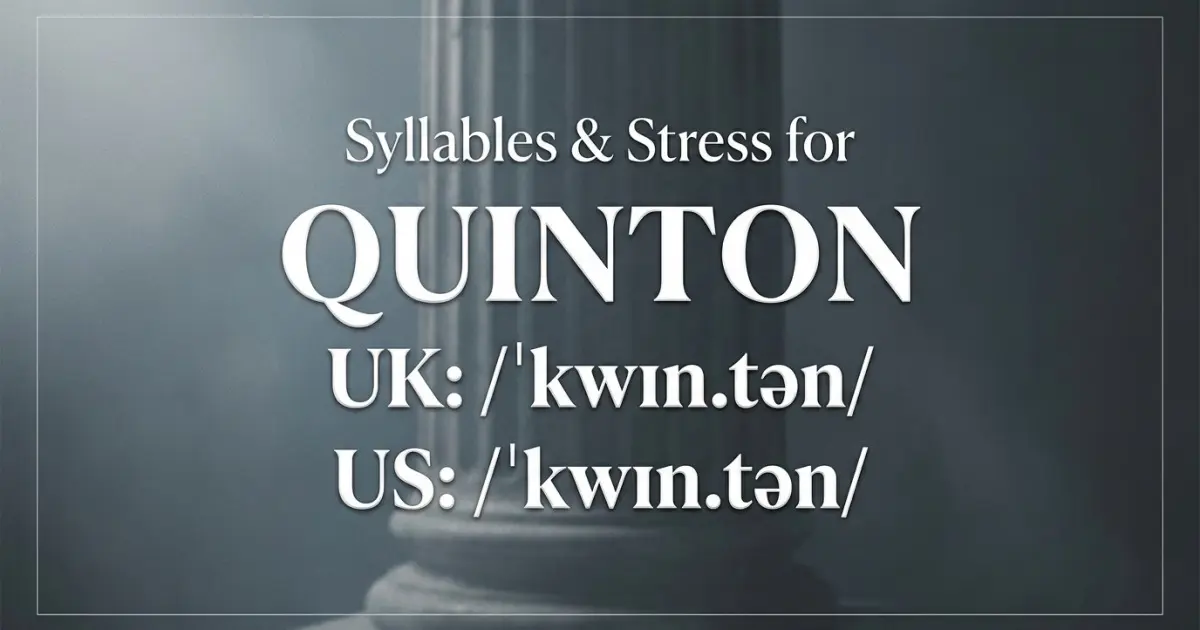
| U.S. IPA | /ˈkwɪntən/ | The stress mark shows that KWIN receives the main emphasis. |
| U.K. IPA | /ˈkwɪntən/ | The U.S. and U.K. IPA forms match, so the name stays stable across these accents. |
| Opening sound | /kw/ | Begin with a blended K-plus-W sound, as in “quick” or “queen.” |
| Main vowel | /ɪ/ | The first vowel is short, like the vowel in “win.” |
| Ending sound | /tən/ | The ending is light and unstressed, closer to “tun” than a strong “tone.” |
The sound of Quinton begins with the Quinn-like first syllable
The “Qu” is not mysterious once it becomes /kw/
The most important sound in Quinton is the opening /kw/. In English, the letters “qu” usually create a blended sound, as in “queen,” “quick,” and “quiet.” Quinton follows that familiar pattern. The beginning is not pronounced like a plain K by itself, and it is not a soft “ch” or “sh” sound. It begins with K plus a quick W glide: KWIN. The sound matters more once you know what the name is meant to carry, which is why the wider frame starts in Quinton meaning.
That W glide gives the first syllable movement. The name does not start as flat “KIN-ton.” It starts KWIN, with the lips briefly rounding as the sound moves from K into W. This is why Quinton feels closely related in sound to Quinn, even though Quinton has a fuller written shape.
The short I keeps Quinton crisp
The vowel in the first syllable is the short I sound, represented in IPA as /ɪ/. It is the vowel in “win,” “pin,” and “this.” That means Quinton should begin like “Quinn,” not like “queen.” The name is not KWEEN-tun. It is KWIN-tun.
This distinction matters because a long E vowel would change the whole character of the name. KWEEN-tun sounds stretched and unnatural in English. KWIN-tun keeps the pronunciation compact, grounded, and familiar. The first syllable should be quick but clear, with the main stress placed there.
Quinton’s second syllable should stay soft, not ceremonial
The ending is “tun,” not “tone”
The second syllable of Quinton is light: “tun.” It should not be pronounced like “tone.” The name is not KWIN-tone. The ending is closer to the soft final syllable heard in many English names and place-style words, where the vowel becomes relaxed because it is unstressed.
In the IPA /ˈkwɪntən/, the final syllable is represented as /tən/. This means the vowel is reduced and practical. In ordinary speech, it may sound like “tun” or even a very light “tən,” depending on accent. The key is that it should not become a long, dramatic syllable.
The final N gives the name a settled finish
Quinton ends with an N sound, a nasal consonant. A nasal sound is made when air passes through the nose as the mouth closes the sound. In everyday terms, this gives Quinton a settled finish rather than a sharp stop. The name closes cleanly without feeling abrupt.
This ending helps explain why Quinton sounds formal but not harsh. The KWIN opening is crisp, the T in the second syllable gives structure, and the final N lets the name land. The full rhythm is strong-light: KWIN-tun.
Quinton stays consistent across U.S. and U.K. pronunciation
The matching IPA keeps the name easy to teach
Both U.S. and U.K. English use the same IPA pronunciation for Quinton: /ˈkwɪntən/. This gives the name a useful stability. Some names shift noticeably between American and British English because of R sounds, broad A vowels, or different treatment of unstressed syllables. Quinton avoids most of those issues.
The first syllable remains KWIN. The second remains light. The stress stays at the beginning. A speaker’s accent may slightly color the final vowel, but it should not change the basic form. Whether spoken in an American classroom or a British one, the name’s core pronunciation remains KWIN-tun.
Accent differences mostly affect the lightness of “tun”
The main accent difference is likely to appear in the final syllable. Some speakers may pronounce the ending with a clearer “tun,” while others may reduce it further into a softer “tən.” Both are normal accent-level variations as long as the first syllable remains stressed and the ending does not become “tone.”
Careful speech may separate the syllables more clearly: KWIN-tun. Fast speech may make the ending lighter. In both cases, Quinton should remain two syllables. It should not expand into three or collapse into something that loses the T sound entirely.
Common mistakes with Quinton usually come from overreading the spelling
Do not say KWEEN-tun
The first common mistake is reading “Qui” as if it contained a long E sound. That creates KWEEN-tun, which is not the standard pronunciation. The first syllable should rhyme with “win,” not “seen.” A simple correction is to connect Quinton to Quinn: Quinn plus tun.
This comparison is helpful because Quinn is familiar and phonetically clear. Once the speaker hears the first syllable as Quinn, the rest of the name becomes easy.
Do not say KWIN-tone
The second common mistake is over-pronouncing the ending as “tone.” Quinton should not rhyme with a phrase like “win tone.” The final syllable is lighter and less rounded. Say KWIN-tun, letting the second syllable fall away gently.
This mistake often happens when readers treat the spelling too formally. The written “-ton” may look like it should be pronounced strongly, but in the name Quinton, the ending is unstressed. The first syllable is the anchor.
Do not add an extra middle syllable
Quinton has two syllables, not three. Avoid KWIN-uh-ton or KWIN-tuh-ton. The transition from KWIN to tun should be direct. The name should move in two clean beats.
A useful practice method is to clap once for each syllable: KWIN-tun. If there are three claps, the name has been stretched too far.
Sound neighbors help explain Quinton without replacing it
Quinn explains the opening
The easiest sound neighbor for Quinton is Quinn. Quinton begins with the same sound, but adds a second syllable. This makes the name feel more formal and complete while keeping the friendly short form available. For pronunciation, Quinn is the best anchor: start there, then add the light “tun.” Once the sound pattern is clear, some shortenings stop feeling optional and start feeling natural, and the clearest map is in Quinton nicknames.
This also helps with nicknames. A person named Quinton may naturally use Quinn, but the full name keeps a stronger formal structure. The pronunciation supports both versions without conflict.
Clinton and Winston explain the rhythm
In rhythm, Quinton sits near English names such as Clinton and Winston: two syllables, first-syllable stress, and a light ending. These names are not the same in origin or meaning, but they help show the sound pattern. The stress comes first, and the final syllable should not be exaggerated.
This rhythm makes Quinton practical in daily speech. It is easy to call, easy to introduce, and easy to pair with a surname. The name has enough structure to feel formal, but not so much complexity that pronunciation becomes a burden.
Practice lines make Quinton easy to say naturally
Everyday practice
Use these lines to hear Quinton in ordinary conversation:
- “Quinton is here.”
- “Can you give this to Quinton?”
- “We are waiting for Quinton.”
- “Quinton, your turn is next.”
- “This is my son, Quinton.”
In each line, keep the first syllable crisp: KWIN. The second syllable should be lighter: tun. The full name should feel steady, not stretched.
Formal practice
These lines test how Quinton sounds in public or ceremonial settings:
- “Please welcome Quinton to the stage.”
- “The award is presented to Quinton.”
- “Quinton will begin the presentation.”
- “Congratulations to Quinton and his family.”
The name holds up well in formal speech because it has a clear opening, a structured middle, and a settled ending. It can sound polished without becoming difficult.
How to Pronounce Quinton: FAQ
How do you pronounce Quinton?
Quinton is pronounced KWIN-tun. The first syllable rhymes with “win,” and the second syllable is light and unstressed.
How many syllables are in Quinton?
Quinton has two syllables: KWIN-tun. It should not be stretched into three syllables.
What is the IPA pronunciation of Quinton?
The IPA pronunciation of Quinton is /ˈkwɪntən/ in both U.S. and U.K. English.
Is Quinton pronounced KWIN-tun or KWEEN-tun?
The standard pronunciation is KWIN-tun. The first syllable uses the short I sound, like “win,” not the long E sound in “queen.”
Is Quinton easy to pronounce?
Yes. Quinton is easy to pronounce once the opening is clear: say “Quinn” and add a light “tun.” The stress stays on the first syllable.