
How to Pronounce Quentin: Sound Breakdown for Confident Speech

Quentin is a name that can look slightly more mysterious on paper than it sounds in real life. A teacher reading it from a class list may pause at the rare initial Q, but once the name is said aloud, the pattern is clear: KWEN-tin. It begins with a quick “kw” sound, moves through a short “e” vowel, and closes with a light second syllable. The name has presence, but it does not require a complicated pronunciation lesson.
That clarity matters because Quentin’s appeal depends on its crispness. The name is Latin in origin, means “fifth,” and has two syllables. Official 2024 U.S. data places Quentin at No. 788 for boys, which means it is in use but still distinctive. Its pronunciation should feel alert and front-weighted, not drawn out or overly formal. When spoken well, Quentin sounds intelligent, compact, and memorable: KWEN-tin.
Quentin Is Said with a Quick “Kw” Opening and a Light Finish
| Element | Phonetic Detail | Quick Tip |
|---|---|---|
| Standard pronunciation | KWEN-tin | Start with “kwen,” then let the second syllable land lightly. |
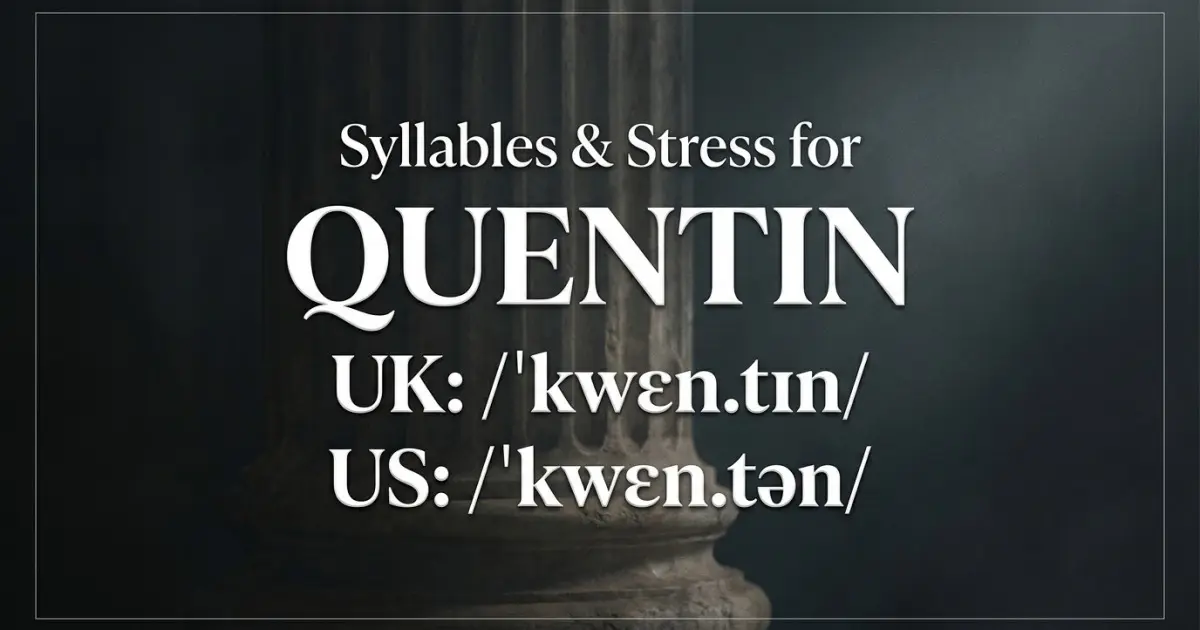
| U.S. IPA | /ˈkwɛntɪn/ | The first syllable carries the stress, and the vowel sounds like the “e” in “pen.” |
| U.K. IPA | /ˈkwentɪn/ | The broad pattern is the same: KWEN-tin, with stress at the front. |
| Syllable count | 2 syllables | Keep it compact: KWEN-tin, not KWEN-tuh-tin or kwen-TEEN. |
| Stress pattern | First syllable stressed | The name should sound front-weighted, with the second syllable quieter. |
| Opening sound | “Qu” = /kw/ | Pronounce the Q like “kw,” as in “queen” or “quick.” |
| Ending sound | Light “tin” /tɪn/ | The final syllable should be clear but not emphasized. |
The Core Pronunciation of Quentin Depends on the “Qu”
The Q is not silent
The most important sound in Quentin is the opening “Qu.” In English, this usually represents a /kw/ sound, as in “queen,” “quest,” or “quick.” Quentin follows that pattern. It begins KWEN, not KEN and not WEN. The lips round slightly for the “w” part of the sound, giving the name its quick forward motion. Before focusing only on syllables and stress, it helps to step back into the fuller frame of Quentin meaning.
This opening is one reason Quentin feels distinctive. The /k/ part gives the name a crisp start, while the /w/ glide softens and rounds the transition into the vowel. In accessible linguistic terms, the “w” acts like a glide: it moves the mouth quickly from the consonant into the vowel. The result is a name that sounds sharp but not harsh.
The first vowel is short and clear
The first syllable of Quentin uses the short “e” sound: KWEN. It is the vowel heard in “pen,” “ten,” and “when.” This is important because Quentin should not begin like “queen.” It is not KWEEN-tin. The spelling may tempt some people toward a long “ee” sound, but the standard pronunciation is KWEN-tin.
Once the opening syllable is correct, the rest of the name is simple. The second syllable is “tin,” light and unstressed. The name should feel like a two-beat movement: KWEN-tin. The first beat leads; the second beat closes.
Quentin’s IPA Shows a Clean Two-Syllable Pattern
How to understand /ˈkwɛntɪn/
The U.S. IPA pronunciation of Quentin is /ˈkwɛntɪn/. The stress mark before the first syllable shows that KWEN gets the emphasis. The /kw/ shows the opening “qu” sound. The /ɛ/ represents the short “e” vowel, and /tɪn/ represents the final “tin” sound.
The U.K. IPA form, /ˈkwentɪn/, points to the same broad pronunciation. In practical terms, both forms tell parents the same thing: Quentin is pronounced KWEN-tin, with two syllables and stress on the first.
Why the spelling can cause a moment of hesitation
Quentin is not difficult, but the letter Q is uncommon enough that some speakers may pause. That pause does not usually mean the name is hard; it means the eye has to process a less common initial letter. Once heard, Quentin is easy to remember.
The most useful pronunciation guide is simple: “Quentin, like KWEN-tin.” If extra help is needed, compare the first syllable to “when” with a “k” sound added at the front. That gives the correct opening without turning the name into a long explanation.
Common Quentin Pronunciation Mistakes Usually Change the First Vowel
Avoid KWEEN-tin
The most likely mistake is KWEEN-tin, using the long “ee” sound from words like “queen.” This is understandable because “qu” often appears in words with that vowel nearby, but Quentin does not use it. The first syllable should rhyme with “when,” not “queen.”
A short correction works well: “It’s KWEN-tin, with the first syllable like ‘when.’” That gives the listener a familiar sound anchor and usually solves the issue immediately.
Avoid KEN-tin
Another mistake is dropping the “w” glide and saying KEN-tin. This removes one of Quentin’s signature sounds. The name should begin with “kw,” not a plain “k.” The difference is small but noticeable. KWEN-tin has movement; KEN-tin sounds flatter and less precise.
To practice, say “quick,” then “quest,” then “Quentin.” The same rounded opening appears in all three.
Avoid kwen-TEEN
The stress should not move to the second syllable. Quentin is not kwen-TEEN. The correct rhythm is KWEN-tin, with the first syllable strong and the second syllable light. Overstressing the ending makes the name sound less natural in standard English.
The final syllable should not become “teen.” It is closer to “tin,” with a short “i” sound. Keep it brief and clear.
Quentin Across Accents Stays Recognizable
American and British pronunciation are broadly aligned
In both U.S. and U.K. English, Quentin is generally pronounced KWEN-tin. Accent differences may affect the exact quality of the vowel, but the main structure remains the same: /kw/ opening, first-syllable stress, and a light “tin” ending.
Some speakers may make the “t” in the second syllable very crisp, while others may soften it slightly in fast speech. In careful pronunciation, however, the “t” should still be present. The name should not collapse into “KWEN-in.”
Sound neighbors help clarify Quentin’s rhythm
Quentin shares a two-syllable, first-stressed pattern with names such as Preston, Calvin, Martin, and Winston. But its “Qu” opening makes it stand apart. It also sits near Quinn in sound, though Quentin is longer and more formal. Quinn can help people remember the opening, but Quentin should keep its full second syllable: KWEN-tin. The way the name resolves at the end often decides which short forms feel natural in speech, and that becomes clearer in Quentin nicknames.
For parents, the easiest spoken formula is: “Quentin: Quinn plus tin, but with the first syllable sounding like KWEN.” This keeps the name recognizable without flattening it into a different name.
Practice Lines Make Quentin Easy to Say Naturally
Everyday speaking practice
Use these lines to hear Quentin in ordinary speech:
- Quentin is here.
- This is Quentin.
- Quentin, come over here.
- We named him Quentin.
- Quentin James has a strong rhythm.
- Quentin is pronounced KWEN-tin.
In each line, let the first syllable carry the name. Say KWEN clearly, then let “tin” finish lightly. The name should sound crisp, not rushed.
A simple correction script for school and family
If someone hesitates, the easiest correction is: “It’s KWEN-tin.” If someone says KWEEN-tin, add: “The first syllable rhymes with ‘when.’” If someone says KEN-tin, add: “There’s a small ‘w’ sound after the Q.” These corrections are short, practical, and easy to remember.
Quentin’s pronunciation is one of its strengths. It has a distinctive first letter, but once the sound is learned, the name is clear and stable. That makes it feel uncommon without being difficult.
Quentin Pronunciation FAQ
How do you pronounce Quentin?
Quentin is pronounced KWEN-tin. The first syllable rhymes with “when,” and the stress is on the first syllable.
How many syllables are in Quentin?
Quentin has two syllables: KWEN-tin.
What is the IPA pronunciation of Quentin?
The U.S. IPA pronunciation is /ˈkwɛntɪn/, and the U.K. IPA pronunciation is /ˈkwentɪn/.
Is Quentin pronounced KWEEN-tin?
No. Quentin is pronounced KWEN-tin, not KWEEN-tin. The first syllable uses the short “e” sound, like the vowel in “when.”