
Nicknames for Phoebe: Creative Picks with Real Everyday Charm
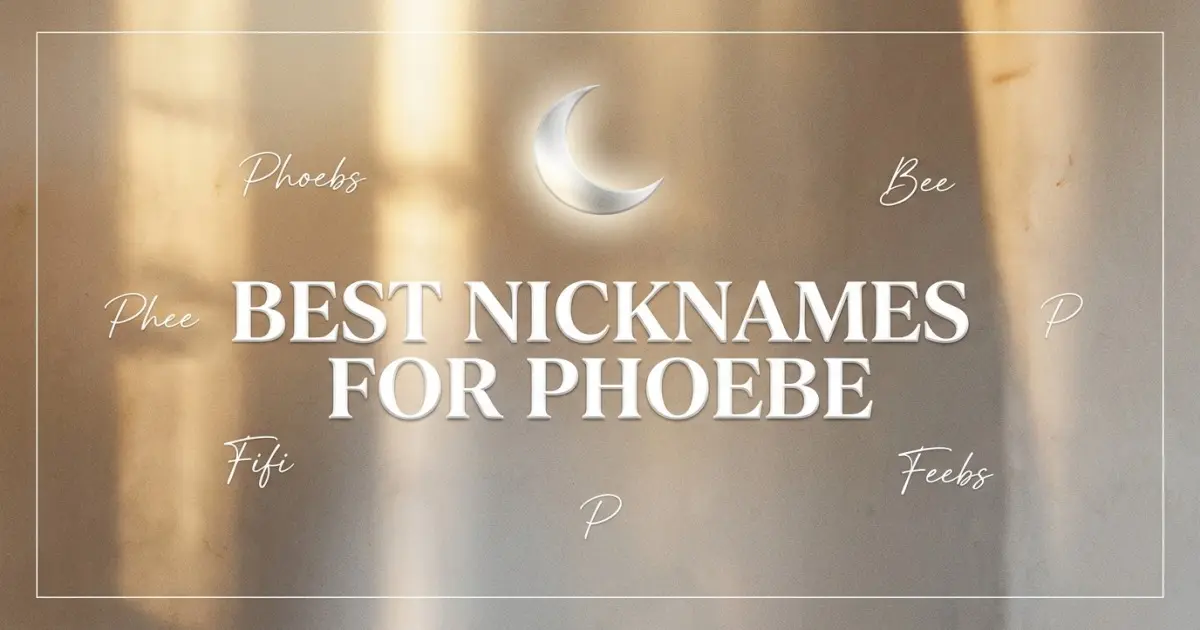
A nickname is often the first sign that a name has crossed from formal identity into real relationship. Parents choose a first name for meaning, history, beauty, or instinct, but nicknames usually arise later, in motion. They are made in kitchens, on playgrounds, in text threads, at bedtime, in sibling jokes, and in the affectionate shortcuts people use when a name has become part of daily life. That is why nicknames matter. They do not simply shorten a name. They reveal who is close enough to reshape it.
Phoebe is especially revealing on this point because the full name already feels intimate. Official data shows it ranked No. 183 for girls in the United States in 2024, which means it is familiar enough to feel socially easy, but still distinctive enough to retain personality. It also means “bright; radiant,” and the sound supports that meaning so naturally that the full form often feels complete from the start. That changes the nickname landscape. Phoebe does not usually need shortening to become warm. Instead, its nicknames tend to signal tone: more playful, more private, more childlike, or more socially improvised. Nicknames add personality at the surface, but the deeper weight of the name still sits in Phoebe meaning.
What the nickname world of Phoebe reveals once the name enters family speech
| Group | Suggested Nicknames | Persona | Use Context |
|---|---|---|---|
| Full-name everyday form | Phoebe | Bright, complete, socially polished | The most realistic outcome when the full name already feels affectionate and easy in daily life |
| Classic short forms | Fee, Phee, Bee | Warm, direct, familiar | Works in family life, childhood, and close friendship circles where the name is spoken often |
| Playful social forms | Pheebs, Beebs, Bebe | Casual, witty, personality-led | Most believable among siblings, close friends, teammates, and text-heavy social groups |
| Cute home forms | Fee-Fee, Phoebie, Bee-Bee | Tender, child-centered, affectionate | Best in toddlerhood, grandparent speech, and private home life rather than broad public use |
| DIY identity forms | P, P.J.-style initials, surname-based nicknames | Situational, adaptive, group-made | Most likely in school, work, or peer groups where nicknames emerge naturally rather than being planned |
Why Phoebe often stays Phoebe
The first thing to understand about this name is that it frequently does not need a nickname at all. Phoebe is already two syllables, already bright, already affectionate, and already easy to say. Many longer names generate pet forms because the formal version feels too distant or too ceremonial for ordinary life. Phoebe does not have that problem. The full name sounds like a lived name from the beginning.
Phoebe already sounds like the familiar version
A parent can call “Phoebe” across a room without sounding formal. A friend can text “Phoebe” without feeling that the name is too long. A teacher can say it easily on the first day of school. That kind of natural usability matters. It means the full form already carries friendliness. The child does not need a smaller name to feel close.
This is one reason the nickname field around Phoebe is not as structurally necessary as it is for longer or more formal names. The nickname story here is usually not about making the name usable. It is about adding shades of intimacy and play.
How Phoebe carries closeness without changing shape
Not every nickname is visibly different from the original. Sometimes intimacy lives in tone, repetition, or context rather than in altered structure. “Phoebe, sweetheart” and “Phoebe, come here” are already different experiences of the same name. Because Phoebe is so warm in sound, many families may find that the full form itself is enough for most of daily life. Any nickname that appears tends to reveal mood rather than solve a problem.
The opening of Phoebe creates the gentlest family nicknames
The first sound zone inside Phoebe is where the softest, most domestic nicknames usually begin. The stressed opening syllable, FEE, is bright, easy to isolate, and naturally affectionate when repeated or trimmed. That makes it a strong base for private family forms. These nickname choices read more clearly once the spoken shape of the full name is in view, so see how to pronounce Phoebe.
Why Fee feels so natural at home
Fee is one of the simplest and most believable short forms because it preserves the stressed opening of the name and keeps its brightness intact. It sounds warm without sounding overdesigned. A parent can say it in a hurry. A grandparent can say it tenderly. A sibling can say it casually. That range makes it one of Phoebe’s strongest affectionate reductions.
Fee also works because it does not fight the nature of the original name. It remains airy, clear, and recognizably connected to Phoebe. It feels like a family voice, not a separate identity.
Why Phee works more on paper and in playful use
Phee is very close to Fee in sound, but visually it preserves more of the original spelling logic. That makes it more likely to appear in playful writing, texts, notes, or family jokes than as a strongly separate spoken identity. It is believable precisely because families often like a spelling that still nods to the unusual elegance of the full name.
As a spoken nickname, Phee and Fee are nearly the same. The difference is emotional texture. Phee feels a little more consciously tied to Phoebe’s visual identity, while Fee feels more purely acoustic and instinctive.
The heart of Phoebe is where the most human nickname shift happens
The second strong nickname zone in Phoebe comes from the ending rather than the beginning. That matters because the full name is built from two bright syllables that mirror each other loosely. Once families move away from the opening, they often land on the end sound, and that creates a very different emotional effect.
Why Bee is one of Phoebe’s most appealing nicknames
Bee is particularly strong because it is simple, vivid, and affectionate. It takes the ending sound of Phoebe and turns it into a complete little identity of its own. Bee feels bright, sweet, and socially easy. It can work in childhood, but it can also remain wearable much later because it is so clean and minimal.
There is also something symbolically pleasing about Bee. Even without pressing the point too hard, the word carries associations with liveliness, energy, and brightness that fit Phoebe’s meaning and sound beautifully. That makes it feel less like an arbitrary shortening and more like a nickname that belongs naturally to the name.
Why Bebe softens Phoebe into something more intimate
Bebe is a more stylized and overtly affectionate option. It usually feels more private than Bee, more likely to belong to very close family or to a child with a particularly playful social circle. It works because Phoebe already repeats bright vowel sounds, so another doubled-beat variation does not feel unnatural. Instead, it sounds like affection amplified.
Bebe is less neutral than Bee. It signals a higher degree of intimacy, and that is often exactly why it appeals. Some nicknames are built for public use. Others are built for love. Bebe belongs mostly in the second category.
The ending of Phoebe creates the most playful social nicknames
Once Phoebe enters school, friendship circles, and group texting culture, the nickname logic often becomes looser and more social. This is where the name begins to collect forms that are not necessarily planned by parents, but arise because the sound of the name invites them.
Why Pheebs feels witty and socially real
Pheebs is one of the most plausible social nicknames because it sounds exactly like something close friends or siblings would create. It preserves the core sound of the name while giving it a slightly more playful, less formal edge. This is the kind of nickname that often thrives in adolescence or in a tight peer group because it feels affectionate, fast, and a little irreverent.
Its strength is that it does not sound invented by committee. It sounds like something that would happen naturally once the name had been said often enough among people who know each other well.
Why Beebs and Bee-Bee live between humor and affection
Beebs and Bee-Bee are similarly plausible, though they usually feel a bit more playful and private. Beebs has a joking, sibling-friendly quality. Bee-Bee feels more child-centered and affectionate. Both arise from the final sound zone, but they serve different social moods. Beebs is more peer-driven. Bee-Bee is more cuddly and domestic.
That difference matters because the same name often generates different nicknames in different social worlds. Phoebe is especially good at this because both its syllables are bright and repeatable, making it easy for families and friends to reshape the name without losing recognizability.
How Phoebe nicknames change with age, setting, and personality
One of the best things about Phoebe is that it can support a layered nickname life without ever losing its center. A little girl may be Fee at home, Phoebe at school, Bee to one grandparent, and Pheebs in a friend group ten years later. These are not contradictions. They are different social readings of the same bright original.
Which Phoebe nicknames are most likely to last
The likeliest long-term forms are Phoebe itself, Bee, and possibly Fee or Pheebs depending on the circle that established them. Phoebe lasts because it is already elegant and warm. Bee lasts because it is minimal and surprisingly age-flexible. Fee often remains more domestic. Pheebs may survive in a close friendship culture because it sounds so naturally informal. Bebe and Bee-Bee are more likely to remain private or fade as the child grows.
The DIY Phoebe nicknames nobody can fully script
No family controls the full nickname future. Once school, teams, social media handles, work life, and friend groups start doing their part, a child named Phoebe may acquire an entirely different shorthand. She may become P in text threads, pick up a middle-initial combination, or be known by a surname-based nickname that has little to do with the first name at all. This is common with names that are already easy to say. When the formal name does not need simplification, people start inventing for social reasons instead.
That is the most realistic way to understand Phoebe. It is not a name with one fixed diminutive that everyone must use. It is a name with a strong, radiant center and several highly believable affectionate satellites. The full form remains the anchor. The nicknames simply show who is close enough to make the light personal.