
How to Pronounce Paxton: What People Often Get Wrong
You can hear whether Paxton is being handled well on the first day of school. A teacher scans a printed list, reaches the name, and either says it in one clean motion or hesitates just long enough to break its rhythm. That is the real-life test of pronunciation: not whether a name can be explained in a guide, but whether it survives ordinary public speech with its shape intact. Paxton usually does. It is short, familiar-looking, and structurally English. But the name still depends on one important thing going right: the speaker has to hear the strong first beat and keep the second syllable light.
That is why Paxton is easier than it looks and more precise than some people expect. It is not a difficult name, but it is a name with timing. The first syllable carries the weight. The second syllable should not be over-enunciated or turned theatrical. Said correctly, Paxton sounds brisk, clear, and modern. Said carelessly, it can become muddy in the middle or overly heavy at the end. The good news is that once you hear its internal rhythm, the name settles into place very quickly.
What Paxton is actually asking your mouth to do
The easiest way to understand Paxton is to treat it as a compact two-part sound shape: a strong opening, then a lighter landing. Everything important about the name lives inside that balance.
| Element | Phonetic Detail | Quick Tip |
|---|---|---|
| Everyday pronunciation | PAKS-tun | Say the first syllable firmly, then let the second syllable fall away more lightly. |
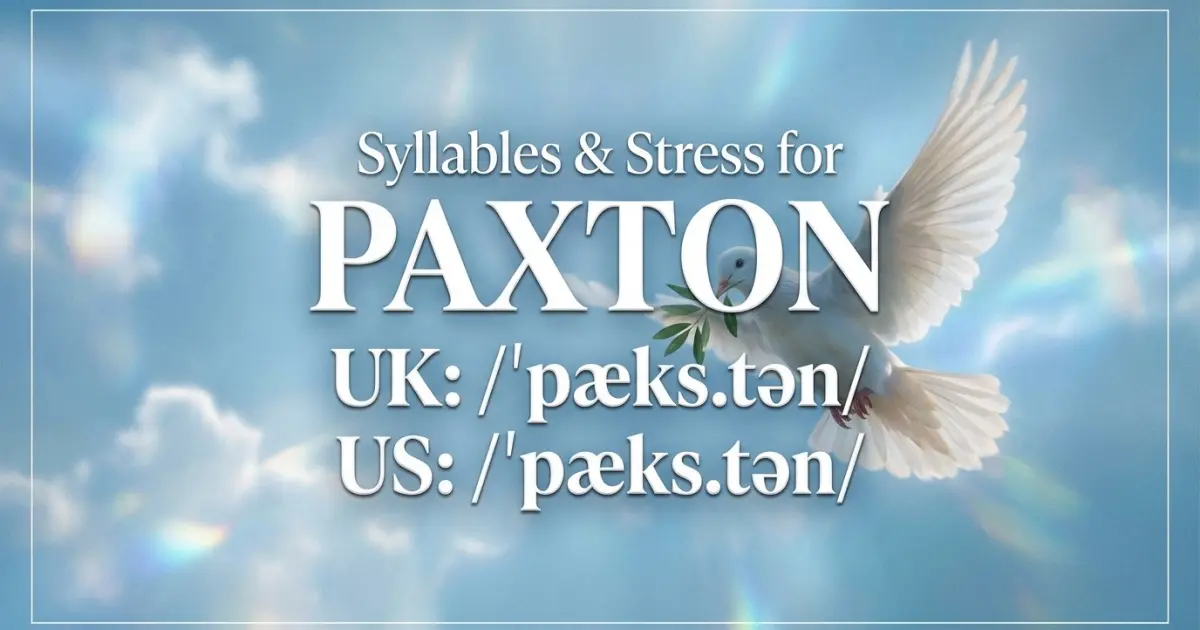
| Syllable count | 2 syllables | Think of it as one stressed beat followed by one softer echo: PAKS | tun. |
| Primary stress | First syllable | If the stress drifts later, the name starts to sound unnatural almost immediately. |
| U.S. IPA | /ˈpækstən/ | The first vowel is the short, bright “a” of “pack,” not a long or softened vowel. |
| U.K. IPA | /ˈpækstən/ | The U.K. and U.S. forms are essentially the same, which makes Paxton very stable across accents. |
| Middle consonant cluster | ks+t | Do not slow this down too much. Let the cluster stay compact so the name keeps its crispness. |
| Ending sound | unstressed “-tun” | The ending should be light and natural, not an overly careful “ton” with equal weight. |
| Closest sound guide | “packs” + “tun” | If you can say “packs one” quickly, you are already close to the flow of Paxton. |
Paxton is a two-beat name, and the first beat does the work
Paxton belongs to the large family of English names that are carried by an opening stress. That matters because English listeners instinctively use stress to decide whether a name sounds familiar, natural, or off. With Paxton, the stress falls squarely on PAX. The second syllable, -tun, exists to complete the name, not to compete with the front half. Pronunciation lands more fully when the name’s roots and history are already in view, so begin with Paxton meaning.
Why the first syllable of Paxton must stay strong
The opening sound is what gives Paxton its authority. The plosive p starts the name cleanly, then the short vowel æ gives it brightness, and the ks cluster adds the crisp edge people often notice first. That is why the name sounds so modern and efficient. If the opening weakens, Paxton loses much of its identity.
In ordinary speech, this means the name should begin with a decisive packs-like unit. Not dragged out, and not softened into something vague. Paxton works because the first syllable is compact and active.
Why the second half of Paxton should stay lighter
The second syllable is not silent, but it is unstressed. In many accents, that means it will sound closer to -tun or a light schwa-based ending than a fully weighted -ton. That is perfectly natural. In fact, that reduction helps the name sound native and fluent. If you pronounce both syllables with equal force, the name becomes clunky.
This is one place where English naming habits are useful. Plenty of familiar names and surnames lighten their second syllable in ordinary speech. Paxton follows that pattern. The result is clean and easy: strong front, softer finish.
Where Paxton usually gets misheard or overdone
Because Paxton is fairly straightforward, pronunciation mistakes tend to be small rather than dramatic. Even so, those small changes can alter the personality of the name.
When Paxton becomes too careful
One common issue is over-pronunciation. A speaker sees the spelling, notices the middle consonant cluster, and says the name too slowly, almost as if each letter deserves a separate spotlight. That can produce something like PAK-s-ton with too much separation. The true rhythm is tighter. The ks and t need to move in a compact line, not in three visible stages.
The fix is simple: say the name once at natural speed. Paxton should sound like a name, not like a spelling test.
When Paxton turns into “Packston” or “Pax-ton” too literally
Another mistake is over-literal reading. Some speakers divide the written form too rigidly and produce something that feels chunkier than real speech. The result is not exactly wrong, but it sounds mechanical. Paxton wants to be blended, not assembled. The x in the spelling represents a sound sequence, but in speech it should feel seamless.
This is where the idea of a consonant cluster helps. The middle of the name is a cluster, not a wall. It should tighten the name, not break it apart.
When the ending gets made too heavy
Because the name ends in -ton, some speakers instinctively give the second syllable too much fullness, making it sound like a place-name being read with ceremonial precision. In everyday use, that is unnecessary. Paxton sounds best when the second syllable is lighter and slightly reduced. Not swallowed, just relaxed. Because the strongest energy lands early, the shorter forms often grow from the opening of the name, and that pattern is easier to see in Paxton nicknames.
That reduction is one reason the name feels modern rather than stiff. It preserves speed and ease.
How Paxton shifts across accents without really changing
One of the practical strengths of Paxton is how little it changes between major English-speaking accents. The U.S. and U.K. IPA forms are the same, and in ordinary life the differences tend to be minor. A speaker’s regional accent may tint the vowel slightly or change how crisp the final n feels, but the identity of the name remains stable.
The vowel stays short and bright in Paxton
The opening vowel is the short a heard in words like pack. That brightness is part of what keeps the name lively. In some accents it may sound a touch flatter or broader, but it generally remains recognizably the same vowel. Unlike names that swing widely across English dialects, Paxton holds its center well.
Why Paxton travels so easily
The name benefits from a lack of tricky liquids, unusual fricatives, or ambiguous stress. There is no hidden syllable, no unstable vowel combination, and no accent-dependent stress pattern. Even the consonant cluster in the middle, while noticeable, is a familiar English sound sequence. That is why Paxton usually performs well in classrooms, offices, and introductions. It asks for accuracy, but not for specialized knowledge.
Saying Paxton naturally in real sentences
The best way to test a name is not in isolation but in motion. Real names live inside phrases, and Paxton sounds most convincing when practiced that way.
Practice lines that make Paxton feel automatic
- “Paxton is here.”
- “Did Paxton already leave?”
- “Paxton, your table is ready.”
- “We’re waiting on Paxton.”
- “Paxton called this morning.”
These lines help because they reveal whether you are over-hitting the second syllable or slowing down too much in the middle. When the rhythm is right, the name moves easily through the sentence.
A simple memory trick for Paxton
If someone is unsure, the easiest guide is still the plainest one: PAKS-tun. Think of packs, then let the ending fall lightly. Once that first beat is secure, the rest of the name almost takes care of itself.
That is what makes Paxton such a practical name phonetically. It has edge, but not complexity. It sounds polished without sounding fragile. And once you hear the proper timing, the pronunciation feels less like a rule to memorize and more like the only natural way the name could ever be said.