
How to Pronounce Owen: Sound Breakdown for Confident Speech
The first real pronunciation test for Owen usually happens in an ordinary room. A teacher pauses over a class list. A receptionist calls the next patient. A coach reads a roster aloud without rehearsal. A grandparent hears the name once over speakerphone and repeats it back. Owen generally does very well in those moments. It looks clean on the page, and it sounds even cleaner aloud. Most English speakers recognize its pattern quickly, which is one reason the name has remained so durable in everyday life.
That ease is worth noticing because Owen has a slightly refined, almost literary calm to it. Names with that kind of polish sometimes turn out to be less intuitive than they appear. Owen is not one of them. Its pronunciation is short, balanced, and highly stable. The first syllable opens broadly, the second lands softly, and the whole name passes through the mouth with very little friction. It sounds composed without sounding formal, which is exactly the kind of advantage that helps a name live well across childhood, adulthood, and every ordinary introduction in between.
How Owen Is Actually Said When People Meet It in Real Life
| Element | Phonetic Detail | Quick Tip |
|---|---|---|
| Common pronunciation | OH-wen | Give the first syllable the main weight, then let the second one resolve quickly and lightly. |
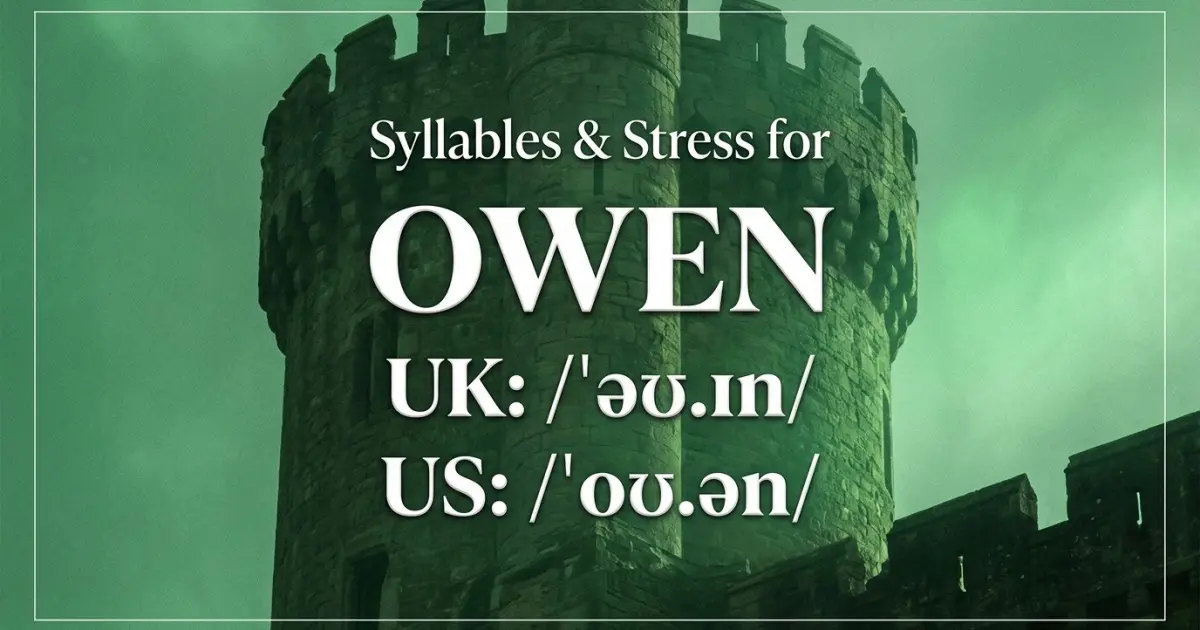
| U.S. IPA | /ˈoʊən/ | The opening vowel moves like the sound in “go” or “home,” not like a flat short o. |
| U.K. IPA | /ˈəʊən/ | In standard British English, the shape is almost the same, with a slightly different coloring of the opening vowel. |
| Syllable count | 2 syllables | Think of Owen as one open syllable followed by one softer, shorter landing. |
| Primary stress | First syllable | Say OH-wen, not oh-WEN. |
| Opening sound | /oʊ/ in American English; /əʊ/ in British English | Start with a rounded glide, not a clipped or flat vowel. |
| Ending sound | /ən/ or a light “wen” finish | The second syllable should sound natural and unstressed, never punched or over-separated. |
| Overall flow | Rounded start, gentle release | Owen sounds best when spoken smoothly, not chopped into two equal pieces. |
Why Owen Sounds So Calm Even Though the Structure Is Precise
Owen is a compact name, but it is not abrupt. The first reason is the opening vowel. In both American and British English, Owen begins with a diphthong, a vowel sound that glides as it is spoken. In simple terms, the voice does not stay in one fixed place. It moves. That movement gives the name roundness and warmth. It is one of the reasons Owen sounds open-hearted rather than hard-edged. Before focusing only on syllables and stress, it helps to step back into the fuller frame of Owen meaning.
The second reason is the unstressed finish. The name does not crash into its second syllable. It eases into it. That means the overall shape is not forceful in a blunt way. It begins clearly, then relaxes. This pattern makes Owen feel calm, approachable, and socially easy, even when the meaning behind it carries strength and nobility.
The first syllable is where Owen lives
Most of the name’s identity sits in the opening OH. That first beat carries the stress and gives the name its recognizability. This is also why families can sometimes shorten Owen to a simple “O” in intimate settings without losing the core of the name. The first syllable is doing nearly all the public work.
Because the stress is so clearly front-loaded, Owen is easy to hear in motion. Someone can call it across a room, on a playground, or in a hallway, and the ear catches it fast. That is one of the quiet strengths of the name. It sounds polished, but it behaves like an easy everyday word.
The second syllable should stay lighter than people expect
The second syllable is not silent, but it should not feel heavy. Some people, especially when sounding the name out too carefully, are tempted to overpronounce the end and make the two syllables feel equal. That is not how Owen usually works in natural English. The name sounds best when the ending is present but relaxed. It should complete the name, not compete with the opening.
This is where the name’s elegance comes from. Owen does not need dramatic emphasis. Its rhythm is already doing the work.
Owen Across American and British English Hardly Changes at All
One of Owen’s practical advantages is that it travels well across English accents. The U.S. and U.K. IPA forms are extremely close: /ˈoʊən/ and /ˈəʊən/. In real-world listening, this means that the name stays recognizably Owen in either setting. The difference lies mostly in the exact quality of the first vowel, not in the stress pattern or in the basic shape of the name.
The accent difference is mostly in the opening glide
American English tends to begin Owen with a slightly fuller, more back-rounded oʊ sound. Standard British English often uses əʊ, which can sound a little more centralized at the start. But this is a subtle distinction. Most listeners will hear the same name. Unlike some names that split noticeably across regions, Owen remains remarkably stable. Because the strongest energy lands early, the shorter forms often grow from the opening of the name, and that pattern is easier to see in nicknames for Owen.
That stability matters for a name now so widely used. A parent does not have to worry that the name will sound radically different depending on where the child travels, studies, or works. Owen remains itself.
Fast speech makes Owen even smoother
In careful pronunciation, the second syllable may sound fairly clear, almost like “wen.” In fast everyday speech, it often softens slightly, and the name may feel like one long rounded motion with a quick finish. This is normal. English reduces unstressed syllables all the time. It does not mean the speaker is saying the name badly. It means the name is moving naturally in fluent speech.
As long as the first syllable remains clearly stressed and rounded, the pronunciation remains solid.
Where People Get Owen Wrong When They Overthink It
Because Owen is so short and familiar, most pronunciation mistakes come from hesitating too much rather than from not knowing what the name is. The name can look simpler than it feels for a moment, and that brief uncertainty can produce a few recurring errors.
The most common mistake patterns
The first mistake is flattening the opening vowel so that it sounds too much like a short o rather than the rounded glide the name wants. The second is giving too much emphasis to the final syllable, which can make the name sound more mechanical and less natural. Owen is not a name of two equal beats. Its rhythm is front-loaded.
Another minor mistake is over-separating the syllables, as if they must be pronounced in a careful, dictionary-style manner every time. That usually makes the name sound stiffer than it should. Owen sounds best when it is allowed to move.
Why the spelling can briefly slow some readers down
The sequence of letters in Owen is not difficult, but the Ow- opening can make some people pause because English spelling uses that combination in several different ways. Once they recognize that Owen begins with the rounded OH sound rather than an ow as in “cow,” the rest of the pronunciation generally settles at once. In other words, the moment of hesitation is usually visual, not phonetic.
Owen Fits English Speech So Well That It Rarely Needs Correction
Another reason the name works so well is that it belongs to a sound pattern English speakers already trust. A strong first syllable followed by a lighter second one is extremely common in English. Owen therefore feels intuitively pronounceable. People do not need to learn a new rhythm to say it. They only need to recognize the correct opening vowel.
The consonants help too. There are no difficult fricatives, no complicated clusters, and no unstable letter combinations after the opening. The name passes from vowel to consonant to nasal finish with very little effort. This is one of the reasons Owen has remained so appealing. It sounds refined, but it behaves like a very usable everyday name.
How to Practice Owen Until It Feels Effortless
Use Owen inside real spoken lines
The easiest way to hear Owen correctly is to place it inside normal conversation rather than repeating it in isolation. Try lines such as:
“Owen, your turn.”
“Have you met Owen?”
“Owen is here.”
“I asked Owen already.”
When spoken this way, the rhythm becomes obvious. The first syllable opens the name. The second simply carries it to a close.
Three quick reminders that solve most issues
First, begin with a rounded OH sound. Second, keep the main stress on that opening syllable. Third, let the ending stay light. If those three things are in place, Owen will sound natural in nearly every English-speaking setting.