
How to Pronounce Otto: Syllables, Stress, and Common Mistakes
Imagine a teacher calling attendance in a bright kindergarten classroom, a nurse reading a newborn’s name from a hospital chart, or a grandfather saying the name slowly for the first time: Otto is brief enough to look simple, but its charm depends on keeping both syllables clear. The name is pronounced OT-oh. It begins with a strong first beat, then opens into a rounded second syllable. It should not be flattened into one sound, stretched into something elaborate, or softened until the central t disappears.
That clean pronunciation suits the name’s structure. Otto has German origin and means “wealth; fortune,” but the name does not sound grand or showy. It sounds compact, warm, and complete. The first syllable gives it firmness; the final oh gives it friendliness. Said well, Otto feels like a small name with solid architecture: two syllables, first-syllable stress, and a rounded finish that makes it easy to call, repeat, and remember.
How Otto Is Actually Said When Both Syllables Stay Clear
| Element | Phonetic Detail | Quick Tip |
|---|---|---|
| Standard pronunciation | OT-oh | Put the main emphasis on OT, then finish with a light rounded oh. |
| Syllables | 2 syllables | Say it as OT + oh, not as one compressed beat. |
| Stress pattern | First syllable stressed | The name should sound like OT-oh, not ot-OH. |
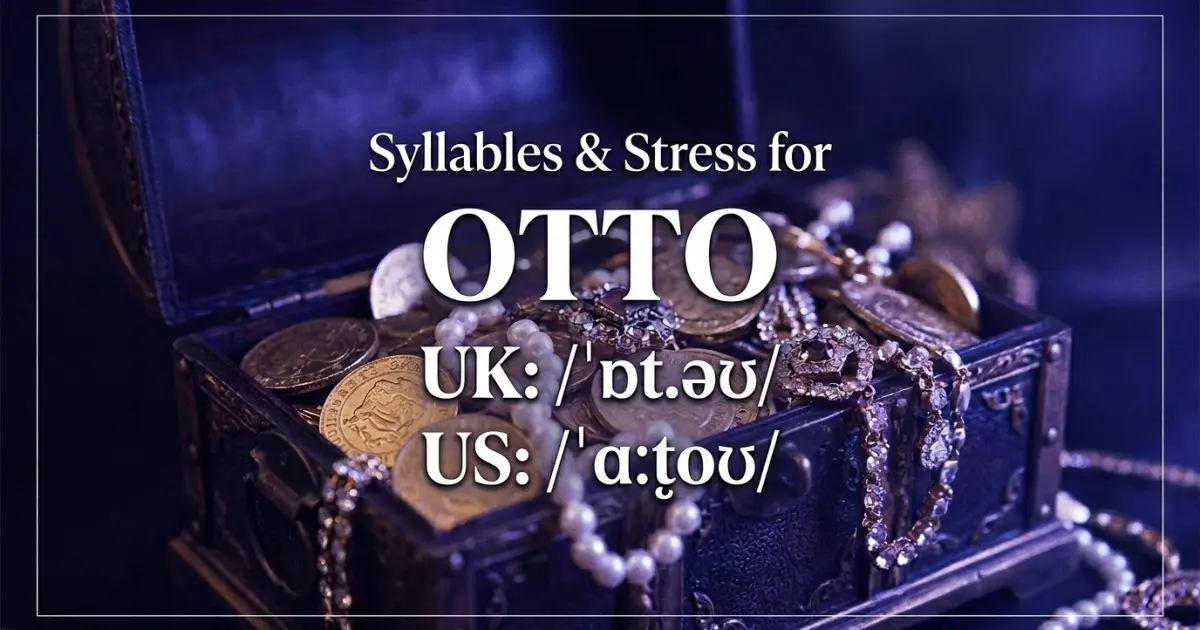
| U.S. IPA | /ˈɑːtoʊ/ | The American form opens with a broad first vowel and ends with a rounded oh sound. |
| U.K. IPA | /ˈɒtəʊ/ | The British form has a slightly different opening vowel, but the same two-syllable rhythm. |
| Opening sound | OT | Begin firmly; the first syllable carries the name’s weight. |
| Middle consonant | t | Keep the t clear enough to separate the two syllables. |
| Ending sound | oh | Finish with a rounded vowel, not a swallowed or clipped ending. |
Otto Has Two Syllables, and the First One Gives It Its Shape
Otto is easiest to pronounce when treated as two clear parts: OT and oh. The first syllable receives the stress, which means it should sound stronger and slightly more grounded than the second. The second syllable should remain audible, but it should not take over the name. The natural rhythm is OT-oh: firm, then warm. Pronunciation lands more fully when the name’s roots and history are already in view, so begin with Otto meaning.
This stress pattern is part of why Otto feels so complete despite being short. It has a beginning and a release. If the name is rushed too quickly, it can lose its second syllable and sound clipped. If the second syllable is overemphasized, it can sound overly sing-song. The best pronunciation keeps the first beat clear and the ending rounded.
The opening OT gives Otto its sturdy first step
The opening syllable, OT, is the name’s anchor. In American English, the vowel is represented as /ɑː/, which many speakers hear as a broad ah-like sound. In British English, the opening vowel is represented as /ɒ/, a shorter rounded vowel. The exact vowel color may differ by accent, but the role of the syllable stays the same: it carries the stress.
The important point is not to make the opening weak. Otto should not begin with a vague or swallowed sound. The first syllable gives the name its vintage strength and compact authority.
The final oh keeps Otto friendly
The second syllable, oh, gives Otto its warmth. Without it, the name would feel abrupt. With it, Otto becomes rounded, friendly, and easy to call. This final vowel is part of the name’s charm, especially in English-speaking settings where many short -o names feel lively and approachable.
The ending should not be exaggerated, but it should be present. Think of a light, rounded finish: OT-oh.
The U.S. and U.K. Pronunciations of Otto Differ Mainly in the First Vowel
The U.S. IPA for Otto is /ˈɑːtoʊ/, while the U.K. IPA is /ˈɒtəʊ/. Both forms keep the same structure: two syllables, stress on the first syllable, and a rounded final vowel. The main difference is the opening vowel. American speakers often use a broader first vowel, while British speakers may use a shorter rounded vowel.
For everyday pronunciation, the same guide works well in both accents: OT-oh. The accent may color the first syllable, but it should not change the number of syllables or move the stress. Otto remains a two-beat name with the first beat leading.
American Otto often has a broad opening
In American English, Otto may sound close to AH-toh for many speakers, though the practical guide remains OT-oh. The first syllable is open and strong, and the final syllable usually ends with a clear oh glide.
The rhythm should be simple: strong-light. The first syllable lands; the second syllable releases.
British Otto keeps the same two-beat structure
In British English, Otto may have a shorter, rounder opening vowel, reflected in /ˈɒtəʊ/. The final oh may also have a slightly different glide. Even so, the essential structure remains unchanged: OT-oh, with stress on the first syllable.
The most important rule is consistency. However the accent colors the vowels, Otto should still have two clear syllables.
Common Otto Pronunciation Mistakes Usually Come from Over-Smoothing
Otto is easy to say, but because it is short, small mistakes are noticeable. The most common issues involve flattening it into one beat, making the second syllable too heavy, or losing the central t sound entirely.
Do not reduce Otto to one syllable
Otto should not become a single clipped sound. It has two syllables: OT and oh. Keeping both syllables audible preserves the name’s warmth.
Do not stress the final syllable
The name is not usually pronounced ot-OH. The first syllable carries the stress. The final syllable should be rounded but lighter.
Do not swallow the T completely
The central t helps separate the two syllables. In fast speech, it may soften, but it should not disappear so much that the name loses definition.
Do not overperform the German feeling
Otto has German origin, but in English the pronunciation is straightforward. The name does not need a theatrical accent or an exaggerated final vowel. A clear OT-oh is enough.
Otto Shares Sound Space with Arlo, Milo, Hugo, and Leo
Otto belongs to a family of short, warm names with rounded vowels and friendly endings. It sits near names such as Arlo, Milo, Hugo, Leo, Nico, and Theo. These names are easy to call, memorable on the page, and softened by open vowel sounds.
What makes Otto distinct is its firm middle. The doubled t gives it more structure than many flowing -o names. Arlo feels airy, Milo feels gentle, Leo feels bright, and Hugo feels rounded and grand. Otto feels compact and sturdy. It has warmth, but it also has a little weight.
Why Otto sounds playful without becoming flimsy
Otto’s sound balances friendliness and structure. The repeated o vowels make it warm and easy to say. The central t keeps it crisp. That is why Otto can sound charming on a child and still credible on an adult.
The pronunciation also supports the meaning “wealth; fortune.” The name sounds small, but complete—like something valuable held in a compact form.
Practice Otto Until the Rounded Ending Feels Natural
The easiest way to practice Otto is to slow it into two parts, then reconnect them. Start with OT. Add oh. Then say the full name smoothly: OT-oh. Once the sound pattern is clear, some shortenings stop feeling optional and start feeling natural, and the clearest map is in Otto nicknames.
Simple practice lines for Otto
- Otto.
- This is Otto.
- Otto is here.
- We named him Otto.
- Otto James has a clean rhythm.
- Please welcome Otto.
Slow-to-natural pronunciation practice
Begin slowly: OT + oh. Then connect the syllables: OT-oh. Finally, place the name in a natural sentence: Otto will be joining us today.
The goal is to keep the name simple without flattening it. Let the first syllable lead, let the final vowel round the sound, and keep the central t clear enough to hold the name together. Once that rhythm is learned, Otto becomes easy to say: compact, warm, and memorable.
Common Questions About Pronouncing Otto
How do you pronounce Otto?
Otto is pronounced OT-oh. It has two syllables, with the stress on the first syllable.
What is the IPA pronunciation of Otto?
The U.S. IPA pronunciation is /ˈɑːtoʊ/. The U.K. IPA pronunciation is /ˈɒtəʊ/.
How many syllables are in Otto?
Otto has two syllables: OT and oh.
Is Otto pronounced differently in American and British English?
The vowel color may differ slightly. American English uses /ˈɑːtoʊ/, while British English uses /ˈɒtəʊ/. Both keep the same basic rhythm: OT-oh.