
Ophelia Name Meaning: Heritage, Meaning, and Elegant Appeal

Some names arrive carrying a ready-made atmosphere. Ophelia enters the room with velvet curtains, candlelight, water, verse, and a faint sense of old Europe. It is a name people often think they already know before they have really examined it. They know the literary shadow, the soft music of the vowels, the way it seems to trail silk behind it. But Ophelia becomes more interesting when you look past the mood and into the structure. Underneath the poetry is a surprisingly practical idea: help. Succor. Relief given when it matters. That is what gives the name its staying power. It is not only decorative. It carries an ethic.
That tension is the real story of Ophelia. The sound is airy, but the meaning is grounded. The cultural image can seem fragile, yet the underlying message is active and human: to support, to aid, to answer need. In an era when many parents want names that feel expressive without sounding invented, graceful without becoming flimsy, Ophelia holds a rare middle ground. It is lush but not empty, recognizably literary without being unusably theatrical, and elegant enough for fantasy while still substantial enough for ordinary life. The more closely you read the name, the less it behaves like a costume and the more it reads like character.
Ophelia's U.S. popularity rank over time, 1880–2024
Popularity statistics are based on official data from the Social Security Administration baby name records.
Ophelia: A Grand and Poetic Greek Pillar
Ophelia functions as a name with one unmistakable center of gravity, sustained by a clear identity on the girls’ side of the chart. Its recent rise suggests revival energy, as parents rediscover grand, multi-syllabic names that carry a sense of literary polish .
The absence of crossover usage reinforces its firm and focused feminine identity. Meaning “help” or “succor,” its rhythmic three-syllable sound gives it an elegant texture that remains distinctive.
Why Ophelia feels older than fashion
| Key Facts | Information | Quick Insight |
|---|---|---|
| Name | Ophelia | The form looks ornate, but it is cleanly built and easy to recognize at a glance. |
| Primary Gender Use | Female | It reads unmistakably feminine in contemporary use, yet not in an overly sugary way. |
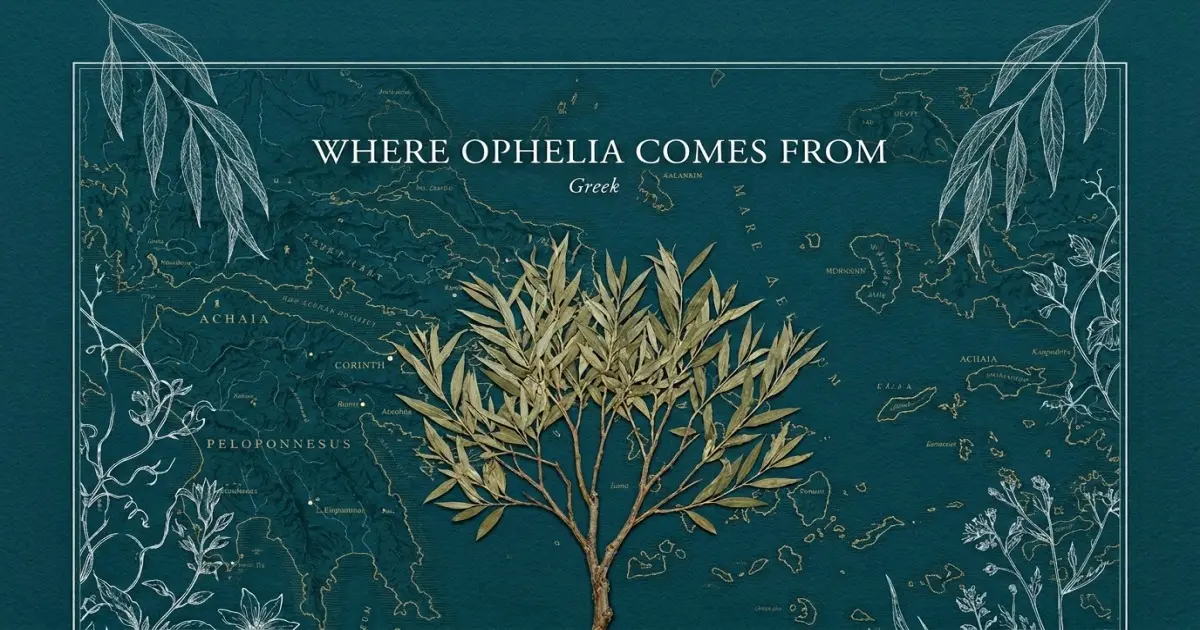
| Origin | Greek | Its classical background gives the name depth and a sense of inherited cultural memory. |
| Core Meaning | Help; succor | This is what makes Ophelia more than a beautiful sound: the meaning points toward care, rescue, and presence. |
| Common Pronunciation | oh-FEEL-yuh | The stress lands in the middle, which gives the name lift and keeps it from feeling heavy. |
| IPA (US) | /oʊˈfiːliə/ | The long ee sound is one reason the name feels flowing rather than clipped. |
| IPA (UK) | /əˈfiːliə/ | The British form softens the opening, adding even more hush to an already lyrical name. |
| Syllables | 3 | Three syllables give Ophelia enough movement to sound elegant, but not so much that it becomes unwieldy. |
| U.S. girls’ rank (2024) | No. 261 | Official data places it in the sweet spot: familiar enough to be legible, uncommon enough to still feel chosen. |
Ophelia carries rescue inside its beauty
Why “help” changes the emotional reading of Ophelia
Names that mean light, beauty, or grace tend to be admired quickly because their symbolism is obvious. Ophelia works differently. Its meaning does not sit on the surface. You have to turn toward it. Once you do, the name becomes richer. “Help” is not passive. “Succor” is not ornamental. These are relational words. They imply someone in difficulty and someone who answers. That makes Ophelia emotionally generous in a way many elegant names are not. It suggests usefulness without plainness, compassion without softness, and presence without performance.
That underlying idea matters because it changes how the name behaves in real life. A great many highly romantic names can feel almost too delicate, as if they belong only to youth, fantasy, or a certain kind of visual femininity. Ophelia resists that problem because its core meaning is adult. It imagines a person who can steady a room, not simply decorate one. Even if nobody around her knows the etymological background, the name still benefits from that hidden architecture. Parents often talk about wanting a name with “substance.” Ophelia has it, but quietly.
Why the sound keeps the meaning from feeling severe
If the meaning were attached to a hard or overly utilitarian sound, the result might feel too stark. Instead, Ophelia balances care with beauty. The opening “O” gives it roundness. The stressed middle, “feel,” creates a liquid center. The final “-ia” lets the name fade instead of stop. That matters. The sound design is one reason Ophelia can carry a serious meaning without sounding dutiful or grim. It sounds like tenderness, not obligation.
There is also a subtle emotional intelligence in the way the name moves. It begins open, concentrates at the center, and releases gently. For many listeners, that shape feels almost narrative. The name seems to travel somewhere. That helps explain why Ophelia has remained memorable across centuries of readers, performers, teachers, and parents. It is not just pretty. It has motion, and that motion mirrors the meaning: an approach toward someone, a reaching outward, a response.
This is the best way to understand the name at its deepest level. Ophelia is not simply a floral antique or a theatrical relic. It is a name that wraps service in music. That combination is rarer than it looks. Plenty of names sound beautiful; fewer sound beautiful while quietly implying moral weight. Ophelia does.
Ophelia in literature changed the name, but did not trap it
From Greek sense to stage memory
Whatever else Ophelia means in private family life, its public image has been shaped by literature. Shakespeare’s Hamlet turned Ophelia from a beautiful classical form into one of the most recognizable women’s names in English-language culture. That single literary event gave the name enormous reach. Even people who have never read the play in full usually know the atmosphere around it: youth, pressure, grief, misreading, vulnerability, and beauty observed too late. Few names carry such a concentrated dramatic inheritance. For more names shaped by the same tradition, explore a wider list of Greek names.
That inheritance can be a burden if a parent wants a blank slate. Ophelia is not blank. It comes with memory attached. But that is not the same thing as limitation. Literary names often endure precisely because they hold more than one reading at once. They begin in art and then keep being reinterpreted by each generation. Ophelia is one of the clearest examples. On stage, she can be fragile, lucid, wounded, manipulated, lyrical, or quietly defiant depending on who is playing her and how the work is read. The name’s survival tells you something important: the culture did not keep it alive because of one tragic plot point alone. It kept it alive because the name itself is unforgettable.
Why modern parents hear more than tragedy
Modern naming culture is far more comfortable with layered associations than older rulebooks used to be. Parents now routinely choose names connected to mythology, novels, folklore, and dark fairy tales without assuming the child inherits the entire plot. That shift has helped Ophelia. The name is no longer heard only as an emblem of sorrow. It is also heard as painterly, intelligent, expressive, and romantically articulate. In many contemporary ears, the literary connection reads less as a warning and more as a sign that the name has already proven it can survive time.
There is another reason the tragedy does not fully define the name anymore: the meaning pushes back. Once you know that Ophelia is tied to help and succor, the old image becomes more complicated. The name begins to read as a study in misalignment between essence and circumstance. A name built on aid was given to a character trapped in a world that failed to protect her. That contradiction gives the name unusual depth. It does not flatten into prettiness, nor does it collapse into sadness. It becomes interpretive.
For some families, that complexity is the appeal. Ophelia feels literary, yes, but not dusty. It invites thought. It suggests a child who may grow into imagination, reflection, and emotional range. And because the name is so firmly established in the cultural ear, it does not need constant explanation. People may think of the play, but they also know how to hold the name. That distinction matters. The strongest literary names are the ones that remain usable after the book is closed. Ophelia clearly belongs in that category.
What Ophelia signals in the modern naming landscape
Recognizable, but not overrun
Official Social Security Administration (SSA) data places Ophelia at No. 261 for girls in 2024. That number tells a useful story. The name is not obscure, and it no longer sits at the extreme edge of taste. Most people have heard it. Most can place it. But it is also far from overexposed. In practical terms, that gives parents one of the most desirable modern balances: familiarity without saturation. A child named Ophelia is unlikely to spend her life explaining that her name exists, but the name still retains a sense of individuality. To compare tone, familiarity, and fit across similar names, explore girls’ names with meanings.
That rank also positions Ophelia differently from the dominant mainstream choices. It lives just outside the heavily trafficked zone, which often means it feels more intentional. Parents who choose it tend to sound like they meant the name, not like they arrived there by habit. That matters socially. Some names feel inherited from the moment; Ophelia still feels selected from a point of view.
Style neighbors without imitation
Part of Ophelia’s appeal is that it can speak to several naming tastes at once. If you like lyrical vowel-rich names, it sits comfortably beside Olivia, Aurelia, or Emilia. If you prefer literary gravitas, it stands near Cordelia, Juliet, or Beatrice. If your instinct runs toward antique romance, Ophelia can live near Florence, Daphne, or Cecilia. Yet it never fully disappears into any one group. It is softer than some, stranger than others, and more haunted in the best sense than almost all of them.
That independence is valuable. A name can feel stylish without feeling derivative. Ophelia accomplishes that because it has an internal identity strong enough to resist blending into trend language. The long vowels give it beauty, but the consonants keep it from dissolving. The literary frame gives it prestige, but the meaning gives it heart. Together these features make the name feel coherent rather than merely fashionable.
How Ophelia behaves in real life
A beautiful name still has to work on forms, introductions, roll calls, email signatures, and adulthood. Ophelia performs better there than skeptics sometimes assume. The spelling is intuitive once seen. The pronunciation is clear enough to settle quickly. It shortens easily if needed, but does not require shortening to function. It can sound refined with a clipped surname and romantic with a longer one. With a brisk last name, Ophelia gains edge; with an elaborate surname, it becomes almost symphonic.
There are, of course, cautions. If you strongly prefer names with minimal cultural baggage, Ophelia may feel too loaded. If you dislike a name that people may discuss rather than simply register, this is probably not your ideal choice. But for families who want beauty with conversation inside it, those are not flaws. They are part of the draw. Ophelia is not neutral. It is expressive. That is exactly why it lasts.
If Ophelia is on your shortlist, these are the next doors to open
Strong name choices usually create a second wave of questions. Once parents know they love the atmosphere of a name, they start testing its practical edges: what balances it, what shortens it, and how confidently it travels through everyday speech. Ophelia naturally opens all three conversations.
Middle names that keep Ophelia balanced
Because Ophelia is lyrical and visually rich, middle names often work best when they either steady it or clarify its mood. Short, clean middles can keep the full combination from becoming overdecorated, while classic middles can lean further into its literary elegance. The key is rhythm: Ophelia usually benefits from a pairing that lets its music remain the star rather than competing with it. If you want the full pairing logic behind that contrast, see middle names for Ophelia.
Nicknames that soften or sharpen Ophelia
Ophelia is one of those names that can stay formal beautifully, but it also contains multiple possible social selves. Depending on the nickname, the name can feel sweeter, brisker, younger, or more modern. That flexibility is part of its usefulness. Families who love a grand full name but still want intimacy in daily life often find Ophelia surprisingly adaptable. To see how those different moods shorten in real life, explore Ophelia nicknames.
Pronouncing Ophelia with confidence
The common spoken form is straightforward once heard, but the name’s softness can make some parents wonder how firm or airy they want the delivery to be. Accent differences also shift the opening slightly. That does not weaken the name; it proves how well it travels. Ophelia keeps its identity even when the music changes a little from one English-speaking context to another. For the detailed stress pattern, accent notes, and IPA, see Ophelia pronunciation guide.
Why the name Ophelia keeps returning
Names return for many reasons. Some come back because they sound fashionable again. Some reappear because celebrities revive them or because the culture suddenly rediscovers an era. Ophelia returns for a more durable reason: it offers contradiction without confusion. It sounds romantic but means something useful. It is old without feeling stale. It is literary without being museum-bound. It is feminine without collapsing into fragility.
That is why Ophelia continues to appeal to parents with very different instincts. One family may hear the name as music. Another may love the classical depth. Another may be drawn to the meaning and its quiet promise of support. Another may want exactly that combination of gravity and grace that very few names can sustain. Ophelia can hold all of those readings without splitting apart.
In the end, the finest argument for Ophelia is not that it is beautiful, though it is. It is that the beauty is backed by structure. The name does not float away from you once admired. It settles. It leaves behind an image of someone who can feel deeply and still matter practically, someone whose presence is not merely ornamental but restorative. That is why Ophelia remains memorable long after the first impression. The name sounds like art, but at its core it speaks the language of help. Few names offer a more compelling balance than Ophelia.
What Parents Ask About the Meaning of Ophelia
Is Ophelia too strongly tied to Shakespeare?
It is definitely a literary name, so the association is real. But that does not make it unusable. Many parents now treat literary links as added depth rather than a fixed script, and Ophelia has enough beauty and meaning to stand on its own outside the play.
Does Ophelia age well from childhood to adulthood?
Yes. Ophelia sounds distinctive on a child, but it also has the composure and seriousness to suit an adult. That is one of its strengths: it feels expressive early in life and substantial later on.
Is Ophelia difficult for people to pronounce?
For most English speakers, no. The familiar spoken form is easy to learn, and once people hear it once, they generally retain it. It looks more elaborate than it actually is in conversation.
Does Ophelia work with short surnames?
Very well. A short surname can sharpen Ophelia and keep the overall name from sounding overly ornate. That contrast often creates one of the most effective combinations for this style of first name.