
How to Say Nova Correctly: Where the Stress Falls and Why
The real pronunciation test for a name almost never happens when parents first write it down. It happens later, in ordinary public moments that decide whether a name can move through daily life without friction: a teacher pausing over the attendance sheet on the first day of school, a pediatric nurse calling into a waiting room, a coach reading a roster aloud at speed, a grandparent repeating the name often enough for it to settle naturally into family speech. Nova usually performs well in those moments. It looks modern, but it does not feel hard. Most English speakers can get very close to the intended sound the first time they see it.
That ease matters, but it is not the whole story. Short names depend heavily on precision because there are so few sounds carrying the entire impression. In Nova, the broad opening and the soft ending do most of the emotional work. The standard everyday form is NOH-vuh. When that first syllable is given its proper weight, Nova sounds confident, clean, and quietly luminous. If the rhythm flattens or the ending gets rushed, the name can lose some of the calm modernity that makes it appealing in the first place. Nova is easy, but it is not casual about itself.
How Nova Is Actually Said When People Get It Right
| Element | Phonetic Detail | Quick Tip |
|---|---|---|
| Standard pronunciation | NOH-vuh | Let the first syllable carry the name. The second should soften rather than compete. |
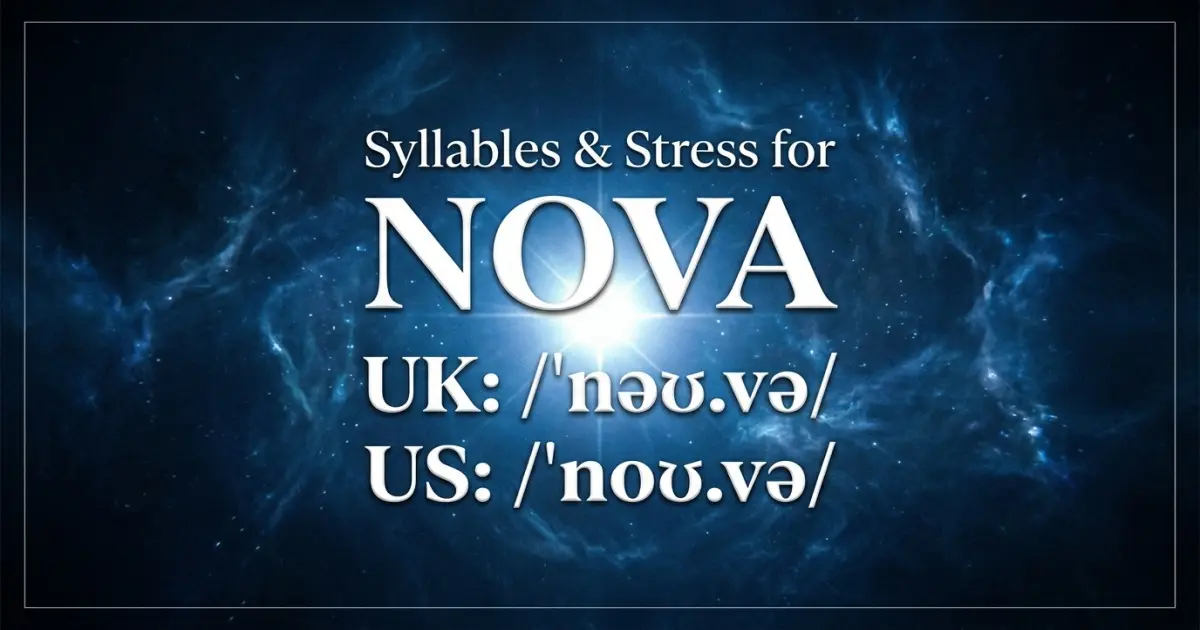
| IPA (US) | /ˈnoʊvə/ | The opening vowel is the same kind of “oh” glide heard in words like go or no. |
| IPA (UK) | /ˈnəʊvə/ | The British form keeps the same overall shape, with only a slight accent difference in the opening glide. |
| Syllable count | 2 syllables | Think of the name as a clean two-beat pattern: NOH | vuh. |
| Primary stress | First syllable | If both syllables get equal weight, the name starts sounding flatter than it should. |
| Ending sound | Soft unstressed “vuh” | Keep the last syllable light. It should finish the name gently, not hit like a second accent. |
| Speech texture | Nasal opening + rounded vowel glide + voiced fricative | The v sound gives Nova movement and brightness, so do not swallow it. |
Why Nova Sounds So Simple but Still Has Shape
The two-beat rhythm inside Nova
Nova is a two-syllable name, and that is one reason it feels modern and easy to use. The first syllable, NOH, carries the weight and identity of the name. The second, vuh, releases it. This is a very familiar English rhythm: strong first beat, lighter second beat. Because the pattern is so recognizable, most speakers can absorb it quickly without needing formal phonetic training. Pronunciation lands more fully when the name’s roots and history are already in view, so begin with Nova meaning.
What keeps Nova from sounding plain, though, is the internal contrast. The opening is rounded and open, while the ending is softer and slightly more relaxed. That contrast makes the name feel finished rather than clipped. Nova is short, but it is not thin.
What the sounds are doing in the mouth
The name begins with n, a nasal consonant that gives it a gentle start rather than a hard attack. After that comes the rounded oh glide, which is where much of the name’s polish comes from. Then comes the v, a voiced fricative. In plain language, that means the sound has a little friction and vibration in it. That small buzz of energy is important. It keeps Nova from drifting into softness and gives the name its clean modern edge.
Finally, the last vowel relaxes. The effect is a name that opens with poise, brightens in the middle, and lands softly. This is why Nova sounds more balanced than some other short names. It has both smoothness and definition.
Where Nova Gets Mispronounced in Real Life
The most common issue is flattening the stress
Most English speakers do not wildly misread Nova. The more common problem is subtle: they flatten the name so both syllables sound equally weighted. That makes Nova feel more mechanical and less graceful. The first syllable should clearly lead. The second should follow. A good mental cue is simple: Nova should start strong and finish light.
The second mistake is rushing the “v”
Because Nova is short, people sometimes move through it too fast and blur the v in the second syllable. When that happens, the name can lose some of its distinctness and start sounding less polished. The v is small, but it matters. It is the sound that gives the name its internal current. If the consonant disappears, so does some of the name’s character.
The ending should not sound over-pronounced
At the other extreme, some speakers make the last syllable too heavy. That creates a name that sounds less natural in English conversation. Nova’s ending should be audible, but relaxed. It is not a name with two equal punches. It is one strong syllable followed by one softer one.
Nova Across Accents and Similar-Sounding Names
US and UK forms are close enough to feel stable
The American and British IPA forms are slightly different on paper—/ˈnoʊvə/ and /ˈnəʊvə/—but in real life the difference is small. Both keep the same first-syllable stress, the same overall “oh” movement, and the same soft final syllable. That is good news for families who care about portability. Nova does not change personality from one English accent to another.
In practice, that means the name tends to travel well. Speakers in different regions may color the opening sound slightly differently, but they are still saying the same name in the same structural way.
Nova beside Nora, Nola, and Noa
Nova shares sound territory with names like Nora, Nola, and Noa. This is useful to know because when people read names quickly, they often reach for the closest familiar neighbor. Nova, however, keeps a distinct contour because of its internal v. That consonant is the separating line. Nora is rounder and softer. Nola feels looser. Noa is even more stripped down. Nova has more forward motion than all three.
This means that even if someone mishears the name once, one correct repetition is usually enough to settle it. Nova is not fragile in speech. It just needs its middle consonant to stay audible.
How to Practice Nova Until It Feels Effortless
Use the two-step method
The easiest way to teach or check Nova is to split it into two beats once: NOH | vuh. That instantly shows where the stress belongs and reminds the speaker that the second syllable should stay lighter. Once the rhythm is clear, the name usually becomes natural very quickly.
Put Nova into ordinary sentences
Names often sound fine in isolation and then change shape inside real conversation. A useful way to test Nova is through simple everyday lines:
Nova is here.
Can Nova come with us?
I saved this for Nova.
In all three lines, the first syllable should still carry the main energy. If the name starts sounding rushed, slow down once and let the v and the final vowel come through.
What good pronunciation of Nova should feel like
When Nova is said well, it should feel calm, rounded, and lightly luminous. The opening should be full without being dramatic, the middle consonant should add a small current of brightness, and the ending should soften away. The name should never feel clipped or overworked. Its elegance comes from control, not complication.