
How to Say Nora Correctly: A Simple Pronunciation Guide
The real pronunciation test for a name rarely happens when parents are choosing it. It happens later, in the ordinary public scenes that names must survive for the rest of a person’s life: a teacher pausing over a class list, a pediatric nurse calling from a doorway, a barista repeating the order back, a grandparent saying the name often enough for it to become part of the house. Nora does unusually well in those moments. It looks familiar, sounds familiar, and settles into English speech with almost no resistance. That practical ease is one reason the name continues to travel so well across generations.
But ease should not be confused with shapelessness. Short names live or die by stress, vowel quality, and timing, because there is so little room for error. Nora works best when it is spoken as NOR-uh, with the weight resting clearly on the first syllable. The opening should feel rounded and warm, not clipped or hurried, and the ending should soften away rather than hit too hard. That balance is what gives Nora its calm authority. Say it properly, and the name sounds polished without effort. Rush it, flatten it, or overemphasize the wrong part, and some of its quiet elegance disappears.
How Nora Is Actually Said When People Say It Right
| Element | Phonetic Detail | Quick Tip |
|---|---|---|
| Standard pronunciation | NOR-uh | Let the first syllable carry the name. The second should feel lighter and shorter. |
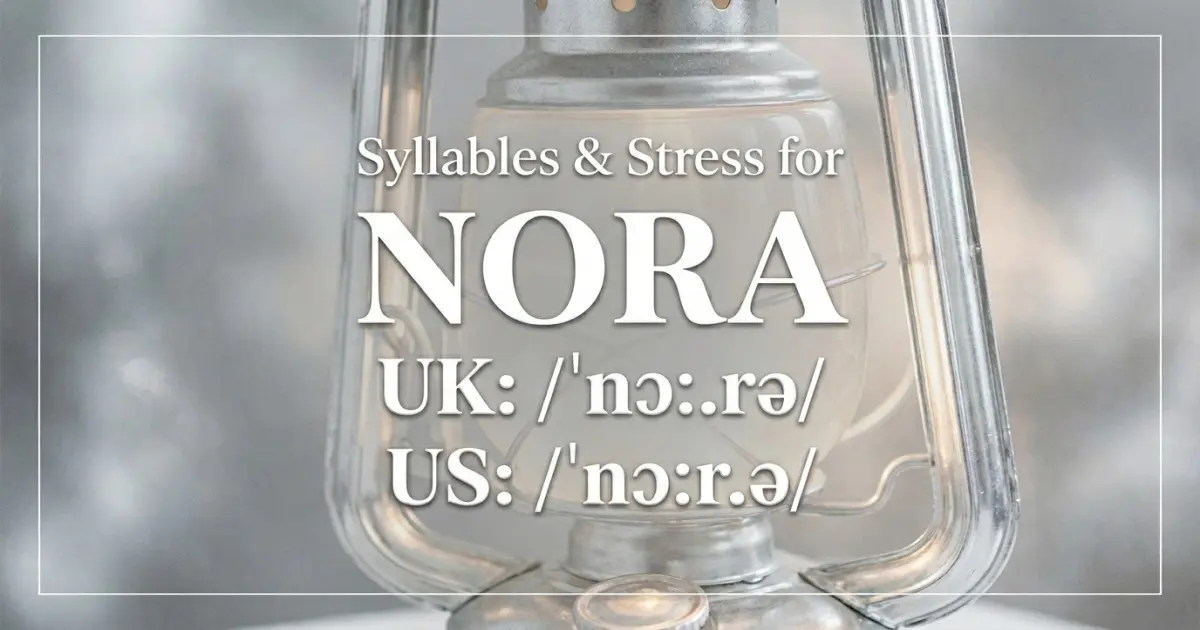
| IPA (US) | /ˈnɔːrə/ | The opening vowel is broad and rounded, closer to “or” than to a short flat “o.” |
| IPA (UK) | /ˈnɔːrə/ | US and UK reference forms align closely here, which makes Nora especially stable across accents. |
| Syllable count | 2 syllables | Think of Nora as a clean two-beat pattern: NOR | uh. |
| Primary stress | First syllable | If both syllables are given equal weight, the name can sound flatter and less graceful. |
| Ending sound | Soft unstressed “uh” | The final syllable should taper gently rather than sounding hard or overly pronounced. |
| Speech texture | Nasal opening + rounded vowel + soft ending | The name should feel warm and smooth in the mouth, not choppy or sharp. |
Why Nora Sounds So Simple but Still Has a Real Shape
The two-syllable structure of Nora
Nora is a two-syllable name, and that alone explains much of its success. Two-syllable names are often easy to remember and easy to repeat, but Nora improves on that formula because each syllable has a distinct job. The first syllable, NOR, carries the stress and the emotional color of the name. The second, uh, releases the sound softly. The first is rounded and substantial; the second is light and unforced. Together they create a name that feels complete without ever sounding heavy. Before focusing only on syllables and stress, it helps to step back into the fuller frame of Nora meaning.
This is also why Nora feels more composed than some equally short names. The rounded vowel in the stressed syllable gives it body. If Nora began with a brighter front vowel, it would sound quicker and perhaps more playful. Instead, the broad or sound slows the name just enough to make it feel calm.
What the consonants are doing
The name begins with a nasal n, which is one of the gentler ways for a word to start. There is no harsh stop consonant, no hissy fricative, and no heavy cluster to complicate the opening. After that comes the rounded vowel, then the r, which adds a slight line of firmness before the final unstressed vowel softens the exit. In plain terms, Nora moves from gentle opening to clear center to soft landing. That is why it sounds so balanced.
In linguistic terms, Nora is efficient. In human terms, it sounds trustworthy. That may sound like an overstatement for two syllables, but pronunciation shapes first impressions more than most people realize.
Where Nora Usually Goes Wrong in Real Life
The most common issue is flattening the rhythm
Because Nora is short and familiar-looking, most English speakers do not mispronounce it wildly. The more common problem is subtle: they flatten the rhythm so that the second syllable receives too much attention or the first syllable loses its natural emphasis. Nora should not sound like two equal pieces set side by side. It should open fully on NOR and then soften.
If you need a quick correction cue, it is this: make the first syllable rounder and stronger, then let the ending fall away.
Sometimes the vowel gets made too flat
Another occasional issue is that the first vowel becomes too short or too flat, especially when someone is saying the name quickly. Nora does not want a cramped opening. The vowel should have breadth. Think more “or” than “ah,” and more warmth than snap. Once that opening sound is right, the name almost always sounds correct.
The ending should stay soft
There is also a temptation, especially in careful or formal speech, to over-pronounce the final syllable. But the second syllable in Nora is not meant to dominate. It should be audible, but light. If the ending becomes too strong, the name starts to sound less natural in everyday English.
Nora Across Accents and Neighbor Names
US and UK English treat Nora similarly
One of Nora’s practical strengths is that the reference pronunciation in American and British English is the same: /ˈnɔːrə/. Real-life accents will still leave their mark. Some speakers will make the opening slightly more rounded, others slightly tighter. Some will soften the final vowel more than others. But the overall pattern remains stable: first-syllable stress, rounded opening, light second syllable.
That stability matters because it reduces the kind of uncertainty some names carry when they cross regions. Nora does not have a major accent problem. It stays recognizably itself.
The names Nora sits beside
Nora shares sound territory with names like Cora, Laura, Norah, and in some speech communities Nola or Noura. But its contour remains distinct because of the strong NOR opening and the soft unstressed ending. It is also worth noting that spelling variation does not usually alter pronunciation much in everyday English. Nora and Norah are generally said the same way.
That makes Nora a name that is visually simple and acoustically reliable. It does not ask people to memorize hidden rules.
How to Practice Nora Until It Feels Effortless
Use the two-beat method
The easiest way to teach Nora or to check yourself on it is to split it once into two clear beats: NOR | uh. This reminds the speaker that the first syllable carries the stress and the identity of the name. Once that pattern is set, normal speech will usually take care of the rest.
Try Nora inside real sentences
Names can sound fine in isolation and still wobble when placed into actual speech. A good way to test Nora is to use it in everyday lines:
Nora is here.
Can Nora come with us?
I saved this seat for Nora.
When spoken naturally, the name should feel easy and rounded, not clipped or over-managed. That is the advantage of practicing in full phrases instead of chanting the name alone.
What good pronunciation of Nora should feel like
When Nora is said well, it should feel settled. The first syllable should open warmly, the r should give the name a slight inner line, and the final syllable should release softly. The whole name should move like a gentle arc, not like two disconnected blocks. That is the secret of Nora’s pronunciation: its elegance comes from proportion more than from complexity.