
Noam Pronunciation: Easy Breakdown and Speaking Tips
The pronunciation of Noam often becomes a real question in ordinary public moments: a teacher reading a class list, a nurse calling a name in a waiting room, a parent introducing a child at the playground. On the page, Noam looks short enough to be simple, but its vowels make people pause. Some readers want to collapse it into one syllable. Others try to make it rhyme with foam. The actual everyday pronunciation is more open and more graceful: NO-ahm.
That two-beat sound is central to the name’s character. Noam is Hebrew in origin and means “pleasantness; charm.” Its pronunciation carries some of that gentleness: it begins with a rounded NO, then settles into a warm ahm. Official data shows Noam was used for boys in the United States in 2024, but it remains uncommon enough that a simple pronunciation guide can make introductions feel smoother from the start.
How Noam Is Actually Said: Two Beats, Not One
The most practical pronunciation of Noam is NO-ahm. It has two syllables, not one. The first syllable sounds like no; the second opens into ahm. The name should feel like a small arc rather than a clipped sound: NO, then ahm.
| Element | Phonetic Detail | Quick Tip |
|---|---|---|
| Everyday pronunciation | NO-ahm | Say it in two clear parts, with the vowels separated gently. |
| Syllable count | 2 syllables | Do not compress the name into one syllable. |
| Stress pattern | Second-syllable stress in the IPA form | The second beat has weight, but the whole name should still sound smooth. |
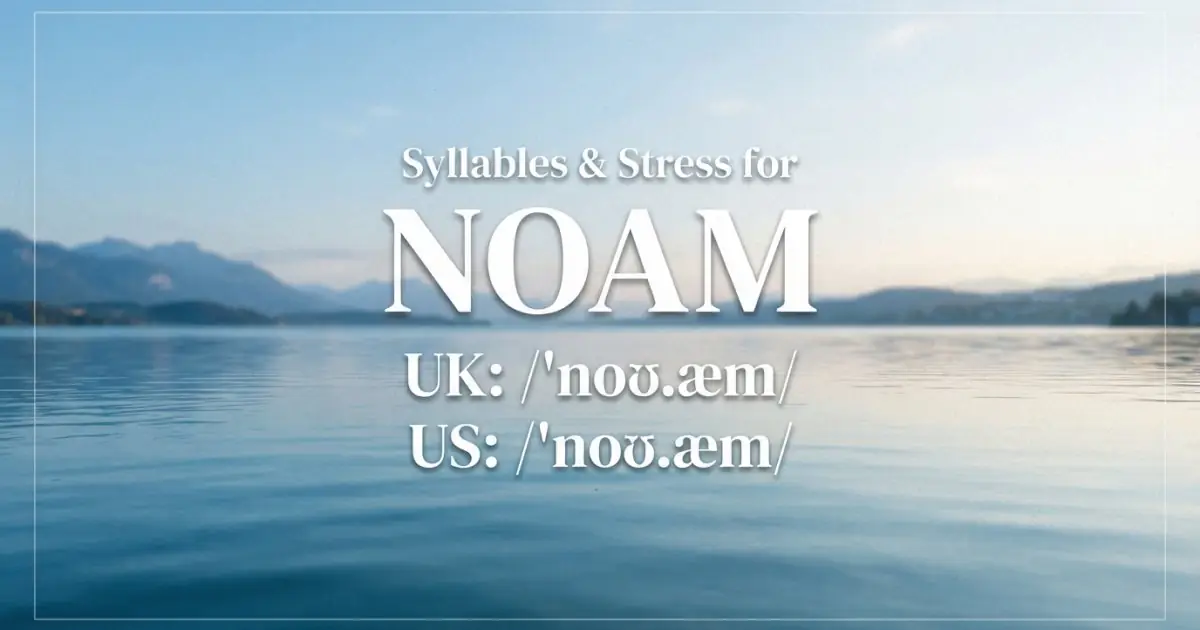
| US IPA | /noʊˈɑːm/ | The final ahm is broad and open in American pronunciation. |
| UK IPA | /nəʊˈæm/ | The first vowel shifts with accent, and the final vowel may sound shorter or brighter. |
| Most common correction | Not “nome” | Noam does not rhyme with foam; it is NO-ahm. |
The Sound Structure of Noam Explains Why People Misread It
Noam is visually simple: four letters, no accent marks, no unusual consonant clusters. But in English, vowel combinations often create uncertainty. The sequence oa commonly appears in words such as boat, road, and foam, where it forms one long oh sound. That is why some English speakers instinctively guess that Noam should sound like Nome. Pronunciation lands more fully when the name’s roots and history are already in view, so begin with Noam meaning.
The first syllable opens the name
In the pronunciation NO-ahm, the opening NO is clear and rounded. It begins with N, a nasal consonant. Nasal consonants are produced with airflow through the nose, and they often give names a warm, resonant beginning. The vowel after it is the familiar oh sound in American English, represented in the US IPA as /noʊ/.
This first syllable should not be swallowed or rushed. If it becomes too quick, the name may sound like a single blurred syllable. A helpful teaching phrase is: “Start with No, then add ahm.”
The second syllable gives Noam its warmth
The second syllable, ahm, is what makes Noam different from Nome. In the US pronunciation /noʊˈɑːm/, the second syllable has an open ah vowel, followed by m. That final m closes the name softly, without a hard stop or sharp fricative.
This ending is important because it gives Noam its calm finish. The name does not snap shut. It settles. That sound quality fits the meaning “pleasantness; charm,” because the name feels gentle without being weak.
Noam in US and UK Accents: Same Name, Slightly Different Vowels
The US and UK IPA forms show the same general structure but different vowel colors. In American pronunciation, /noʊˈɑːm/ points to NO-ahm, with a broad second vowel. In UK pronunciation, /nəʊˈæm/ suggests a first vowel shaped by British oh and a final vowel closer to the a in some pronunciations of cat or ham.
American speakers usually hear NO-ahm
For many American speakers, the easiest guide is NO-ahm. The first syllable sounds like the word no. The second syllable sounds like ahm, with an open, broad vowel. The stress mark in the IPA appears before the second syllable, so the final beat should not disappear.
In natural speech, however, the name should not sound exaggerated or theatrical. It is not no-AHHHM with a heavy dramatic ending. It is a smooth two-syllable name: NO-ahm.
British pronunciation may make the final vowel brighter
In many UK accents, the first vowel may sound slightly different from American no, and the second vowel may be shorter or brighter. The result can still be understood as Noam as long as the two-syllable structure remains clear. The essential point is not to make the name rhyme with foam or home.
Accent variation is normal. A speaker from London, New York, Sydney, or Toronto may color the vowels differently, but the name remains recognizable when it keeps its two parts: No plus am.
Common Noam Pronunciation Mistakes and Easy Corrections
Noam is not a difficult name after someone hears it once. Most mistakes come from reading the spelling through English word patterns. The best corrections are short and friendly, because the name itself is short and friendly.
Mistake one: pronouncing Noam like “Nome”
This is the most likely mistake in English-speaking settings. Because oa often makes a single long o sound, some readers may pronounce Noam as one syllable, like Nome. The correction is simple: “It’s two syllables: NO-ahm.”
Mistake two: saying “No-um” with a heavy second syllable
Some speakers may separate the vowels but use um instead of ahm. This makes the name sound flatter and less open. A useful correction is: “The ending is ahm, not um.”
Mistake three: overcorrecting into “No-AH-am”
Once people learn that Noam has two syllables, they may over-separate the vowels. The name should not become three syllables. It is not No-ah-am. It is NO-ahm: two beats, smooth transition, soft close.
Sound Neighbors That Help People Learn Noam Quickly
Sound neighbors can make Noam easier to learn. The first syllable is like the word no. The ending is close to ahm, the sound many English speakers use when saying alm in words such as calm in non-rhotic-style approximations, though Noam should keep its own clear two-syllable rhythm. When the stress sits in the center, the nickname logic often follows that same center of gravity, which is why nicknames for Noam is the natural next step.
Noam may visually remind some readers of Noah, and that can be useful with care. Both names begin with a similar No sound, but Noam ends differently. Noah usually sounds like NO-uh; Noam is NO-ahm. The final m gives Noam a warmer and more closed ending.
It can also sit near short, vowel-rich names such as Jonah, Ezra, Ari, and Levi in style, though its pronunciation has its own distinct shape. The main teaching point remains simple: Noam is not one syllable. It is NO-ahm.
Practice Lines for Saying Noam Naturally
The best pronunciation practice happens in real sentences. A name may sound easy in isolation but change slightly when placed before a surname, a verb, or a formal phrase. These practice lines help Noam feel natural in everyday speech.
Slow practice
- NO-ahm.
- Noam has two syllables.
- The name is pronounced NO-ahm.
Everyday practice
- Noam, your shoes are by the door.
- Can Noam join the group?
- This is my son, Noam.
- Noam will be there after school.
Formal practice
- Please welcome Noam to the stage.
- Noam has completed the assignment.
- The certificate is awarded to Noam.
- Noam will introduce the next speaker.
Why Noam Becomes Easy Once Its Vowels Are Understood
Noam’s pronunciation challenge is not length or complexity. It is expectation. English readers see oa and often expect a one-syllable word. Once that expectation is corrected, the name is simple: NO-ahm. Two syllables, a rounded opening, an open ending, and a soft final m.
That spoken shape is part of Noam’s appeal. It sounds calm, compact, and warm. It does not need a nickname to feel approachable, and it does not need an elaborate explanation to be learned. A parent can introduce it with one clear line: “Noam, pronounced NO-ahm.” After that, the name usually settles easily into conversation—quiet, memorable, and true to its meaning of pleasantness and charm.