
How to Pronounce Nancy: The Easy Way to Say It Right

The pronunciation of Nancy usually gets tested in the kinds of ordinary moments that reveal whether a name is truly easy to live with: a teacher reading a roll sheet aloud, a receptionist calling from behind a desk, a neighbor meeting the child for the first time, or a grandparent saying the name from a birthday card without rehearsal. Nancy tends to do well in those situations because it looks familiar and sounds familiar. But familiar names can still be overthought. When speakers try too hard, they sometimes flatten the rhythm or push the second syllable too lightly, and the name loses some of its clean balance.
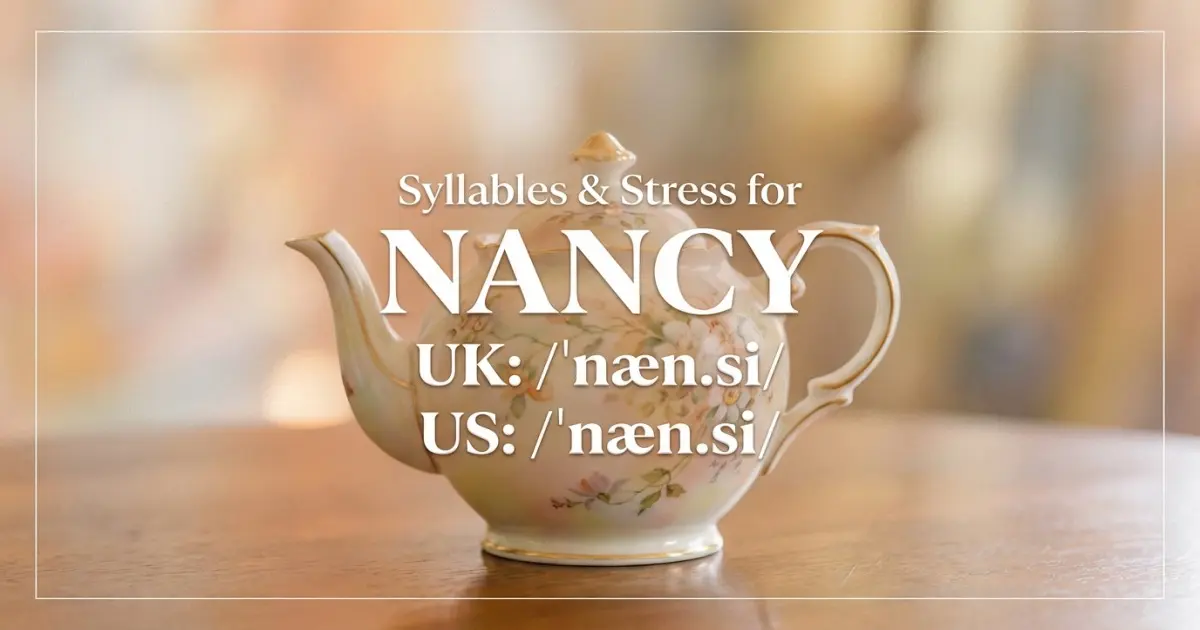
In the pronunciation used here, Nancy is NAN-see. The stress falls clearly on the first syllable. The opening vowel is the short a sound heard in words like cat or hand, and the ending stays bright and audible. That pattern is what makes Nancy sound so natural in everyday English. It begins firmly, then releases lightly. Once that shape is clear, the name becomes exactly what it has long been in ordinary speech: warm, direct, and easy to say without fuss.
What Nancy is actually clarifying every time it is said aloud
| Element | Phonetic Detail | Quick Tip |
|---|---|---|
| Everyday Pronunciation | NAN-see | Say it in two clean beats, with the first syllable carrying the weight. |
| IPA (US) | /ˈnænsi/ | The first vowel is the same short a sound heard in cat. |
| IPA (UK) | /ˈnænsi/ | The pronunciation stays essentially the same in both major English accents. |
| Syllable Count | 2 syllables | Think of the name as Nan + see, not one blurred sound. |
| Primary Stress | First syllable | Lean gently on NAN, then let the ending brighten and finish the name. |
| Final Sound | Clear -see | Do not reduce the ending too much; the final ee gives Nancy its lift. |
Nancy sounds strongest when the opening syllable stays grounded
The center of Nancy’s pronunciation is the first syllable. NAN is where the name begins and where the ear recognizes it immediately. In phonetic terms, the vowel is /æ/, the same short open sound found in words like apple, sand, and family. That sound matters because it gives Nancy its warmth. If the opening vowel changes, the whole name changes with it. Before focusing only on syllables and stress, it helps to step back into the fuller frame of Nancy meaning.
This is one reason Nancy sounds so natural in everyday English. The first syllable is built from very familiar speech material. There is no rare consonant cluster, no unusual stress pattern, and no difficult vowel. The name begins with a simple nasal consonant, opens into that recognizable short vowel, and closes the syllable neatly before moving on. That straightforward opening is part of why Nancy has remained easy to say across generations.
Why the short a matters in Nancy
The first vowel should not drift toward a long a or a softened neutral sound. Nancy is not NAYN-see, and it is not Nuhn-see. The short a keeps the name vivid and grounded. It gives the opening a friendliness that would disappear if the vowel were stretched or blurred.
Why the first syllable should feel complete
Because Nancy has only two syllables, the first one has to feel finished before the second begins. If a speaker rushes too quickly through NAN, the name can start to sound thin or mumbled. The opening should be clear enough that the listener hears the full syllable before the ending arrives. That is what gives Nancy its satisfying balance.
Nancy’s ending is where the name gets its brightness
If the first syllable gives Nancy its grounding, the second gives it light. The final -see uses the long ee vowel /i/, the same sound heard in words like see, tree, and easy. This bright ending is part of what keeps Nancy from sounding too heavy or too blunt. It adds a quick lift after the firmer opening.
That lift matters. Without it, Nancy would sound much more abrupt. The second syllable softens the name and makes it more socially open. It is also part of why the name has always sounded approachable rather than severe. The pronunciation begins grounded but ends with a smile.
Nancy is not “Nance-ee” with an over-hard middle break
Some speakers separate the name too rigidly, almost as though the first half were the full word Nance and the second were attached afterward. In natural speech, the transition is smoother. The name should feel like one easy unit, not two pieces clicked together with too much force.
Nancy is also not “Nan-suh” with a reduced ending
Another common drift is weakening the final syllable too far. In ordinary English, the second syllable should stay clearly see, not collapse into a duller suh sound. The bright ending is part of the name’s identity. If it disappears, Nancy loses some of its charm and clarity.
Nancy across accents keeps the same clean backbone
One of Nancy’s quiet advantages is that the U.S. and U.K. pronunciations given here are identical: /ˈnænsi/. That tells us something useful. The overall shape of the name is very stable across major English accents. Speakers may vary slightly in speed, emphasis, or how open they make the first vowel, but the structural pattern stays the same: first-syllable stress, short a opening, bright ee ending.
This kind of stability is one reason Nancy travels so well in English-speaking settings. Some names shift noticeably from one accent to another, which can create hesitation or inconsistency. Nancy does not have that problem. Its sounds are so basic to English speech that the name remains recognizable and natural almost everywhere it goes.
Why Nancy is easy to repeat after hearing it once
Nancy is built from highly familiar sounds. The first syllable uses a common English vowel, and the second ends with one of the most recognizable bright vowels in the language. There is nothing acoustically difficult about it. That is why most people only need to hear the name once before they can say it back correctly.
Where people stumble on Nancy, and how to fix it quickly
Most pronunciation mistakes with Nancy are small rather than dramatic. Because the name is so familiar, speakers can become careless and flatten what should be a very clear two-part rhythm. The usual problems involve changing the opening vowel or weakening the ending too much.
Nancy is not “Nen-see” or “Nain-see”
These are not common standard forms in English, but they can happen if someone lets the spelling or their own regional vowel habits pull the sound away from /æ/. The fix is simple: keep the first syllable close to the vowel in cat. If the opening sounds like nan in ordinary English, the name is already mostly correct.
Nancy should not lose its final brightness
In very fast speech, the second syllable may blur slightly, but it should still sound like see, not like a duller reduced vowel. That brightness is what keeps Nancy from sounding old-fashioned in a heavy way. It is part of the name’s grace.
Nancy in real speech: the easiest way to say it naturally
The best way to say Nancy correctly is not to make it more formal than it needs to be. Start with a clear NAN, keep the short vowel open and familiar, then finish with a light, bright -see. The name should feel easy in the mouth. It should not sound clipped, over-enunciated, or overly careful.
Practice lines that make Nancy sound natural
- “Nancy, your table is ready.”
- “Is Nancy coming after school?”
- “Nancy left her notebook in the car.”
- “Hi, I’m Nancy.”
These full-sentence examples matter because names often sound different in isolation than they do inside real speech. If Nancy feels smooth and balanced in a sentence, the pronunciation is almost certainly right.
Why Nancy remains so easy to say and so hard to distort
Nancy works phonetically because every part of the name has a clear job. The opening gives it warmth and identity. The ending gives it lift and friendliness. The stress pattern is uncomplicated, and the vowels are familiar to ordinary English speech. That is a very strong design for a name meant to survive daily life.
The simplest practical advice is still the best: say NAN-see, not too flat at the front and not too weak at the end. Once that rhythm is heard, Nancy sounds exactly as it should—clear, gracious, and wonderfully easy to live with.