
How to Pronounce Myla: How to Avoid the Most Common Pronunciation Slips

The easiest place to understand how Myla is pronounced is not in a phonetics chart but in an ordinary public moment: a teacher pausing over a class roster, a receptionist calling the next patient, or a barista reading a cup before speaking the name into a noisy room. Myla is one of those names that looks modern and intuitive, yet still carries a tiny point of hesitation because English readers have seen nearby forms like Mila, Myra, Maya, and Lyla. The eye pauses for a second. The ear usually settles quickly once it hears the name said correctly.
That correct form is simpler than many people expect: MY-luh. The first syllable carries the energy. The second syllable softens the landing. That is why Myla sounds bright without sounding sharp, and gentle without sounding vague. It is a short name, but it has shape. Spoken naturally, it feels airy, friendly, and clear — exactly the kind of pronunciation that survives everyday life because it does not ask speakers to work too hard.
How Myla is actually said when the spelling becomes speech
| Element | Phonetic Detail | Quick Tip |
|---|---|---|
| Standard pronunciation | MY-luh | Say the first syllable like “my,” then let the second fall softly into “luh.” |
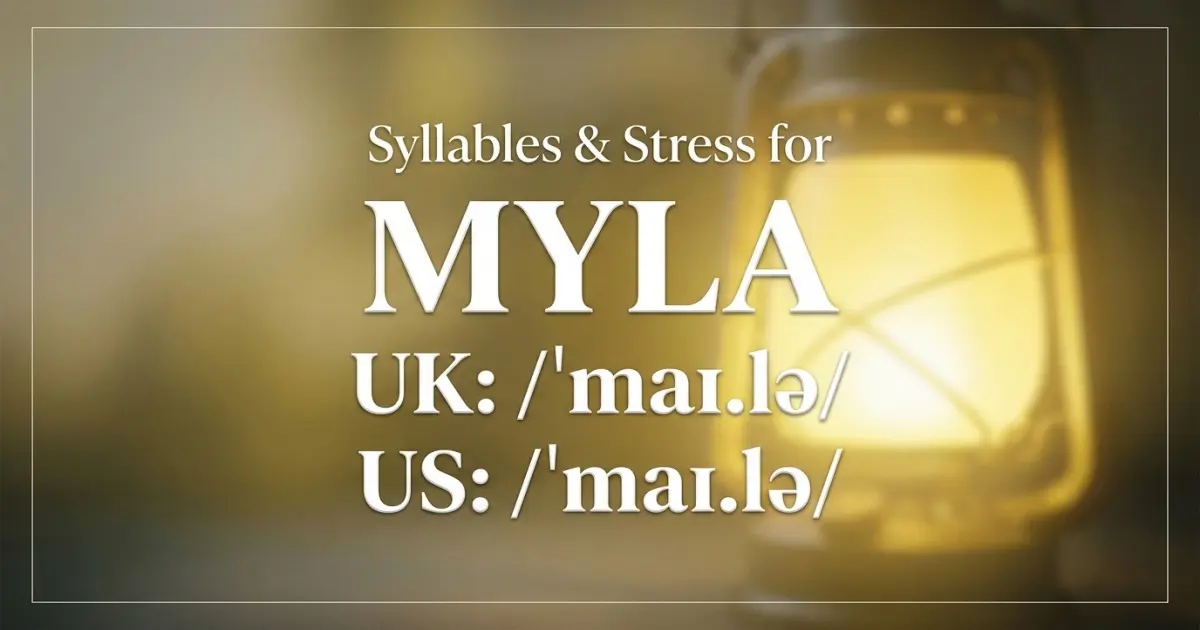
| IPA (US) | /ˈmaɪlə/ | The stress mark shows that the first syllable is the strongest part of the name. |
| IPA (UK) | /ˈmaɪlə/ | American and British English use the same core pronunciation here, which makes Myla very stable. |
| Syllable count | 2 syllables | Think of Myla in two clean beats: MY / luh. |
| Stress pattern | Primary stress on the first syllable | If the opening syllable is clearly stronger, the name will usually sound natural. |
| Opening sound | /maɪ/ diphthong | The first syllable rhymes with words like “my,” “sky,” and “high.” |
| Ending sound | Light schwa-like ending /lə/ | Finish softly with “luh,” not a heavy “lah” and not an overly bright “lee.” |
Why Myla sounds so light when it is pronounced correctly
The first syllable gives Myla its brightness
The opening of Myla does most of the name’s work. The first syllable uses the diphthong /aɪ/, which is the same moving vowel heard in words like “my,” “time,” and “light.” A diphthong is a vowel that glides from one position to another rather than staying fixed in one place. That gliding quality gives Myla motion right away. It is one reason the name sounds lively rather than flat. Pronunciation lands more fully when the name’s roots and history are already in view, so begin with Myla meaning.
Because the stress falls on this first syllable, the opening must be clear. If the first syllable is weakened, the whole name can start to feel fuzzy. Myla’s charm depends on that bright entrance. It is not a dramatic entrance, but it is a distinct one.
The second syllable keeps Myla gentle
The last syllable, luh, is quieter. It should not compete with the beginning. Its job is to soften the name, not to become a second point of emphasis. This light ending is one reason Myla feels approachable even though it begins strongly. The name does not stop abruptly. It opens, then relaxes.
That pattern matters more than it may seem. Many two-syllable names become either too clipped or too sing-song depending on how the second syllable is handled. Myla avoids both problems when the ending stays light. The result is a name that sounds polished without sounding formal.
The consonants in Myla help it feel smooth, not hard
Myla also benefits from a gentle consonant pattern. The m at the beginning is soft and voiced, and the l in the second syllable is a liquid consonant, which means it flows rather than snaps. That liquid quality helps the name feel fluid. Even though one of Myla’s meanings points toward “soldier,” the spoken shape never sounds militaristic. The sounds themselves are too warm for that. They guide the name toward human softness.
That is one reason Myla can carry a stronger meaning while still sounding tender. The pronunciation itself makes room for both sides of the name.
Where Myla is most often mispronounced
Myla is most often confused with nearby names
The most common issue with Myla is not that the name is difficult. It is that it sits close to several other familiar names. Readers may briefly confuse it with Mila, Maya, or Lyla because the letter pattern feels visually familiar. That is especially common in quick-reading situations, where the eye recognizes a general shape before the mouth has fully committed to the exact sounds.
The simplest correction is to anchor the first syllable immediately. Myla begins with the sound in “my.” Once that is fixed, the name usually becomes straightforward.
Why Myla should not be overenunciated
Another small mistake happens when speakers try too hard to be careful. Because the name looks stylish and modern, some people may over-pronounce the second syllable and give it more weight than it should have. That can make Myla sound less natural than it really is. The second syllable should stay light. The name is not supposed to feel elaborate.
In everyday speech, Myla sounds best when it is clear but effortless. It should not feel like it needs to be performed syllable by syllable.
Myla should not collapse into one sound
The opposite problem is rushing through the name so quickly that the ending nearly disappears. If the second syllable is swallowed entirely, the name can begin to sound unfinished. Myla needs both parts: the bright opening and the soft close. The balance between them is what gives the name its identity.
A useful rule is simple: let the first syllable lead, but do not let the second vanish.
How Myla holds steady across accents and neighboring names
Myla stays remarkably stable in American and British English
The supplied IPA is the same in both American and British English: /ˈmaɪlə/. That is helpful because some names shift noticeably across accents, especially in the stressed vowel. Myla does not do that here. The same bright opening and soft ending remain in place. That stability makes the name especially practical. It feels modern, but it is not fragile in use.
Small differences in voice texture may still appear. Some speakers may clip the last syllable a little faster. Others may let it breathe a touch more. But those are tiny variations in style, not major changes in pronunciation. Myla remains clearly itself.
Myla becomes clearer when heard beside Mila and Lyla
One of the best ways to hear Myla correctly is to compare it with similar names. Mila usually begins with a different first syllable entirely, so the contrast helps fix Myla’s opening sound. Lyla shares the same bright first-syllable pattern, but the initial consonant changes the feel of the name. Myla starts more softly with m, while Lyla begins with the lighter lift of l. That small difference gives Myla a slightly more inward, cushioned quality.
These comparisons help because they show that Myla is not hard to say. It simply belongs to a cluster of names that ask the ear to pay attention for one extra second.
How to practice Myla until it feels effortless
Use two beats and let the second one fall softly
The easiest way to practice Myla is to say it in two clear parts: MY / luh. Let the first syllable carry the weight. Then relax into the second. That is all the name needs. If the first beat sounds like “my” and the second sounds like the end of “sofa,” you are very close to the standard pronunciation.
Because Myla is short, speakers sometimes assume they should say it faster than they need to. But a good pronunciation does not come from speed. It comes from rhythm. The name should feel brief, not rushed.
Practice lines that sound like real life
- “This is Myla.”
- “Myla is here.”
- “Have you met Myla?”
- “Myla will join us in a minute.”
- “I’m looking for Myla Bennett.”
Practicing the name inside full sentences is useful because that is how names are actually heard and remembered. Myla tends to sound even easier once it is part of ordinary speech.
The fastest self-check for Myla
If you want one quick test, ask three questions. Does the first syllable rhyme with “my”? Is the first syllable clearly the stronger one? Does the second syllable end softly as “luh”? If the answer is yes to all three, the pronunciation is almost certainly right.