
Murray Pronunciation: Easy Breakdown and Speaking Tips

A receptionist sees Murray on an appointment list and says the name with two equally heavy syllables: MUR-RAY. The spelling makes that guess understandable, especially for someone encountering the name for the first time. The intended pronunciation is simpler and softer: MUR-ee. The opening syllable carries the weight, while the ending uses the light ee sound heard in words such as happy and city.
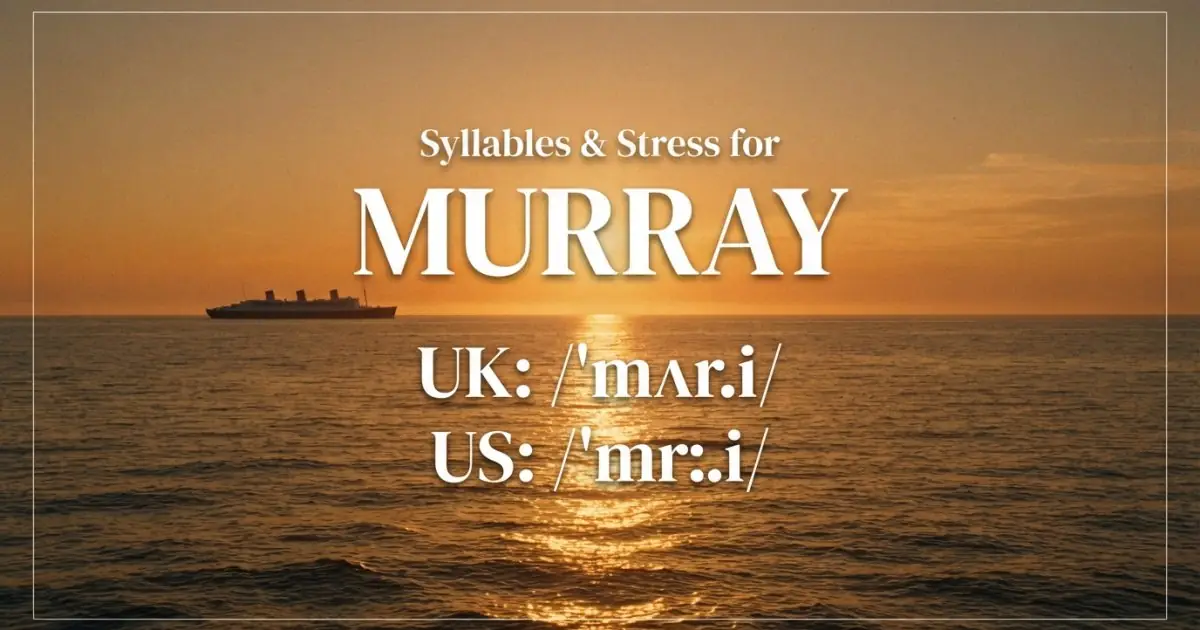
Murray has two syllables and the same supplied IPA form in American and British English: /ˈmɜːri/. The pronunciation is not built around the word ray, even though those letters appear at the end. Most mistakes come from reading the spelling too literally, shifting the stress, or changing the final vowel. Once the pattern is established, the name is compact and straightforward: MUR-ee.
How Murray Is Actually Said Beneath the Familiar Spelling
| Element | Phonetic Detail | Quick Tip |
|---|---|---|
| Everyday pronunciation | MUR-ee | Stress MUR and keep the second syllable light. |
| Syllable count | 2 syllables: MUR + ee | Do not divide the ending into ray or add a third syllable. |
| Primary stress | First syllable | The name begins at its strongest point: MUR-ee. |
| U.S. IPA | /ˈmɜːri/ | The stress mark appears before the opening syllable. |
| U.K. IPA | /ˈmɜːri/ | The supplied British form preserves the same rhythm and sound sequence. |
| Opening vowel | /ɜː/ | Use a sustained central vowel rather than the vowel in mar or more. |
| Middle consonant | /r/ | American speakers may pronounce the R more strongly than some British speakers. |
| Final vowel | /i/ | End with a light ee, not ay or eye. |
Murray Places Its Weight on the Opening Syllable
The core rhythm is: The sound matters more once you know what the name is meant to carry, which is why the wider frame starts in Murray meaning.
MUR-ee
The capital letters show the stressed syllable. Murray begins with its strongest sound and then relaxes. The final syllable remains audible, but it should not compete with the opening for emphasis.
The stressed “MUR” gives Murray its grounded sound
The name begins with /m/, a nasal consonant. Nasal consonants are made with airflow passing through the nose, which gives the opening a resonant quality rather than a sharp release.
The vowel /ɜː/ is central and sustained. It does not match perfectly with every English example because accent affects the sound, but it should feel closer to the vowel heard in words such as bird or stir than to the vowel in mar. The first syllable should be full enough to establish the name immediately.
The /r/ helps shape the end of the stressed syllable. In many American accents, that sound is clearly pronounced. In many British accents, it may be lighter or absent unless another vowel follows. The important point is that the syllable remains MUR, not MAR, MORE, or MYUR.
The final “ee” keeps Murray gentle
The second syllable uses /i/, the light ee sound heard at the end of happy, city, and family. It should be clear but unstressed.
This ending softens Murray after the heavier opening. The name does not close on a hard consonant, so the voice releases naturally:
MUR-ee
The ending should not become ray, despite the final letters in the spelling. It should also not turn into rye or a vague uh.
The two syllables should connect without a pause
Murray is not pronounced as two separate words. The syllable guide helps establish the structure, but ordinary speech should remain smooth:
MUR-ee, not MUR…ee.
The name is compact enough that an exaggerated pause can make it sound unnatural.
Why Murray Is Misread Even Though Its Sounds Are Simple
Murray contains no unusual consonant cluster, but its spelling allows several plausible guesses. The letters -ray are the main source of confusion, while accent can affect the treatment of the central r.
MUR-ray gives the ending too much weight
This version treats the final three letters like the independent name Ray. The intended ending is ee, not ray.
Compare:
MUR-ray — incorrect ending
MUR-ee — intended pronunciation
A brief correction is: “The ending sounds like ee, not ray.”
mur-EE shifts the stress too late
This version keeps the correct two syllables but emphasizes the second one. Murray begins with the stronger beat:
MUR-ee
A useful correction is: “The stress is on the first syllable.”
MAR-ee changes the opening vowel
Some readers may interpret Murray as though it began like mar. The intended first vowel is more central. The name should not sound like MAR-ee.
The clearest practical guide remains MUR-ee.
MYUR-ee inserts a Y sound
Another possible guess adds a y glide after the initial consonant. The supplied pronunciation contains no /j/ sound. Begin directly with mur, not myur.
MUR-rye changes the final vowel completely
The second syllable does not rhyme with sky or my. It uses the light ee ending heard in happy.
Murray Changes More by Accent Than by Structure
The supplied American and British IPA forms are identical: /ˈmɜːri/. Both preserve two syllables, first-syllable stress, and the final /i/ vowel. The most noticeable regional difference is likely to involve the central r.
American English usually makes the R more audible
Most American accents are rhotic, meaning speakers pronounce the /r/ in the stressed syllable clearly. The opening may therefore sound strongly defined:
MUR-ee
The final syllable remains light and should not be lengthened.
British English may soften or omit the R
Many British accents are non-rhotic, which means the written r may not be strongly pronounced unless another vowel follows. This can make the first syllable sound smoother or less tightly closed.
That difference does not change the name into a separate pronunciation. The same two-syllable pattern remains in place, with stress on the opening and ee at the end.
Sound Anchors Make Murray Easy to Remember
Murray can be learned through a few familiar cues:
- MUR carries the same general central vowel quality heard in words such as stir or bird, depending on accent.
- The opening receives the primary stress.
- ee sounds like the ending in happy or city.
- The written ending -ray is not pronounced like the name Ray.
The simplest memory line is:
MUR + ee = MUR-ee
The two parts should flow together naturally. The formula is only a learning aid.
Practice Murray in Introductions and Everyday Speech
Build the name in three steps
- Say MUR with the main stress.
- Add a light ee.
- Join them smoothly: MUR-ee.
Use Murray in natural sentences
- “This is Murray.”
- “Murray will be joining the class today.”
- “Have you met Murray?”
- “Please give the folder to Murray.”
- “Murray is waiting near the entrance.”
- “We saved a seat for Murray.”
Keep pronunciation corrections brief
- “It’s pronounced MUR-ee.”
- “The stress is on MUR.”
- “The ending sounds like ee, not ray.”
- “It has two syllables: MUR-ee.”
- “You were close—the last part is lighter.”
Murray may cause occasional hesitation because the spelling suggests more than one familiar English pattern. Once the final ee and first-syllable stress are established, the name is easy to repeat and difficult to forget.
Common Questions About Pronouncing Murray
How do you pronounce Murray?
Murray is pronounced MUR-ee. It has two syllables, with the primary stress on the first.
Does Murray end with “ray”?
No. The final syllable is pronounced ee, not ray. The name is MUR-ee.
How many syllables are in Murray?
Murray has two syllables: MUR + ee.
Which syllable is stressed in Murray?
The first syllable carries the primary stress: MUR-ee.
Do American and British speakers pronounce Murray differently?
The supplied U.S. and U.K. IPA forms are identical: /ˈmɜːri/. American speakers may pronounce the central r more clearly, while some British speakers may soften it, but the syllable count and stress remain unchanged.