
How to Pronounce Muhammad: How to Say It Clearly and Naturally
The real pronunciation test for a name rarely happens in a dictionary. It happens when a teacher pauses over a new class list, when a pediatric nurse calls a child in from a waiting room, when an airport official checks a passport, or when a coach reads a roster aloud in front of twenty other boys. Muhammad is a name that often lives in exactly those public moments: familiar enough to be widely recognized, but still vulnerable to flattening, hesitation, or overcorrection when speakers are unsure which syllable to trust. That is why getting the pronunciation right matters. It is not only about technical accuracy. It is about respect, ease, and whether the child hears his name spoken as something known rather than guessed at.
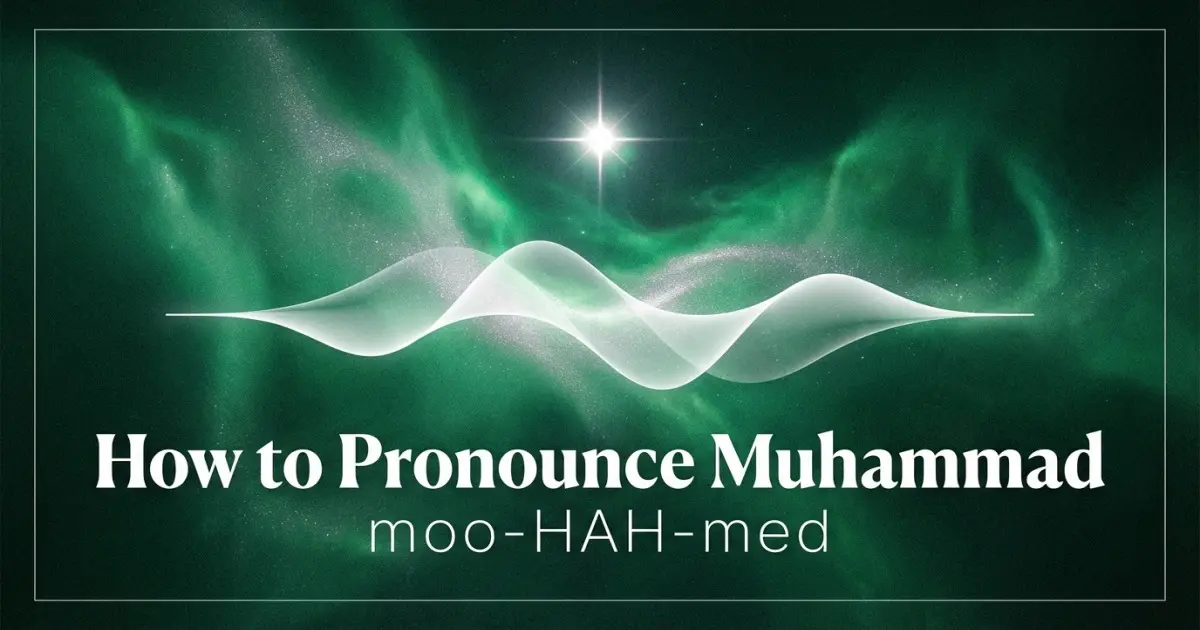
Official data shows Muhammad is now visible enough in American life that more people encounter it regularly, yet the name still carries clear religious and cultural weight. That combination makes pronunciation especially important. A name like Muhammad is not just a sequence of sounds. It is often spoken in family, devotional, and public settings with slightly different emotional stakes. The good news is that its standard English form is very teachable. Once you hear the rhythm, it settles quickly: mo-HAM-uhd. The stress lives in the middle, the opening stays light, and the ending should not be overforced.
What Muhammad is actually clarifying when people say it aloud
Muhammad looks longer and heavier on the page than it feels in the mouth. Its spoken form is structured, but not difficult, once the stress pattern becomes clear.
| Element | Phonetic Detail | Quick Tip |
|---|---|---|
| Standard spoken form | mo-HAM-uhd | Think of the middle syllable as the anchor. That is where the name’s weight sits. |
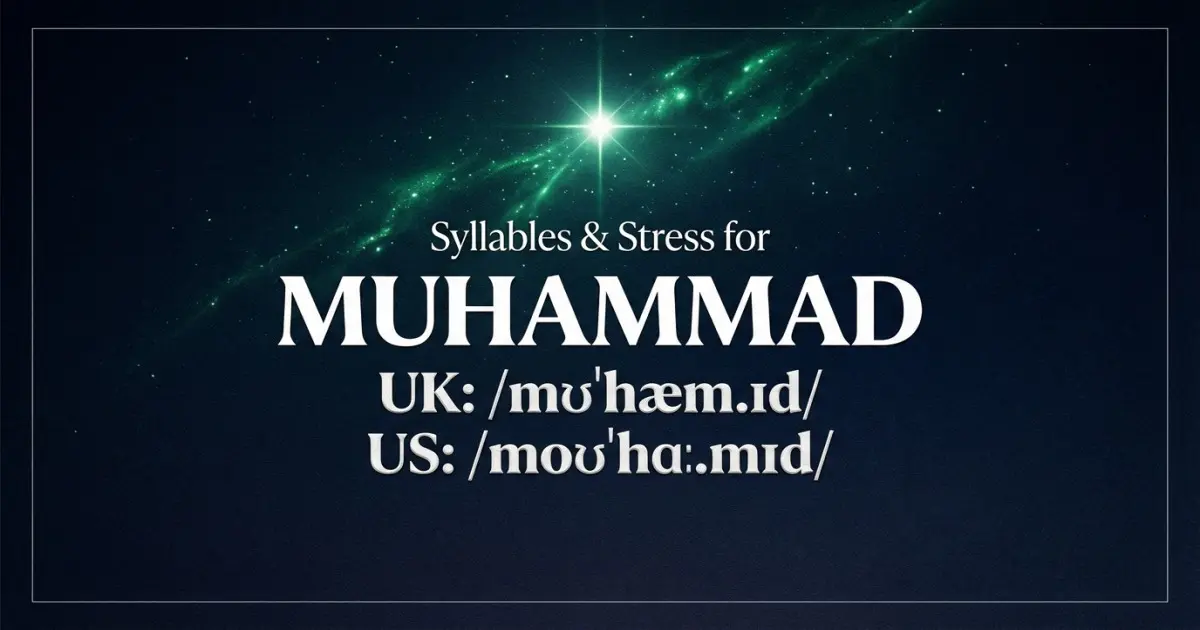
| US IPA | /muːˈhæməd/ | The opening is light and rounded, while the stressed middle sounds like “ham.” |
| UK IPA | /muːˈhæməd/ | In broad English use, British and American forms usually stay very close here. |
| Syllable count | 3 syllables | Keep all three beats audible, but let the second one lead. |
| Stress pattern | Middle syllable stressed | Do not flatten the name into equal beats. HAM must carry the stress. |
| Ending texture | Soft final syllable | The name should close gently, not with an exaggerated hard stop. |
How Muhammad moves through the mouth without becoming heavy
Muhammad works because the three syllables do different jobs. The first syllable opens lightly, the second bears the force, and the third releases the name so it does not sound stiff. That balance is one reason the name can carry so much cultural and religious significance without becoming impossible in everyday speech. Before focusing only on syllables and stress, it helps to step back into the fuller frame of Muhammad meaning.
Why the middle of Muhammad carries the name’s identity
The center of the name, HAM, is where listeners usually recognize the rhythm correctly. In phonetic terms, the stress falls on the second syllable, which gives the name its internal firmness. If a speaker gets that one point right, the rest of the pronunciation usually falls into place. This is why Muhammad should never be said as though the first syllable were the strongest. The opening sets the name up, but the center defines it.
The h here also matters. It should be audible enough to keep the name from collapsing into a mushier English blur, but it does not need to be dramatically pushed. In ordinary English pronunciation, the goal is clarity, not theatricality.
Why the opening of Muhammad should stay light
The first syllable is often where speakers get nervous. Some over-shorten it into a rushed mutter; others over-round it into a full “moo” that makes the name sound overly segmented. In practice, English speakers often land somewhere between a light moo and a softer muh/mo depending on accent and pace. That is why the common guide spelling mo-HAM-uhd works well for everyday use. It cues the rhythm clearly without forcing an artificial sound. When the stress sits in the center, the nickname logic often follows that same center of gravity, which is why nicknames for Muhammad is the natural next step.
The main rule is that the first syllable should not compete with the middle. It is a lead-in, not a drumbeat.
Why the ending of Muhammad should not be over-pronounced
The last syllable is softer and less important than people often think. When speakers are trying very hard to be respectful, they sometimes over-articulate the final part and accidentally make the name sound stiff or broken into too many parts. In broad English usage, the ending is lighter. It should be present, but not hammered. Muhammad sounds most natural when the final syllable releases the name gently after the stressed center.
Muhammad stays fairly stable across English accents, but spelling can change expectations
One useful feature of Muhammad is that its standard English IPA form is broadly the same in American and British English: /muːˈhæməd/. That does not mean every household says it in exactly the same way, but it does mean the core pronunciation remains surprisingly stable across major English accents.
Muhammad in American English
In American speech, Muhammad is usually heard with a rounded opening vowel, a clearly stressed HAM, and a softened final syllable. The first sound may move slightly depending on the speaker—some families favor something closer to moo-HAM-uhd, while others keep it nearer to muh-HAM-uhd—but the overall contour remains constant. The middle stress is what keeps the name recognizable and respectful.
Muhammad in British English
In British English, the rhythm is usually very similar. The first vowel may be a touch less broad or less rounded depending on region, but the three-part shape remains intact. This is good news for parents in multilingual or international environments. Muhammad is not one of those names that splinters into radically different spoken identities across English-speaking countries.
Why spelling variants can make pronunciation look less stable than it really is
Muhammad has many accepted spelling variants in public life: Mohammed, Mohammad, Mohamed, and others. These spellings can make outsiders think the pronunciation changes more dramatically than it usually does. In reality, most of the variation stays within a narrow range. The central stress and overall three-syllable pattern remain the most important constants. That is the part worth teaching clearly.
Where people most often get Muhammad wrong
The most common errors are not wild misreadings. They are usually rhythm errors or overcorrections caused by uncertainty.
When speakers put the stress in the wrong place
This is the most important mistake to avoid. If the stress shifts away from the middle, the name loses its natural form. A flat MU-ham-mad or an over-punched ending can make the name sound guessed at rather than known. The fix is simple: keep the weight on HAM.
When Muhammad is chopped into separate English-looking pieces
Some speakers try too hard to honor the spelling and end up pronouncing the name as if every letter needed equal attention. That usually produces a stiff, unnatural result. Muhammad should move. It has three syllables, but it is not meant to sound mechanical.
When the opening becomes too casual or too exaggerated
The first syllable can drift in two directions: too weak or too heavy. Too weak, and the name sounds swallowed. Too heavy, and the name starts to sound over-foreignized in an English-speaking context where the family may simply want a respectful, natural pronunciation. The best approach is a light opening that leads cleanly into the stressed center.
How to practice Muhammad until it sounds natural in real life
The easiest way to learn Muhammad is to say it in complete lines of speech, not just as an isolated vocabulary item. That helps the rhythm settle into ordinary language, which is where the name actually lives.
Practice lines that keep Muhammad sounding human
Try these aloud:
- “This is Muhammad.”
- “Muhammad is here.”
- “Can you help Muhammad with his bag?”
- “We named him Muhammad.”
If the name feels too formal when you say it, lighten the first syllable and keep the final one soft. If it feels too rushed, slow down just enough to let all three syllables appear. The goal is not a stiff recital. The goal is a respectful, natural mo-HAM-uhd that could be spoken warmly and confidently in daily life.
That is the real strength of Muhammad as a spoken name. It carries deep meaning and public dignity, but once the rhythm is understood, it is fully usable in ordinary English. It does not need to be feared, flattened, or performed. It simply needs to be known.