
How to Pronounce Mira: An Easy Guide to Saying It Naturally

The real-life pronunciation test for a name rarely happens in a quiet study. It happens at a pediatric check-in desk, in a kindergarten classroom, on the first day of camp, or in the half-second before someone reads a name from a printed list and commits to saying it out loud. Mira does well in those moments. It looks simple, but not flimsy. It sounds gentle, but not vague. And because the pronunciation is stable in everyday English, most people can say it confidently after seeing it once.
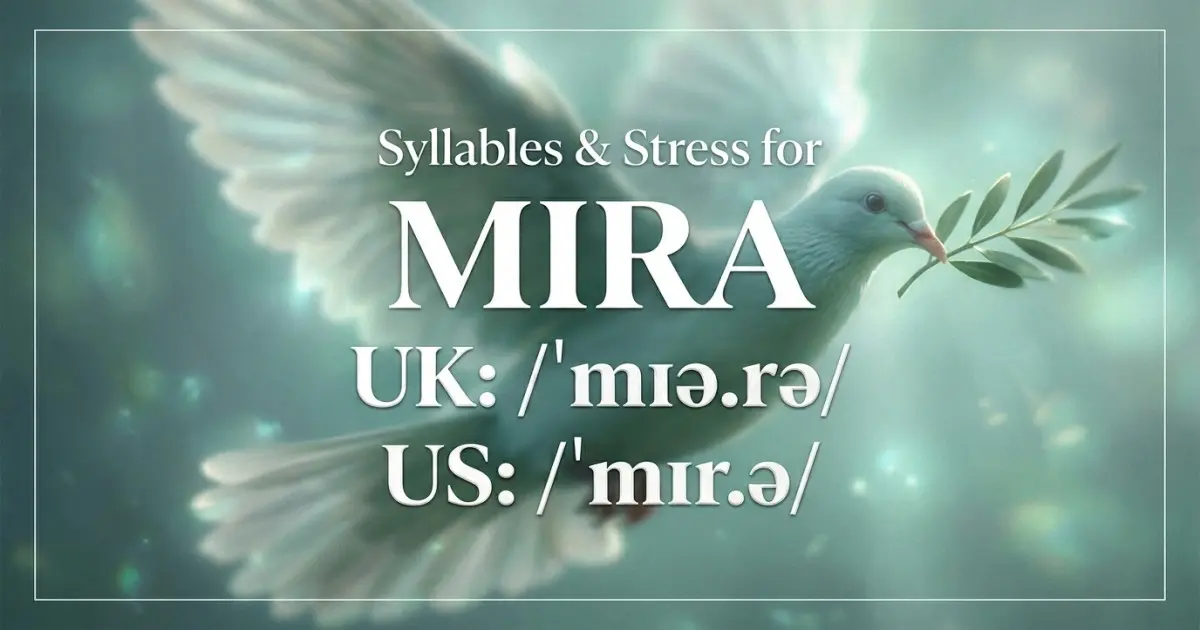
That matters more than parents sometimes expect. A name may look beautiful on paper yet become tiring if it is constantly bent, overexplained, or misread in ordinary life. Mira has the opposite advantage. Official usage data shows the name is established in modern American use, and part of that staying power comes from how naturally it moves through speech. Mira is said as MEER-uh: two syllables, stress on the first, with a bright opening and a soft landing. It is a name that feels clear in the mouth. That clarity is part of its elegance.
How Mira is actually said when it leaves the page
| Element | Phonetic Detail | Quick Tip |
|---|---|---|
| Everyday pronunciation | MEER-uh | Say the first syllable clearly, then let the second one fall away softly. |
| U.S. IPA | /ˈmɪərə/ | The opening sounds like “meer,” not “my” and not “may.” |
| U.K. IPA | /ˈmɪərə/ | In this case, standard U.S. and U.K. guidance align closely, which makes the name unusually portable. |
| Syllable count | 2 syllables | Think of it as MEER | uh, not as a stretched three-part name. |
| Stress pattern | Primary stress on the first syllable | If the stress moves to the second syllable, the name stops sounding natural in English. |
| Key consonant feature | Soft liquid consonant r in the middle | The r keeps the name flowing rather than flat. |
| Most common confusion | Mixing it up with MY-ra or mee-RAH | Keep the emphasis at the front and the ending light. |
Mira works because the first syllable carries the whole line
Mira is a short name, but it is not rhythmically loose. Its structure depends on a very clear first beat. The stress belongs on MEER, and once that opening syllable is in place, the rest of the name falls into order almost automatically. English speakers are highly sensitive to stress, which is why names with familiar letters can still sound wrong if the emphasis lands in the wrong place. Mira avoids that problem when spoken with a strong first syllable and a lighter second one. The sound matters more once you know what the name is meant to carry, which is why the wider frame starts in Mira meaning.
Why the opening needs to stay bright
The first syllable is what gives Mira its identity. It begins with the soft nasal m, which makes the opening feel calm rather than sharp. Then comes the vowel-and-glide quality of “meer,” which gives the name brightness without harshness. Because the opening is so clean, the name feels instantly readable to English speakers. There is nothing ornamental about it, but it is not flat either.
This is one reason Mira tends to sound more polished than many other short names. It does not start with a hard stop. It begins with a hum, then opens. The effect is gentle but self-possessed.
What the middle r contributes
The r in Mira is important. Linguistically, r is often described as a liquid consonant, a term used for sounds that help speech flow rather than break sharply. In Mira, that liquid quality keeps the name from sounding abrupt. Without the r, the transition from the first syllable to the second would feel much plainer. With it, the name gains movement. That is part of why Mira feels graceful in speech even though it is so short.
The final schwa-like ending, the quiet -uh, should not be overworked. It is there to complete the name, not to compete with the first syllable. Mira sounds best when the second half is gentle and brief.
Mira across accents stays remarkably steady
One of the most reassuring things about Mira is that standard U.S. and U.K. guidance closely align. The IPA is the same in both cases: /ˈmɪərə/. That does not mean every speaker on earth will say the name identically, but it does mean the core pronunciation remains remarkably stable across major English-language contexts. For parents who care about portability, that is a real advantage.
Why the shared IPA matters
Some names shift noticeably between American and British speech. Vowels broaden, stresses migrate, or entire syllables change color. Mira is less volatile. Even when accents differ, the name usually keeps its same overall shape: stress first, soft ending, clear two-syllable flow. That means the name can travel between classrooms, countries, and generations with relatively little distortion.
Natural accent variation is still normal
Of course, real people do not speak in pure dictionary notation. In some mouths, the first syllable may sound a touch tighter or slightly more open. In fast speech, the ending may reduce more in one region than another. But these are surface variations, not identity changes. Mira does not usually become a different name under accent pressure. It remains recognizable and coherent, which is one of its practical strengths.
This stability also makes the name easier to teach. Parents who choose Mira are unlikely to spend years correcting the basic pronunciation. Most people will either get it right immediately or need only a single gentle clarification.
Where people most often stumble on Mira
Mira is not a hard name, but short names can invite overconfidence. People sometimes see familiar letters and make an instant guess based on another name they already know. In Mira’s case, that usually produces one of two errors: shifting the vowel toward “my,” or shifting the emphasis too far toward the second syllable.
The “MY-ra” mistake
This is probably the most common confusion because English speakers also know names like Myra. Visually, the two names sit close together, and a hurried reader may substitute one pattern for the other. But Mira is not MY-ra. The opening should sound like “meer,” not “my.” Once that vowel is corrected, the whole name immediately feels more natural.
The overly dramatic ending
Another occasional mistake is to over-pronounce the second syllable as though the name were meant to sound more exotic or theatrical than it is. That can lead to something closer to mee-RAH. For some families in multilingual settings, that may reflect a real and valid pronunciation tradition. But in the pronunciation pattern described here, the ending is lighter: just a quick, soft -uh. Mira’s elegance comes from restraint, not flourish.
Sound neighbors worth noticing
Mira sits near several names that can affect how people guess it: Myra, Miri, Moira, and Meera. That does not make the name confusing; it simply means listeners may map it onto the nearest familiar pattern they already carry. The best correction is usually the shortest one: “Mira, like MEER-uh.” Because the name is so compact, people generally adjust quickly. Because the strongest energy lands early, the shorter forms often grow from the opening of the name, and that pattern is easier to see in nicknames for Mira.
Mira sounds best in whole phrases, not isolated rehearsal
Parents often test pronunciation by repeating a name alone, but names live inside sentences. That is where rhythm shows itself. Mira tends to sound strongest when practiced in ordinary lines that resemble actual life.
Try Mira in speaking situations that matter
Say these aloud:
“Mira, your turn.”
“This is Mira Bennett.”
“We’re so happy to meet Mira.”
“Mira Elise Carter.”
If the name feels smooth in all four settings, you are hearing what really matters: not whether Mira can be pronounced in theory, but whether it behaves well in living speech. And it usually does. The opening is clear, the liquid consonant keeps the sound moving, the ending relaxes naturally, and the stress pattern does not fight English instinct.