
Mia Pronunciation: How the Name Is Usually Said
The most revealing moment for a name’s pronunciation often happens in a completely ordinary place: a receptionist glancing at a screen, a teacher pausing at the attendance list, a barista calling across a crowded counter. Mia usually passes that test with remarkable ease. People see it, say it, and move on without anxiety. That is one of the name’s great practical strengths. It does not ask for a performance. It asks for a clean, open sound and a gentle landing. In real life, that matters more than many parents expect.
But a name can be easy and still deserve precision. Mia works because its two syllables are balanced so well. The first syllable carries the weight and the identity of the name. The second syllable opens it rather than cuts it off. In everyday English, the usual form is MEE-uh. When that pattern is right, Mia sounds bright, affectionate, and complete. When speakers rush it, swallow the second syllable, or overemphasize the end, the name can suddenly feel flatter than it should. The good news is that Mia is one of the most stable modern names in spoken English. Once you hear its rhythm clearly, it becomes almost impossible to misplace.
How Mia is actually said when everyday speech takes over
| Element | Phonetic Detail | Quick Tip |
|---|---|---|
| Everyday pronunciation | MEE-uh | Keep the first syllable clear and long, then let the second syllable open softly. |
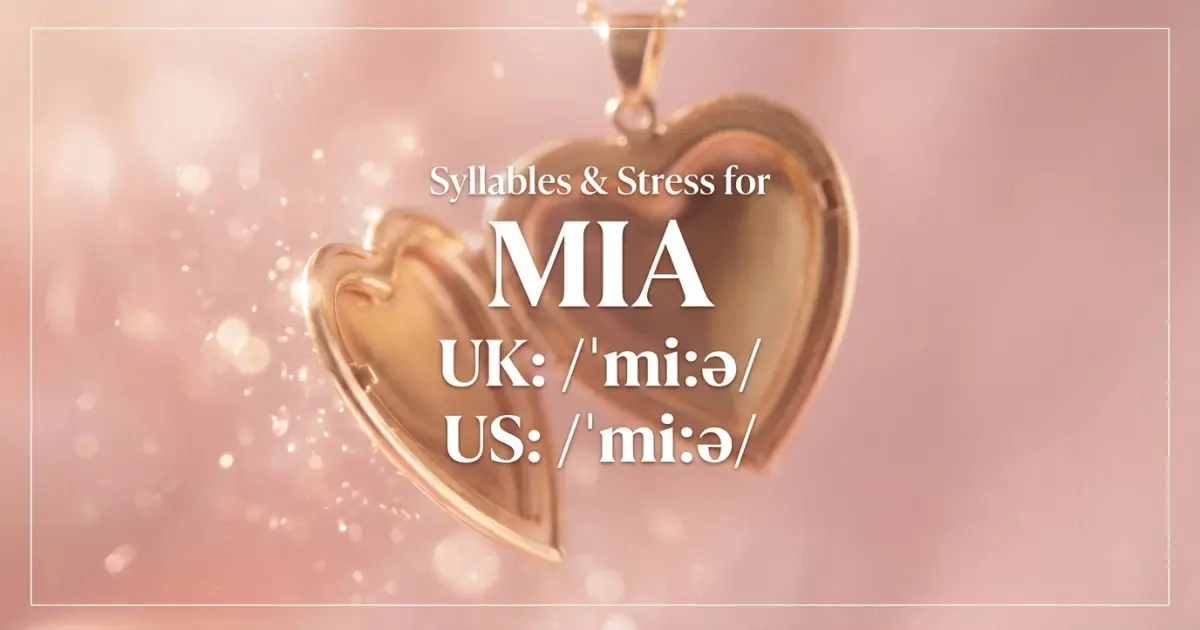
| US IPA | /ˈmiːə/ | The stress sits fully on the first syllable, with a smooth glide into the second. |
| UK IPA | /ˈmiːə/ | American and British English use essentially the same spoken pattern for Mia. |
| Syllable count | 2 syllables | Think of Mia as one strong beat followed by one lighter release. |
| Stress pattern | Primary stress on the first syllable | If the second syllable gets equal weight, the name loses its natural ease. |
| Sound flow | Open vowel sequence | Do not clip Mia into one syllable; let the vowels breathe into each other. |
Why Mia sounds so small and still so complete
Mia is a short name, but it does not sound unfinished. That is because its sound structure is doing subtle work. The name opens with the consonant m, a soft bilabial sound made with both lips. In everyday terms, that simply means the name begins gently rather than sharply. Then it moves into the long ee vowel, which gives Mia brightness and clarity. After that, the second syllable opens outward into uh, creating a soft release instead of an abrupt stop. The whole pattern feels warm and continuous. Before focusing only on syllables and stress, it helps to step back into the fuller frame of Mia meaning.
Why the first syllable of Mia carries the name
The first syllable does most of the identifying work. It holds the stress, it holds the long vowel, and it is what the ear catches first across a room. If someone says “Mia,” the Mee- arrives before anything else, and that is why the name feels immediately recognizable even in noisy settings. A good pronunciation begins by letting that first syllable stay confident and clean.
This is also why the name does not need embellishment. Some two-syllable names rely on elaborate consonants or a dramatic ending to feel memorable. Mia does not. Its first syllable already carries enough presence to anchor the whole name.
Why the ending of Mia should stay open
The second syllable matters because it prevents the name from sounding clipped. If the first syllable supplies the identity, the second supplies the warmth. Without it, Mia can collapse into something too abrupt, almost like a single beat rather than a full name. That second syllable should feel light, but it should still be heard. The way the name resolves at the end often decides which short forms feel natural in speech, and that becomes clearer in Mia nicknames.
This is one of the reasons Mia sounds more emotionally open than some other short girls’ names. It does not stop at the first sound. It opens outward and lets the voice soften at the end.
Why Mia is easy to say but still elegant
Research and naming usage suggest that names often become widely loved when they balance ease and shape. Mia does exactly that. It is easy because the sound pattern is familiar and the vowels are open. It is elegant because the transition between syllables is smooth rather than choppy. In practical life, that means Mia sounds just as natural in a nursery as it does in a professional setting later on.
Mia in American and British speech
Mia is one of the easiest names to carry across major English accents because the American and British IPA are the same: /ˈmiːə/. That is a strong advantage. Some names shift noticeably in one country or another, but Mia keeps its spoken identity almost intact. The spelling points clearly toward the sound, and the sound itself requires very little local adjustment.
What stays the same in US and UK Mia
The stress pattern is the same, the long first vowel remains the same, and the overall rhythm stays the same. This means Mia sounds recognizably like itself whether it is spoken in England, the United States, or other English-speaking places. That consistency is one reason the name has become so internationally comfortable.
Why Mia travels well outside one accent system
Names with open vowels and very simple stress patterns often move easily across languages and regions. Mia benefits from that. It does not depend on a tricky consonant, a heavily regional vowel, or an unusual stress pattern to sound right. Its structure is light, but highly stable. That is why it tends to feel cosmopolitan without sounding imported or difficult.
In daily use, this means fewer corrections, fewer uncertain pauses, and a smoother social life for the name. For many parents, that is not a minor benefit. It is part of the beauty of the choice.
Where Mia gets misheard and how to keep it clear
Because Mia is so familiar, most pronunciation mistakes are small. But small mistakes matter more with short names because there is less room to recover.
Turning Mia into one syllable
The most common issue is rushing the name so much that the second syllable nearly disappears. That can make Mia sound clipped or under-finished. The solution is simple: let the first syllable stay long, and keep a small but audible second syllable at the end. Not exaggerated, just present.
Giving both syllables equal weight
Another mistake is stressing the name too evenly, almost as if both syllables should carry the same force. That makes Mia sound mechanical. The first syllable should clearly lead, and the second should follow more lightly. Once that contrast returns, the name sounds natural again.
Over-separating the vowels
Sometimes speakers can divide the two syllables too sharply, giving Mia an artificial pause in the middle. The better effect is a glide. The name should move from Mee into uh smoothly, not as though it were two unrelated pieces. That smoothness is part of what makes Mia sound polished.
Names near Mia help explain why Mia sounds so balanced
Looking at neighboring sounds can help make the name’s pronunciation even clearer. Mila also begins with the same long Mee sound, but its ending is more defined and firmer. Maya is broader and more open in the second syllable, with a more expansive feel. Miri shifts the rhythm slightly and changes the emotional texture. Mia sits right between these styles: shorter than Maya, more open than a clipped name, and cleaner than many other two-syllable vowel-driven names.
This matters because a name’s sound is not only about correctness. It is also about impression. Mia sounds affectionate because the consonant is soft and the vowels open outward. It sounds modern because it is clean and minimal. And it sounds complete because the two syllables balance each other so naturally.
How to practice Mia until it feels effortless
Use Mia in normal spoken lines
“Mia, it’s your turn.”
“Have you met Mia yet?”
“Mia will be joining us today.”
“Can Mia come to the front, please?”
Lock the stress onto the first beat
If the rhythm feels uncertain, say it once slowly: MEE-uh. Then return to normal speaking speed. The goal is not to over-pronounce the name forever, only to hear where it naturally anchors.
Keep the second syllable light but audible
A good final check is to make sure the ending is present without becoming heavy. If it disappears, the name sounds clipped. If it becomes too strong, the name sounds overworked. Mia is most convincing in the middle ground: open, easy, and quietly finished.
Mia Pronunciation FAQ
How do most English speakers pronounce Mia?
Most English speakers say it as MEE-uh, with two syllables and clear stress on the first syllable.
Is Mia pronounced differently in the US and the UK?
Not in any major way. Both American and British English usually pronounce Mia the same way, with the first syllable stressed and the second syllable softened.
How many syllables does Mia have?
Mia has two syllables. The first carries the stress, and the second opens the name gently rather than closing it abruptly.
What is the most common pronunciation mistake with Mia?
The most common mistake is rushing it into one syllable or almost swallowing the final sound. Mia sounds best when the second syllable remains light but clearly audible.
Does Mia usually need correction in daily life?
Usually not. Mia is one of the most phonetically stable and easy-to-read modern names in English, so most people say it correctly on first reading.