
How to Pronounce Marlowe: Syllable Guide and Easy Stress Tips
Marlowe is the kind of name that often looks more complicated on a screen than it sounds in a room. A teacher reaches it on a class list, a receptionist sees it on an intake form, a barista reads it from a cup, and there is a brief pause while the eye wonders whether the final -owe should behave like a full extra syllable, whether the ending should sound older, or whether the whole name should feel more formal than it actually does. Then someone says it aloud – MAR-loh – and the name resolves almost instantly. It turns out to be clean, grounded, and much more direct than the spelling first suggests.
That matters because Marlowe carries a certain atmosphere before anyone explains it. The name feels literary, cool, and quietly unisex, so the pronunciation has to keep all of that from becoming too misty. It does. Spoken naturally, Marlowe has two very clear beats: a broad, steady opening and a softer release. The result is a name that feels polished without sounding precious. It has calm in it, but not passivity. It has style in it, but not strain. In the mouth, Marlowe is simpler and stronger than the eye first expects.
What Marlowe is actually telling the ear once it is spoken
| Element | Phonetic Detail | Quick Tip |
|---|---|---|
| Everyday pronunciation | MAR-loh | Say it in two syllables, with the strongest stress on the first one. |
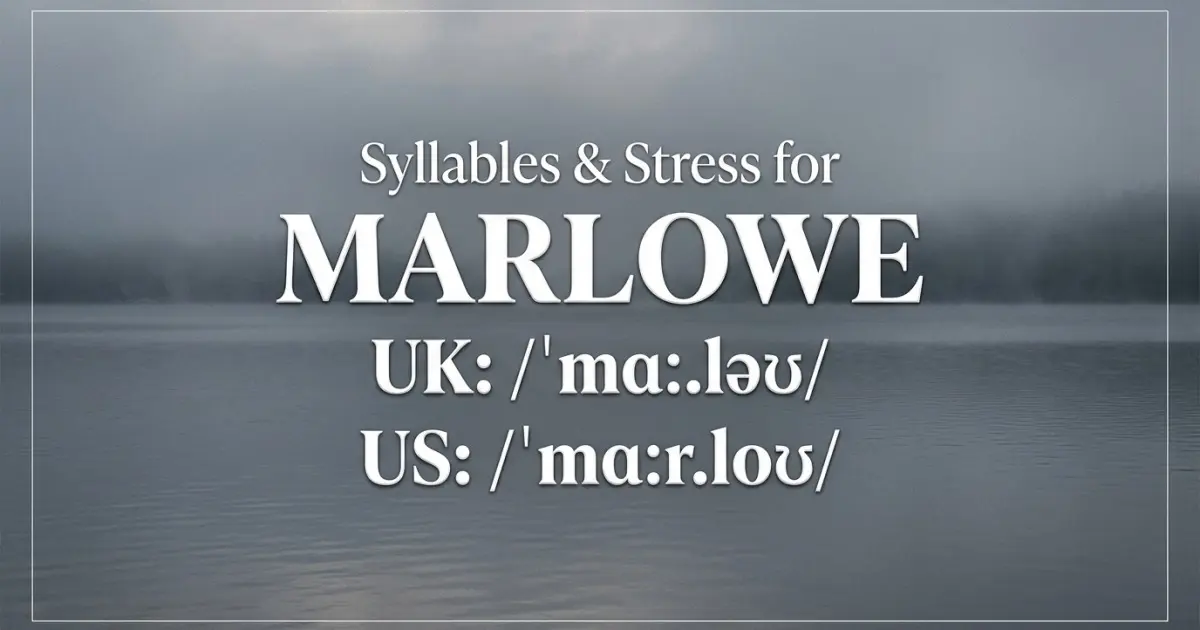
| IPA (US) | /ˈmɑːrloʊ/ | In American English, the first syllable is broad and the r is clearly heard. |
| IPA (UK) | /ˈmɑːləʊ/ | In many British pronunciations, the rhythm stays the same even though the r may soften or disappear. |
| Syllables | 2 | Think MAR + loh, not three syllables and not a stressed ending. |
| Stress pattern | Primary stress on the first syllable | If the opening lands firmly, the whole name usually sounds right immediately. |
| Opening consonant | Nasal m followed by a broad vowel | Start gently but clearly; the name should feel grounded from the first beat. |
| Ending | Soft final -loh | The second syllable should release the name, not compete with the first. |
Why Marlowe depends on a strong opening more than the spelling suggests
The most important fact about Marlowe is that the name lives in the first syllable. On the page, the ending can distract people because English spelling has trained readers to expect several possibilities from a word ending in -owe. But in speech, the opening does most of the real work. MAR carries the weight, the identity, and the emotional center of the name. The second syllable finishes the thought, but it does not lead it. Before focusing only on syllables and stress, it helps to step back into the fuller frame of Marlowe meaning.
Why the first beat of Marlowe gives it its calm authority
The opening begins with m, a nasal consonant. In ordinary listening terms, that means the name does not strike hard at the front the way a sharp stop consonant might. It enters more smoothly. But immediately after that smooth start comes the broad stressed vowel, and that vowel is what gives Marlowe its stance. The name sounds settled from the beginning. It does not wobble into itself.
This is one reason Marlowe feels so composed. The first syllable has both softness and weight. It is not aggressive, but it is not flimsy either. That balance is a big part of the name’s appeal, especially for a name often chosen because it feels cool and intelligent rather than overtly dramatic.
Why the second syllable should stay lighter
The final -loh is important, but it should not pull the center of gravity away from the front. If speakers make the ending too heavy, Marlowe can start to sound more theatrical than natural. The second syllable does its best work when it opens the name outward a little and then lets it settle. It is a release, not a climax.
That lighter ending is also what keeps Marlowe wearable. Without it, the name might feel too blunt. With it, the name has contour and grace without losing its cool, unforced quality.
Marlowe stays stable across American and British pronunciation
The fact packet shows a small but useful difference between American and British IPA. In American English, /ˈmɑːrloʊ/, the r in the first syllable is heard clearly. In many British pronunciations, /ˈmɑːləʊ/, the rhythm remains the same but the r is not strongly pronounced. This is a normal difference between rhotic and non-rhotic accents, and it does not change the identity of the name.
What changes between accents, and what does not
The main shift is texture. American Marlowe feels a little more anchored in the middle of the first syllable because the r is audible. British Marlowe often sounds a little smoother and more streamlined. But the architecture stays intact: two syllables, stress first, softer second beat. That consistency is what matters most.
Names that keep their rhythm across accents are easier to carry in public life. People may say them in slightly different colors, but they are still saying the same name. Marlowe has that advantage. It looks stylish, but it behaves predictably once spoken.
Why the ending remains recognizable in both forms
Whether the first syllable is rhotic or not, the second syllable stays recognizably loh. That makes the name easier to hold in memory. The ending is not ambiguous once heard. This is one reason Marlowe settles quickly in conversation. The spelling may invite a moment of uncertainty, but the sound does not stay uncertain for long.
Where Marlowe most often gets misread, overhandled, or flattened
Most pronunciation problems with Marlowe come from people trying to solve the spelling rather than trusting the spoken pattern. The good news is that the mistakes are usually small and easy to fix once the rhythm becomes clear.
The extra-syllable mistake
One common issue is stretching the name as though the ending should create more than one syllable. That happens because the spelling looks more elaborate than the sound really is. But Marlowe is compact. It is not a three-beat name. If the name starts to sprawl, it loses some of the cool precision that makes it attractive.
The over-light opening mistake
Another mistake is underplaying the first syllable so much that the name loses its backbone. Because Marlowe has a soft style, some speakers instinctively make the whole thing too airy. But the first syllable needs real presence. If MAR is too weak, the name can sound unfinished.
The overdramatic ending mistake
Some speakers also try to make the final -loh do too much, almost as though the name needs a flourish. But Marlowe is not improved by being overperformed. It sounds best when the ending stays clean and understated. The name’s elegance is in its restraint.
How Marlowe becomes easier to hear beside its sound neighbors
One useful way to understand Marlowe is to hear it beside nearby names. Compared with Harlow, Marlowe feels a little calmer and less overtly glamorized because the opening is rounder and less sharp. Compared with Monroe, it sounds slightly softer and more inward. Compared with Marlo, the full Marlowe spelling carries a more literary texture even when the spoken form remains nearly identical. These neighbors make the same point in different ways: Marlowe works because it sounds simpler than it looks, but more sophisticated than that simplicity might suggest. The way the name resolves at the end often decides which short forms feel natural in speech, and that becomes clearer in Marlowe nicknames.
How to practice Marlowe until it sounds completely natural
The easiest way to settle Marlowe is not to repeat it as a spelling puzzle, but to place it inside ordinary speech. Once the name lives in a normal sentence, its rhythm becomes obvious.
Practice lines that let Marlowe settle into the mouth
- Marlowe is here.
- I just spoke with Marlowe.
- Marlowe will join us later.
- This belongs to Marlowe.
These lines reinforce the same pattern every time: strong first beat, lighter second beat, no extra syllable, no dramatic flourish. After a few repetitions, the name usually feels exactly as direct and composed as it should.
How to self-check the sound of Marlowe
Ask three quick questions. Is the first syllable clearly the strongest? Does the second syllable sound like a soft release rather than a second stress? Is the name staying in two clean beats instead of spreading wider? If the answer is yes, Marlowe is almost certainly being pronounced naturally and well.