
Marion Pronunciation: Speaking Tips for a Smoother Pronunciation
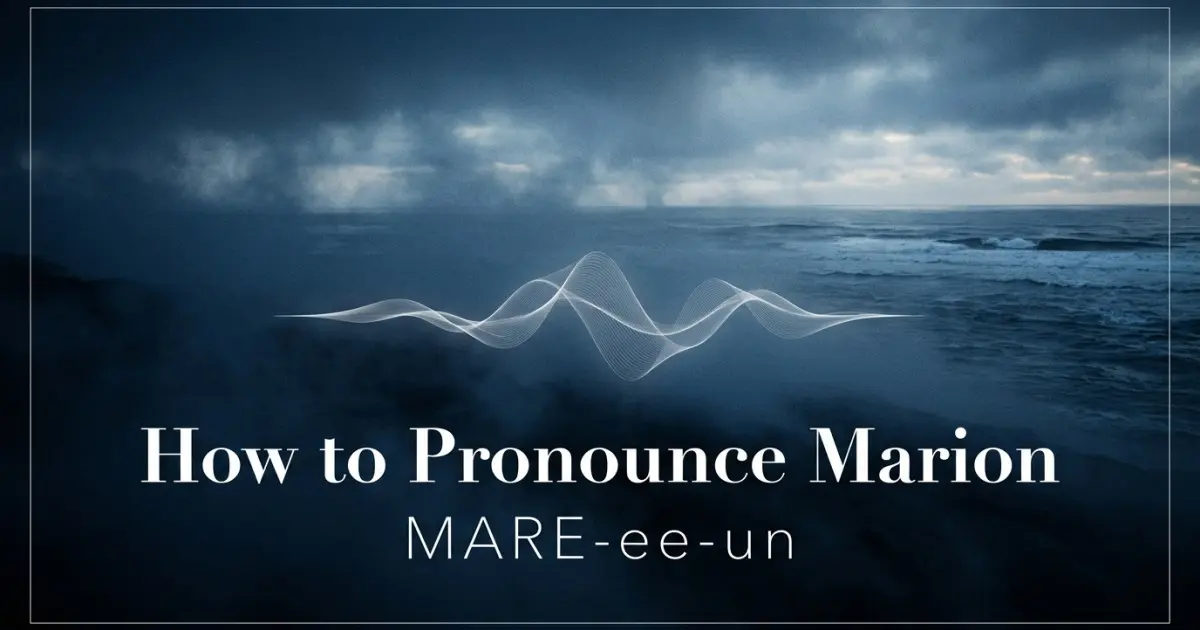
Imagine a master of ceremonies reading a name from a printed program: Marion. The spelling is familiar, but the voice still has a choice to make. Should it sound like MARE-ee-on, MAR-ee-on, or something closer to Mary-un? The intended pronunciation is MAIR-ee-un: three light syllables, strongest at the beginning, with a smooth middle and a gentle final landing.
That softness is part of Marion’s character. The name is French in origin, means “star of the sea” and “bitter,” and has a flowing sound that suits its sea-lit meaning. In American English, the IPA is /ˈmɛriən/. In British English, it is /ˈmeəriən/. The main difference is the first vowel: American speakers may say it closer to merry-un, while British speakers may give the first syllable a clearer mare-like glide. In both cases, Marion remains a three-syllable name with first-syllable stress.
How Marion is actually said when the first syllable sets the course
| Element | Phonetic Detail | Quick Tip |
|---|---|---|
| Standard pronunciation | MAIR-ee-un | Start with MAIR, then move lightly through ee-un. |
| Syllable count | 3 syllables | Say it in three beats: MAIR + ee + un. |
| Stress pattern | First syllable stressed | The name is MAIR-ee-un, not ma-REE-un. |
| U.S. IPA | /ˈmɛriən/ | In many American accents, the first vowel may sound close to the first syllable of “merry.” |
| U.K. IPA | /ˈmeəriən/ | In British pronunciation, the first syllable may sound closer to “mare.” |
| Common confusion | MAR-ee-on, ma-REE-on, or MARE-yun | Keep the name light, three-syllable, and front-stressed: MAIR-ee-un. |
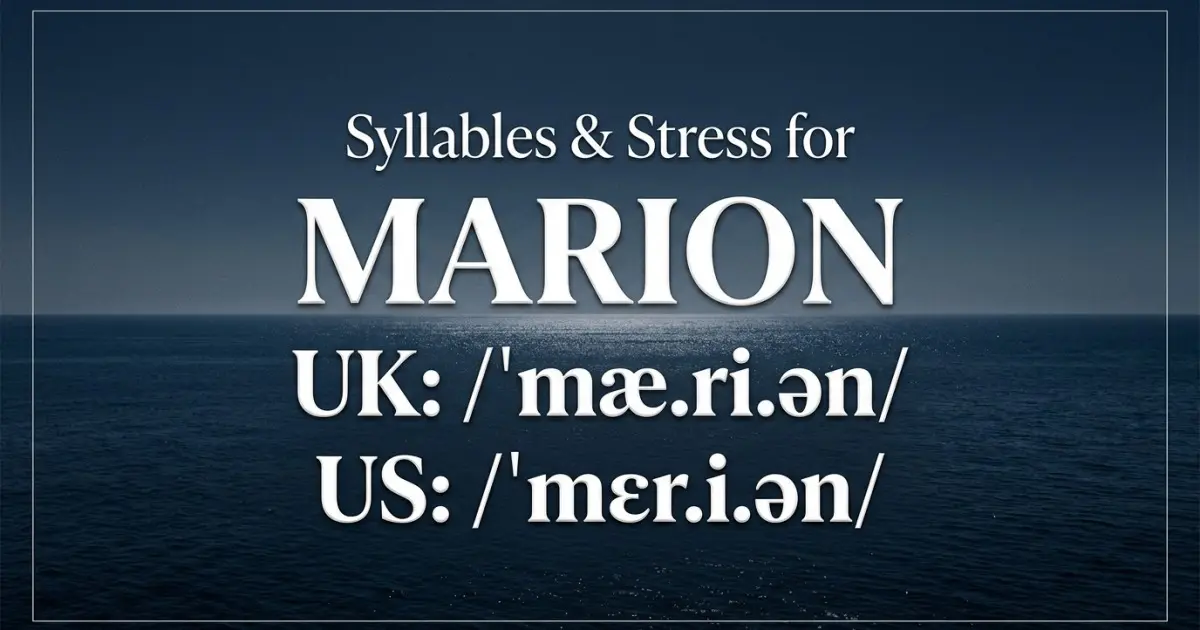
Marion begins with a warm M and a clear “Mair” sound
The first sound in Marion is M, a voiced consonant made with the lips closed. It gives the name a soft but steady entrance. Unlike names that begin with a hard stop such as K or T, Marion opens warmly. That warmth suits the name’s gentle, vintage style. Pronunciation lands more fully when the name’s roots and history are already in view, so begin with Marion meaning.
The first syllable is the pronunciation anchor: MAIR. In the broad pronunciation guide, it sounds like mare or air with an M at the front. This is where the stress belongs. If the stress moves into the middle, Marion starts to sound less natural in everyday English. The name should begin clearly, then flow through the rest.
The American vowel may sound closer to “merry”
The U.S. IPA form /ˈmɛriən/ points to a first vowel that many American speakers pronounce close to the vowel in merry. Depending on accent, Marion may sound like MEH-ree-un or MAIR-ee-un. The written guide MAIR-ee-un is useful because it keeps the first syllable open and recognizable.
The British vowel may sound closer to “mare”
The U.K. IPA form /ˈmeəriən/ suggests a more gliding first vowel for many British speakers, closer to mare. That makes the first syllable feel slightly more open. The important point is that the name still has three syllables and still begins with the main stress.
The middle of Marion should stay light and flowing
The second syllable is ee. It should be light, not heavy. Marion is not pronounced ma-REE-on, with the middle syllable taking over. The middle syllable simply carries the name from the stressed opening into the final sound.
This light middle is part of what gives Marion its graceful rhythm. The name does not sound clipped or abrupt. It moves smoothly, almost like a small phrase: MAIR, ee, un. That movement helps preserve the name’s refined, sea-like softness.
Do not turn Marion into ma-REE-on
A common mistake is to place the stress on the second syllable, making the name sound like ma-REE-on. That changes the rhythm. The intended pronunciation is front-weighted: MAIR-ee-un. The middle syllable should be clear, but not dominant.
Do not compress Marion too sharply
Another mistake is to compress the name into something like MARE-yun. In fast speech, the final two syllables may naturally become lighter, but the guide pronunciation preserves three beats. For introductions, ceremonies, and careful speech, MAIR-ee-un is the clearest form.
Marion’s final syllable gives the name a gentle landing
The final syllable of Marion is un. It should be soft and quick. The name should not end with a heavy on, as in a sharply pronounced MAIR-ee-ON. The final syllable is there to close the sound gently, not to take the stress.
The ending also helps Marion feel elegant rather than blunt. Names ending in soft -ion or -ian sounds often have a flowing quality because they do not land on a hard final stop. In Marion, that softness supports the name’s old-soul, refined character.
The final “n” should be present but not heavy
The n at the end of Marion gives the name closure. It should be heard, but not exaggerated. If the ending becomes too heavy, the name loses some of its grace. Think of the final syllable as a soft landing after the clearer first syllable.
The ending should not become “own”
Marion should not end like MAIR-ee-own. The final syllable is lighter: un, not own. A useful correction is: “Marion — MAIR-ee-un, with a soft ending.”
Marion travels well across accents, but the first vowel may shift
Marion is fairly easy across English-speaking accents because its spelling is familiar and its rhythm is stable. The main difference is the first vowel. American English may make Marion sound closer to merry-un, while British English may make it closer to mare-ee-un. Both versions preserve the name’s identity.
American English: softer first vowel, same three beats
In American English, Marion can sound close to MEH-ree-un or MAIR-ee-un, depending on regional accent. The IPA /ˈmɛriən/ captures the shorter first vowel used by many speakers. The most important rule is still stress: the first syllable leads.
British English: more open first vowel, same gentle flow
In British English, Marion may sound closer to MAIR-ee-un, reflected in /ˈmeəriən/. The first syllable may feel more open or gliding, but the name should remain light through the second and third syllables.
Sound neighbors help explain Marion without flattening it
Marion sits near several familiar sound neighbors: Marian, Miriam, Mary, Marius, and Merion. The closest practical guide is to think of Mary plus a soft -un ending, though Marion should still be treated as a three-syllable name. It is not simply Mary with an n; it has its own rhythm. Once the sound pattern is clear, some shortenings stop feeling optional and start feeling natural, and the clearest map is in Marion nicknames.
For correction, short phrases work best. Marion is a soft name, so long explanations can make the pronunciation feel more complicated than it is.
Useful correction phrases for Marion
“It’s Marion — MAIR-ee-un.”
“Stress the first syllable: MAIR-ee-un.”
“Three light syllables: MAIR, ee, un.”
“The ending is soft, not a heavy ‘on.’”
Practice lines for saying Marion naturally
Practice helps because Marion should sound graceful, not overworked. The goal is to keep the first syllable clear and let the rest of the name flow.
Slow practice
MAIR — ee — un.
MAIR-ee-un.
Marion is here.
This is Marion.
Everyday practice
Marion, come here for a second.
Can you give this to Marion?
Marion has a three-syllable name.
We pronounce Marion with the stress at the beginning.
Full-name practice
Marion James sounds classic, grounded, and clear.
Marion Alexander gives the name a broader formal rhythm.
Marion Grant adds a crisp, masculine middle after the soft first name.
Marion Theodore keeps the full name warm, vintage, and dignified.