
How to Pronounce Marcos: How to Say It Clearly and Naturally
Imagine Marcos being read aloud from a classroom roster, a soccer lineup, or a graduation program. The spelling looks familiar, but the intended pronunciation has a warm Spanish shape: MAR-koh. The name moves in two clear beats. The first syllable carries the weight, and the second opens into a rounded “koh” sound. Even though the spelling ends in S, the pronunciation guide here does not add a final “s” sound; the name is spoken as MAR-koh, not MAR-koss.
That open ending matters because Marcos means “warlike; of Mars.” The meaning has strength, but the sound is not harsh. The name begins firmly with MAR, then softens into the final vowel. In U.S. speech, the r in the first syllable is usually pronounced clearly; in many U.K. accents, it may be lighter. But the main shape remains the same: two syllables, first syllable stressed, open final sound.
Marcos Is Said With a Strong MAR and an Open Koh
| Element | Phonetic Detail | Quick Tip |
|---|---|---|
| Everyday pronunciation | MAR-koh | Say it in two beats, with the first syllable strongest. |
| Syllable count | 2 syllables | Keep the rhythm clean: MAR + koh. |
| Stress pattern | First syllable stressed | The name is MAR-koh, not mar-KOH. |
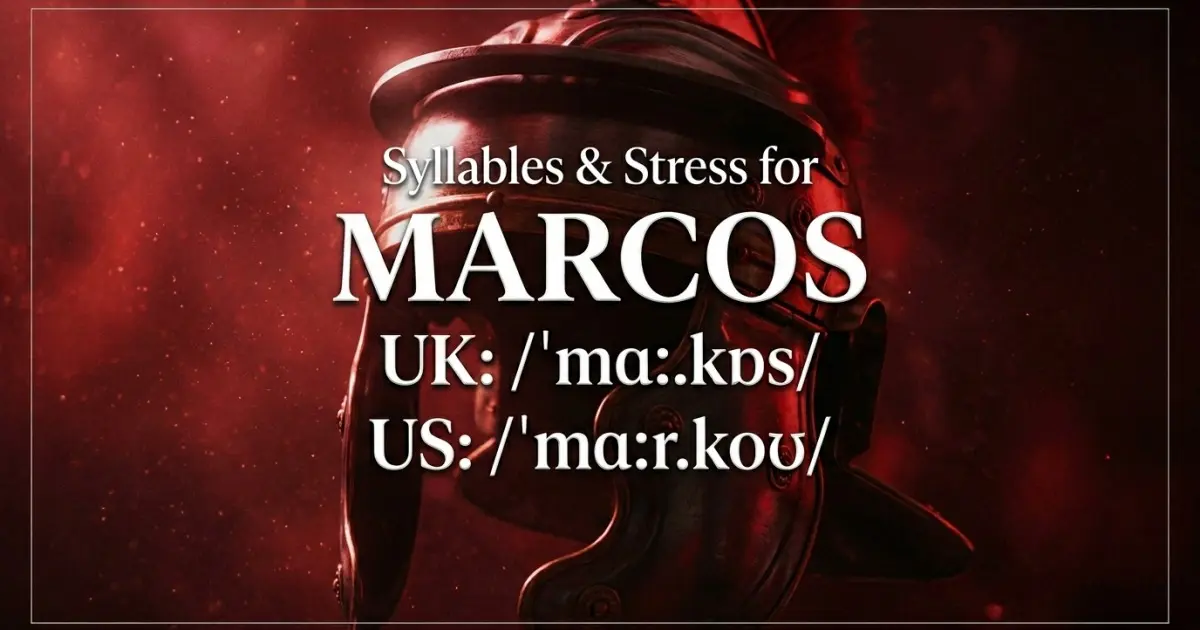
| U.S. IPA | /ˈmɑːrkoʊ/ | The U.S. form usually keeps the r sound clear in the first syllable. |
| U.K. IPA | /ˈmɑːkəʊ/ | The U.K. form may reduce or soften the r depending on accent. |
| Opening sound | MAR | Begin with the broad “mar” sound, as in “market” without the final part. |
| Middle consonant | Hard K sound | The C is pronounced like K, not like S. |
| Ending | Open “koh” | Finish with a rounded vowel sound; do not add a final “s” in this guide. |
The Everyday Pronunciation of Marcos Depends on the Open Ending
Marcos is pronounced MAR-koh. The name should feel strong at the beginning and open at the end. The first syllable, MAR, carries the stress. The second syllable, koh, should be rounded and light, not clipped or overworked. Before focusing only on syllables and stress, it helps to step back into the fuller frame of Marcos meaning.
The first syllable gives Marcos its strength
The opening MAR begins with the soft nasal consonant M, then moves into a broad vowel and, in many American accents, a clearly pronounced r. This gives Marcos its grounded sound. The name does not begin sharply, but it does begin with presence.
The r sound is a liquid consonant, which means it can shape the vowel around it and give the syllable a fuller quality. In U.S. English, MAR often sounds more r-colored. In some U.K. accents, the r may be less audible unless followed by another vowel. Either way, the first syllable remains the stressed part of the name.
The final S belongs to the spelling, not this pronunciation guide
The most important detail for this pronunciation is the ending. Marcos is guided here as MAR-koh, not MAR-koss. That means the final S is not pronounced in the everyday guide. The name ends with an open “oh” sound, giving it warmth and movement.
This makes Marcos feel smoother than a hard-ended form. The martial meaning gives the name backbone, while the open ending keeps the sound friendly and approachable.
Marcos’s IPA Shows How U.S. and U.K. Accents Handle the R
The U.S. IPA for Marcos is /ˈmɑːrkoʊ/. The U.K. IPA is /ˈmɑːkəʊ/. Both forms show two syllables and stress on the first syllable. The key difference is the treatment of the r in the first syllable and the exact shaping of the final vowel.
What the U.S. IPA shows in plain English
In /ˈmɑːrkoʊ/, the stress mark appears before the first syllable, showing that MAR is strongest. The /ɑːr/ portion gives a broad vowel followed by an audible r in many U.S. accents. The /k/ sound confirms that the C is hard, and /oʊ/ gives the rounded “oh” ending.
For American English, the simple spoken guide is MAR-koh. The r should usually be heard, and the final sound should stay open.
What the U.K. IPA changes
In /ˈmɑːkəʊ/, the r is not shown in the same way, reflecting a pronunciation where the r may be reduced or not pronounced in many British accents. The final /əʊ/ still gives a rounded “oh” quality. The name remains two syllables and first-stressed.
For families, the practical rule is simple: accent may change the r, but it should not change the name into MAR-kuss or mar-KOH. The intended shape remains MAR-koh.
Common Marcos Pronunciation Mistakes Usually Come From the Final S
Marcos is not difficult, but its spelling can lead to a few common mistakes. Most of them come from pronouncing every written letter or shifting the stress to the wrong place.
Mistake one: saying MAR-koss
The most common mistake is adding a final S sound. In this guide, Marcos is pronounced MAR-koh. A simple correction is: “It ends with koh, not koss.” That keeps the name aligned with the intended pronunciation.
Mistake two: saying MAR-kuss
Some English speakers may be influenced by Marcus and pronounce Marcos as MAR-kuss. That changes both the vowel and the ending. Marcos should finish with an open “koh” sound, not the reduced “kuss” ending of Marcus.
Mistake three: stressing the second syllable
Marcos should not be pronounced mar-KOH. The stress belongs at the front: MAR-koh. The second syllable is clear, but it should not overpower the first.
Marcos Sound Neighbors Help Clarify the Name
Marcos sits near names such as Marco, Marcus, Mario, Mateo, and Marcelo in broad sound or style. These comparisons can help, but Marcos has its own exact pronunciation. The way the name resolves at the end often decides which short forms feel natural in speech, and that becomes clearer in nicknames for Marcos.
Marco is the closest pronunciation anchor
Marco is the easiest comparison because Marcos, in this guide, is pronounced very close to Marco: MAR-koh. The difference is visual and formal rather than strongly audible in the supplied pronunciation. If someone hesitates, saying “like Marco” can help them quickly reach the intended sound.
Marcus is a useful contrast
Marcus is helpful because it shows what Marcos is not. Marcus is commonly said MAR-kuss, while Marcos is guided here as MAR-koh. The difference is the ending. Marcos should stay open and rounded.
Practice Lines for Saying Marcos Naturally
The easiest way to make Marcos sound natural is to practice it in ordinary sentences. Keep the first syllable strong and the final sound open.
Slow practice
- MAR-koh.
- Marcos has two syllables.
- The first syllable is strongest: MAR-koh.
- The ending is open, not “koss.”
Everyday practice
- Marcos is ready for school.
- Can you call Marcos?
- This is Marcos Gabriel.
- Marcos will meet us there.
- We chose the name Marcos.
Correction practice
- It’s pronounced MAR-koh.
- Not MAR-kuss—the ending is koh.
- The C has a hard K sound.
- Marco can help you remember the pronunciation of Marcos.
How to Pronounce Marcos: FAQ
How do you pronounce Marcos?
Marcos is pronounced MAR-koh. It has two syllables, with the stress on the first syllable.
What is the IPA pronunciation of Marcos?
The U.S. IPA pronunciation is /ˈmɑːrkoʊ/. The U.K. IPA pronunciation is /ˈmɑːkəʊ/.
Is Marcos pronounced like Marcus?
No. In this pronunciation guide, Marcos is pronounced MAR-koh, while Marcus is commonly pronounced MAR-kuss. The ending is the main difference.
What is the most common pronunciation mistake for Marcos?
The most common mistake is pronouncing Marcos as MAR-kuss or adding a final S sound. The intended pronunciation here is MAR-koh.