
How to Pronounce Maeve: How to Say It Clearly and Naturally
Maeve is the kind of name that exposes a truth about modern naming almost immediately: people are often less intimidated by long names than by short ones with heritage spellings. A teacher sees Maeve on a first-day roster, pauses for half a beat, and decides whether this is a name she already knows or a name she needs to decode. A nurse calls it in a waiting room. A barista writes it on a cup after hearing it once. In those ordinary public moments, a name either survives on elegance alone or proves that its elegance is matched by usability. Maeve proves it very quickly. Once spoken aloud, it is startlingly direct.
The everyday pronunciation is MAYV. One syllable. One strong vowel. One clean finish. That is part of the name’s power. The older Irish lineage behind Maeve may look more visually complex in historical spellings, but the modern form is highly efficient in speech. There is no extra softness at the end, no hidden syllable, and no drifting finish. Maeve lands, and that landing is exactly why the name feels so memorable.
What Maeve’s spoken form actually makes clear
| Element | Phonetic Detail | Quick Tip |
|---|---|---|
| Everyday pronunciation | MAYV | Say it in one clean beat, not as two syllables and not with an added soft ending. |
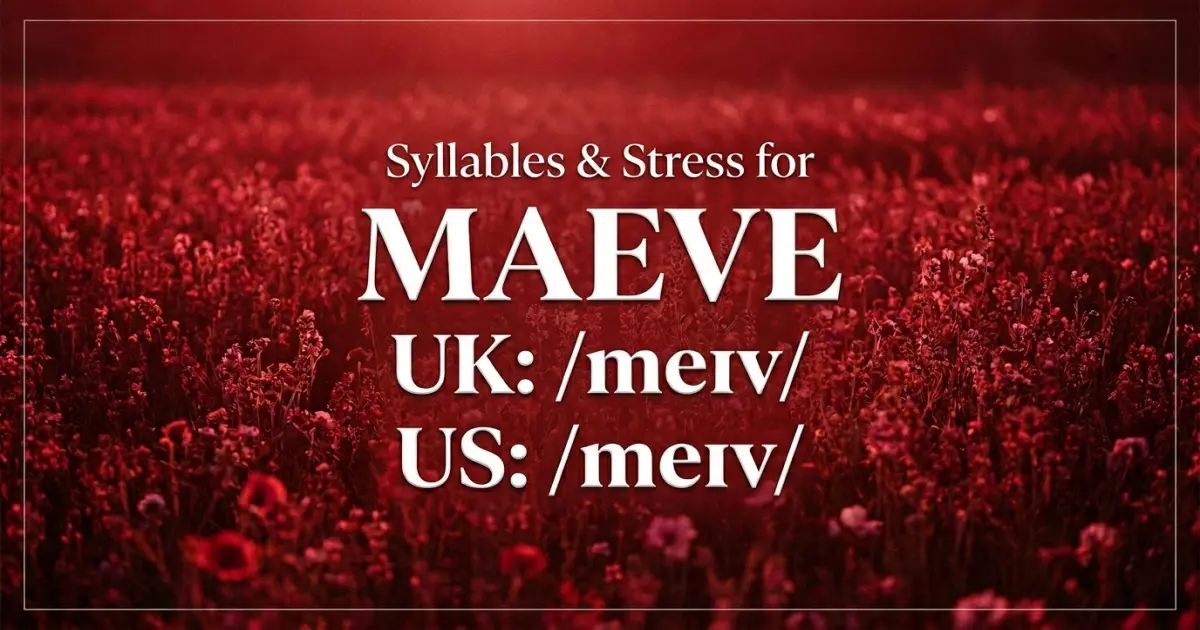
| IPA (US) | /meɪv/ | The long ay vowel is the center of the name and should stay clear and bright. |
| IPA (UK) | /meɪv/ | The same core structure works in British English, which helps the name remain stable across accents. |
| Syllable count | 1 syllable | Maeve is powerful partly because it refuses extra sound. Keep it compact. |
| Stress pattern | Single stressed syllable | There is no secondary beat to soften or stretch. The whole name carries equal force in one pulse. |
| Key ending sound | Voiced v | The final consonant gives Maeve its edge, so do not blur it into a softer ending. |
| Sound profile | Open vowel plus crisp consonant finish | The elegance comes from contrast: luminous in the middle, exact at the end. |
How Maeve sounds in real speech instead of on the page
Maeve works because it is both simple and exact. It begins with a soft consonant and moves immediately into a long, open ay vowel, which gives the name brightness and width. Then it closes with a voiced fricative, the v sound, which adds firmness and a little bite. That combination matters. Without the broad vowel, the name could feel too clipped. Without the final v, it could float away into softness. Together, those two elements give Maeve its distinct balance of grace and force. Pronunciation lands more fully when the name’s roots and history are already in view, so begin with Maeve meaning.
Why the long vowel is doing so much work in Maeve
The heart of Maeve is the AY sound. It is the same basic vowel English speakers know from words like “day” or “say,” which is one reason the name becomes easy once heard aloud. That long vowel makes the name feel more expansive than many one-syllable names. Even though Maeve is brief, it does not feel cramped. The sound opens before it closes.
This is part of why Maeve often sounds more elegant than a purely clipped one-syllable name. The vowel gives the name room, even while the overall structure stays compact.
Why the final consonant keeps Maeve from sounding too soft
The ending is equally important. Maeve finishes on a voiced fricative, which means the sound continues with a slight vibration rather than ending in a hard stop. In practical terms, that gives the name texture. A softer ending would make Maeve feel gentler but less distinct. A harder stop would make it sound more severe. The v lands in exactly the right place between those extremes.
This is one reason Maeve sounds both feminine and authoritative. The final consonant gives it outline. It is a short name, but not a vague one.
Maeve, Irish heritage, and why the modern pronunciation feels so clean
Historically, naming references connect Maeve to older Irish forms such as Meadhbh, Medb, and Méabh. That matters because it explains why some people glance at the name and expect the pronunciation to be more difficult than it is. The older forms carry visible heritage complexity. Maeve, by contrast, is the streamlined modern spelling that keeps the sound highly accessible. In effect, the modern spelling has done some of the pronunciation work in advance.
Maeve is an anglicized form that protects the sound
Research and naming references often describe Maeve as an acceptable anglicized form of the older Irish name. That makes the pronunciation easier to carry in wider English-speaking contexts without breaking from the traditional sound. This is a major advantage. Parents get the Irish heritage and mythic force of the older name family, but in a spelling that most English speakers can learn quickly.
That is one reason Maeve works so well in the contemporary world. It is not heritage that needs constant footnotes. It is heritage that has already found a practical spoken bridge.
Why people still hesitate even though the name is simple
The brief hesitation some speakers feel usually comes from visual uncertainty, not phonetic difficulty. The letters ae are not the most common vowel pairing in modern English names, so some readers briefly overthink them. Once the name is heard as MAYV, that uncertainty usually vanishes. There is very little instability in the actual sound.
This means Maeve is a name that benefits enormously from hearing. On paper it may look heritage-rich and slightly mysterious. In speech it is direct.
Maeve across American and British speech
The fact packet gives the same IPA for U.S. and U.K. English: /meɪv/. That is useful because it confirms something important. Maeve is one of those names that remains very stable across major English-speaking accents. Accent may add subtle color, but the structure stays essentially unchanged.
Why the name travels so well across accents
Some names shift meaningfully between American and British pronunciation. Maeve generally does not, because there is so little structural room for variation. One syllable, one central vowel, one final consonant. This compactness helps the name remain recognizable and consistent in a way that longer names sometimes cannot.
That stability is one of Maeve’s practical strengths. It sounds literary and heritage-rich, but it behaves like an easy everyday name in international English-speaking use.
Small accent color changes do not alter the identity
Speakers may color the long vowel slightly differently depending on region, but the overall effect remains the same. The name still opens into May and closes with the same voiced v. That consistency protects the name’s identity. You do not have to choose between a formal version and a casual one. Maeve is simply Maeve.
Where people usually get Maeve wrong
Maeve is not hard, but it can be overthought. Most mistakes happen when speakers try to make the name match the visual complexity they imagine is there rather than the very clean sound it actually has.
Adding an extra syllable is the most common error
The clearest mistake is trying to turn Maeve into something longer or softer than it is. Maeve should not sound like two beats. It is not a name that trails off into an extra vowel. The elegance depends on its compression.
Blurring the final v weakens the whole name
Another mistake is softening the ending so much that the final consonant nearly disappears. That removes much of the name’s outline. Maeve needs that closing v to keep its edge and precision.
Overstressing the heritage can make the name feel heavier than it is
Because the name comes from a rich Irish background, some speakers can become too careful and start over-performing it. In practice, Maeve works best when spoken naturally. Its history is deep, but its spoken form is elegant because it is so direct.
Maeve beside its sound neighbors
It helps to hear Maeve next to nearby names. Mae or May shares the same central vowel but lacks the edged finish that gives Maeve its authority. Mabel and Mavis belong to a neighboring style world of vintage names, but both are softer and more obviously expanded. Eve shares some of the crispness, yet Maeve feels older-world and more grounded because of the initial consonant and the broader vowel opening. The way the name resolves at the end often decides which short forms feel natural in speech, and that becomes clearer in Maeve nicknames.
What makes Maeve distinct is exactly this balance: a spacious vowel inside a very short frame, then a clean consonant finish. It is neither airy nor blunt. It is poised.
How to practice Maeve until it feels automatic
The easiest way to settle Maeve into the mouth is not to repeat it in isolation, but to place it into ordinary phrases. A name becomes natural when it is used the way it will actually live.
Three useful practice lines for Maeve
Maeve is here.
Maeve Claire Morgan.
Hello, Maeve.
These help because they test the name in greeting, in a full-name combination, and in direct address. If the name still lands in one strong syllable with a clear final v in all three, the pronunciation is secure.
The easiest memory cue for Maeve
If you want one simple cue, keep this: MAYV. Think of the word “may,” then add a clean v at the end. Bright center, sharp finish. That is the entire secret of Maeve.