
How to Pronounce Maddox: Syllable Guide and Easy Stress Tips
The most useful place to hear Maddox is not in a baby-name forum or a phonetics chart. It is in a real room where someone has to say it on first sight: a teacher pausing at attendance, a pediatric nurse calling the next family, a coach reading a roster before anyone has met in person. Maddox looks modern and slightly high-impact on paper, especially because of the x ending, so some speakers expect a trick hidden in the spelling. But once the name is said aloud, the uncertainty usually disappears. It is strong, quick, and easier than it looks.
That ease is part of the name’s success. Maddox is pronounced MAD-uks, with two syllables and clear stress on the first. The opening lands hard and familiar, while the second syllable relaxes just enough to keep the whole name conversational. The final x gives it edge, but not complication. In practical speech, Maddox feels much more natural than many people assume from the spelling alone. It is one of those names whose visual styling suggests attitude, while its pronunciation stays remarkably straightforward.
What the Sound of Maddox Is Actually Clarifying
| Element | Phonetic Detail | Quick Tip |
|---|---|---|
| Everyday pronunciation | MAD-uks | Say “mad,” then add a quick “uks.” Keep the first part stronger than the second. |
| Syllable count | 2 syllables | Do not stretch it into three beats. Maddox should stay compact and direct. |
| Stress pattern | Primary stress on the first syllable | The emphasis belongs on MAD, not on the ending. |
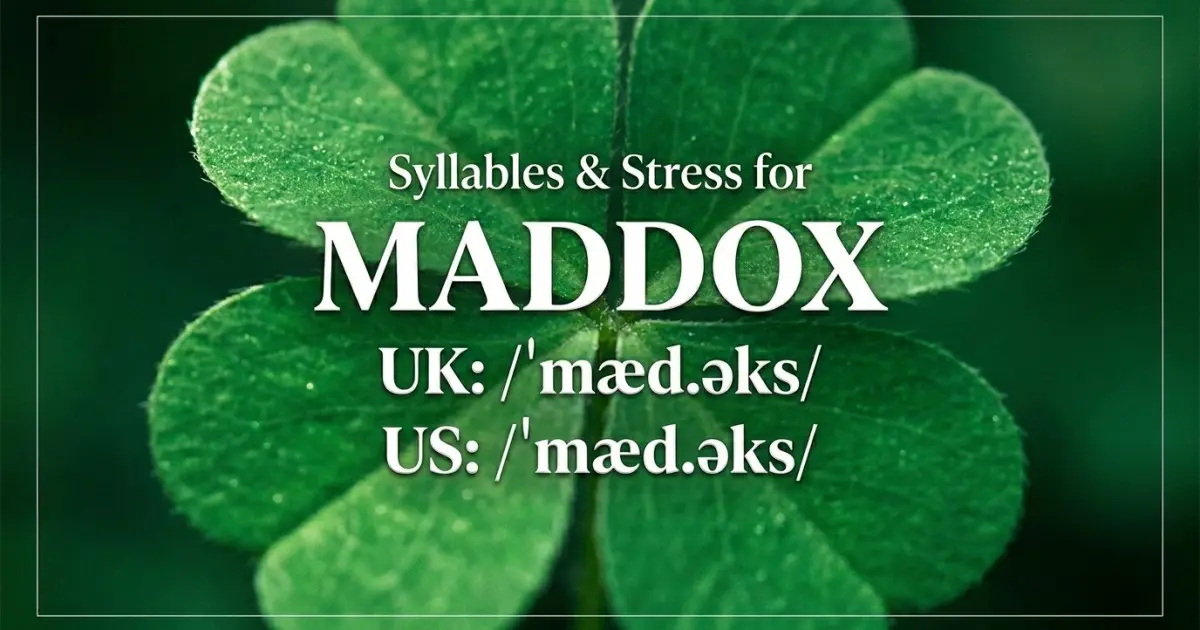
| IPA (US) | /ˈmædəks/ | The first vowel is the short a from “cat,” and the second syllable begins with a relaxed schwa sound. |
| IPA (UK) | /ˈmædəks/ | British and American English keep essentially the same rhythm and overall shape here. |
| Opening consonants | m + d frame around a short vowel | The first syllable should feel firm and familiar, not drawn out or softened. |
| Ending cluster | Final /ks/ sound | The x is heard as “ks,” not as a separate exotic flourish. |
| Most common error | Overpronouncing the ending or misreading the vowel | If it starts sounding like “Mad-OX” or “May-dox,” it has drifted away from the usual spoken form. |
Maddox Hits Hardest on the First Beat
The core of Maddox is the first syllable. MAD carries the stress, the energy, and most of the social impression. That is why the name sounds so immediate. English speakers are very comfortable with short, front-stressed two-syllable names, and Maddox fits that pattern exactly. The first vowel is the short a heard in words like mad, bad, and back. It is not lengthened, rounded, or stylized. Keeping that vowel short is one of the keys to saying the name naturally. The sound matters more once you know what the name is meant to carry, which is why the wider frame starts in Maddox meaning.
The consonants matter too. The opening m gives the name a slightly warm start, but that warmth does not last long. The d closes the first syllable firmly, which is one reason Maddox sounds more decisive than soft. There is no liquid consonant such as l or r to blur the line. The first syllable arrives, lands, and holds.
Why the first vowel matters so much
Because Maddox is so compact, even a small vowel shift changes the personality of the name. If the opening becomes too broad or too long, the name starts sounding more theatrical than it should. If it drifts toward something like “may,” the name loses its grounded modern force. The best guide is still simple: the opening should sound exactly like the common English word mad.
What the second syllable is supposed to do
The second syllable, -uks, is lighter and quicker. It contains the schwa-like vowel sound heard in many unstressed English syllables, followed by the final /ks/ cluster. This is where speakers sometimes overperform the name because the spelling looks cool. But the pronunciation does not need to be flashy. The ending should complete the name, not stage a second entrance.
That balance between a hard first beat and a lighter second beat is what makes Maddox feel strong without sounding overcomplicated.
How Maddox Stays Steady Across American and British English
One of the more practical advantages of Maddox is that it remains very stable across major English accents. Both the U.S. and UK forms are represented as /ˈmædəks/, which means the name changes very little from one side of the Atlantic to the other. For parents, that is useful. A name can look modern and stylized while still being extremely dependable in speech.
What stays the same in both accents
In both American and British English, Maddox keeps the same short opening vowel, the same first-syllable stress, and the same /ks/ ending. The overall rhythm does not drift. It remains MAD-uks in ordinary speech, whether it is being said in California, London, or Sydney.
Where accent shading can still appear
The differences that do happen are small and mostly belong to speech texture rather than name structure. One speaker may clip the ending more sharply. Another may reduce the middle vowel a little more casually. Some accents may make the final /t/ in other names disappear, but Maddox is helped by the fact that its ending is /ks/, which tends to remain audible. That gives the name unusual consistency.
In other words, Maddox is not a name with competing English pronunciations. It is a name with one strong basic shape and only minor accent shading around the edges.
Where Maddox Usually Gets Misread on the Page
Maddox is not difficult, but it does invite a few predictable mistakes, mostly because the x and the surname-like look make speakers assume there may be more complexity hidden inside it than there really is.
The “Mad-OX” mistake
The most common error is to make the second syllable too literal, as if the ending were a fully stressed ox. That creates something closer to Mad-OX, with too much force on the back half of the name. In normal pronunciation, that second syllable is lighter and less independent than that.
The overstylized vowel mistake
Another error is to stylize the first vowel, either by lengthening it or drifting toward a different sound. This often happens when speakers see a fashionable name and assume the pronunciation must also be unusual. Maddox is more grounded than that. Its spoken form is much more ordinary than its visual branding suggests.
Why the final x is easier than it looks
The x can make the name seem intimidating to some readers, but in phonetic terms it is doing something very familiar. It simply produces the /ks/ cluster, the same ending heard in many everyday English words. Once speakers realize that, Maddox becomes much easier to trust aloud. The name’s “edge” is visual as much as auditory.
Maddox Beside Its Sound Neighbors
It often helps to understand a pronunciation by placing it next to similar names. Maddox sits near names like Madoc, Dax, Paxton, and Maxwell, but its spoken personality is distinct. The way the name resolves at the end often decides which short forms feel natural in speech, and that becomes clearer in nicknames for Maddox.
Compared with Madoc, Maddox is sharper and more contemporary in English because the final /ks/ gives the name a cleaner punch. Compared with Dax, Maddox is fuller and more grounded because it has a stressed first syllable plus a supporting second. Compared with Paxton, Maddox feels denser and more focused; it does not drift into the softer -ton ending that many surname-style names use. Compared with Maxwell, it is more clipped and modern, with less traditional softness.
These comparisons help explain why Maddox sounds both current and durable. It has enough phonetic familiarity to be easy, but enough edge to remain memorable.
Practicing Maddox Until It Sounds Natural
The simplest way to practice Maddox is to break it into two familiar English pieces: mad + uks. Say the common word mad, then add a quick second syllable that rhymes loosely with the unstressed ending in many casual English names. Once those pieces are joined, the name usually locks in immediately.
Practice lines that teach the rhythm
- Maddox is ready.
- Have you met Maddox?
- Maddox will be there soon.
- This belongs to Maddox.
These work because they place the name in ordinary speech, where natural stress patterns become obvious very quickly. If the first syllable sounds stronger and the second stays lighter, the name is being said well.
A quick self-check
You are likely pronouncing Maddox naturally if the name feels compact, front-stressed, and easy to repeat. You are probably overworking it if the ending becomes louder than the beginning or if the first vowel drifts away from the plain short sound in mad. Maddox should sound confident, not complicated.