
Linus Name Meaning: A Soft, Elegant Name with Lasting Appeal
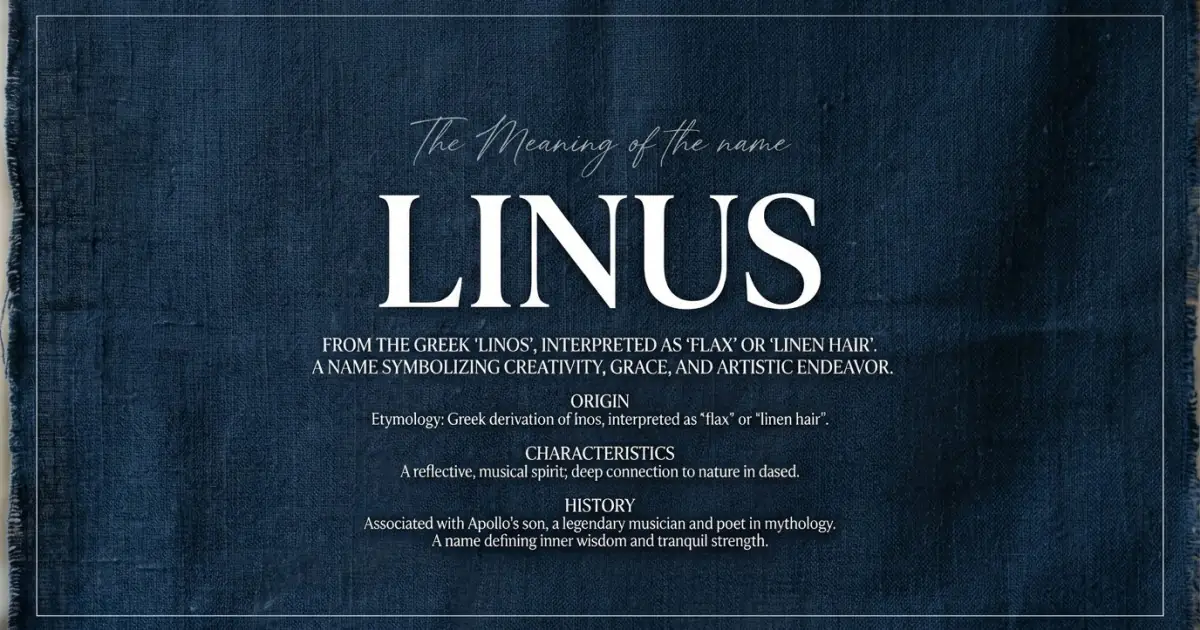
Linus is a name that seems to carry two materials at once: thread and music. Its meaning, “flax; song,” joins something tactile with something heard. Flax is the plant behind linen, a fiber associated with weaving, usefulness, simplicity, and the long human work of making fabric from the earth. Song is less visible but just as old: memory shaped into sound, feeling given rhythm, a human voice trying to make meaning last.
That pairing gives Linus its unusual quietness. It does not sound like a name built for spectacle. Pronounced LY-nuss, it has two clear syllables, a soft final sound, and a scholarly, old-world profile. Official Social Security Administration (SSA) data shows Linus ranked No. 1425 for boys in the United States in 2024, placing it outside the most common naming tier but within the range of usable, recognizable rarities. For parents drawn to Greek-rooted names, literary atmosphere, gentle masculinity, and names that feel intelligent without being severe, Linus offers a subtle kind of depth: humble as linen, resonant as a song.
Linus's U.S. popularity rank over time, 1882–2024
Popularity statistics are based on official data from the Social Security Administration baby name records.
Linus Carries Flax, Song, and Greek Old-World Grace
| Key Facts | Information | Quick Insight |
|---|---|---|
| Name | Linus | The name feels concise, literary, and quietly distinctive, with a soft classical finish. |
| Primary gender usage | Male | Linus reads traditionally masculine, but its gentle sound gives it a thoughtful rather than forceful style. |
| Primary origin | Greek | The Greek origin places Linus in an ancient naming world shaped by myth, music, learning, and language. |
| Primary meaning | Flax; song | The meaning is unusually poetic, joining a useful plant fiber with the expressive power of music. |
| Pronunciation | LY-nuss | The pronunciation is straightforward in English, with first-syllable stress and a soft second syllable. |
| IPA | US: /ˈlaɪnəs/; UK: /ˈlaɪnəs/ | The matching US and UK IPA forms make Linus stable and easy to teach across English accents. |
| Syllable count | 2 | Two syllables give Linus enough rhythm for warmth while keeping it compact and refined. |
| U.S. boys’ rank (2024) | No. 1425 | Linus is uncommon in current American use, giving it a distinctive profile without making it feel invented. |
The Meaning of Linus Finds Poetry in Useful Things
“Flax” gives Linus an earthy, woven foundation
The first meaning of Linus, “flax,” gives the name a surprisingly grounded base. Flax is not a decorative flower or a grand tree. It is a practical plant, valued for what it can become. From flax comes linen, a fabric associated with simplicity, durability, breathability, and daily life. As a name meaning, flax suggests quiet usefulness rather than showy beauty.
This gives Linus a rare kind of humility. Many names point toward royal status, battle glory, divine favor, or obvious natural drama. Linus points toward a plant that becomes thread. The image is small but meaningful: something grown from the soil, gathered, worked, and transformed into something that protects, covers, and lasts. For parents who like nature meanings but want something subtler than River, Forest, or Stone, Linus offers a nature connection that is more textile than landscape.
“Song” gives Linus emotional lift
The second meaning, “song,” changes the name from purely earthy to lyrical. Song suggests voice, memory, rhythm, and feeling. It is one of the oldest human forms of expression: a way to mourn, celebrate, teach, soothe, and remember. In Linus, song does not feel loud or theatrical. It feels thoughtful, almost ancient.
The two meanings work beautifully together. Flax gives Linus the image of weaving; song gives it the image of melody. One belongs to the hand, the other to the voice. One makes cloth, the other makes memory. Together, they create a name about craft and expression, usefulness and beauty, matter and music.
Linus Has a Greek Origin That Feels Learned Without Feeling Cold
Linus’s Greek origin gives the name an intellectual and classical atmosphere. Greek-rooted names often feel connected to philosophy, mythology, early literature, and the long history of ideas traveling through language. Linus belongs to that world, but it does not feel grand or intimidating. It is smaller, gentler, and more approachable than many ancient names. To view more names linked to this cultural tradition, explore explore Greek names.
This is one of the reasons Linus feels distinctive. It has old-world depth without a heavy ceremonial sound. Names like Alexander, Demetrius, or Leonidas carry grandeur and public force. Linus feels more private: a name for a thoughtful child, a careful observer, a gentle wit, or someone whose strength is carried through mind and character rather than volume.
A classical name with domestic warmth
Because Linus means “flax; song,” its Greek identity does not stay abstract. The meaning pulls the name back into daily life. It is classical, but not remote. It can suggest ancient music and mythic resonance, but it can also suggest linen, thread, texture, and home. That combination keeps the name from becoming too academic.
Parents drawn to Linus may be responding to this balance without naming it directly. The name sounds intelligent, but not cold. It feels rare, but not strange. It has literary energy, but not pretension. Its meaning carries both usefulness and art, which gives the name an unusually humane center.
Linus as a bridge between ancient and modern taste
Modern naming has created space for older names that once felt too quiet to be obvious choices. Linus fits beautifully into that revival. It has the compactness many parents like today, the soft ending that makes it gentle, and the classical origin that gives it depth. It can sit near names like Silas, Felix, Atticus, Elias, and Milo in style, while keeping its own distinct sound.
That makes Linus especially appealing to families who want something thoughtful and underused. It does not chase novelty through unusual spelling. It earns distinction through age, meaning, and tone.
The Sound of Linus Is Gentle, Bright, and Memorably Clear
The first syllable gives Linus its light
Linus is pronounced LY-nuss, with the stress on the first syllable. The opening “LY” sound gives the name brightness. It begins with the long “i” sound, represented in IPA as /aɪ/, the same vowel heard in “line” and “light.” That vowel makes the name feel clear and open from the start.
The “L” is a liquid consonant, a smooth sound that gives Linus softness before the bright vowel arrives. This matters because the name’s personality is not sharp or heavy. It starts gently, then opens. The effect is refined rather than forceful.
The soft ending keeps Linus from sounding severe
The second syllable, “nuss,” is lighter. It gives the name a soft landing rather than a hard stop. The final “s” adds clarity, but the unstressed syllable keeps the name from becoming brittle. In both US and UK IPA, /ˈlaɪnəs/, the structure remains stable: first syllable strong, second syllable relaxed.
This sound pattern supports the meaning. A name meaning “flax; song” should not feel overly hard-edged. Linus sounds like something woven and sung: clear at the beginning, gentle at the end. Its sound is part of its emotional intelligence.
Linus in Modern Use: Rare, Recognizable, and Quietly Stylish
Official SSA data shows Linus ranked No. 1425 for boys in the United States in 2024. That makes it uncommon, but not inaccessible. It is rare enough that many children named Linus may not share the name with classmates, yet familiar enough in form that people can read and pronounce it with little trouble. If you are weighing names with a similar gender profile, visit familiar and rare boy names.
This is a strong position for parents who want distinction without confusion. Linus does not look invented. It does not require decorative spelling. It has a long-rooted feel and a clean English pronunciation. Its rarity comes from taste rather than difficulty.
Why Linus feels familiar even when it is underused
Linus has several features that help it feel accessible. It is short. It has two syllables. It ends in a familiar “-us” pattern seen in classical and biblical-adjacent names. It is easy to say, and its spelling clearly supports the pronunciation LY-nuss.
At the same time, it remains uncommon enough to feel distinctive. This gives Linus a gentle rare-name advantage. It can stand out in a classroom or on a list, but it does not demand constant correction. The name invites curiosity rather than confusion.
Linus beside other soft classical names
Stylistically, Linus may appeal to families who like names with literary, scholarly, or old-world charm. It shares some territory with names like Felix, Silas, Tobias, Cyrus, and Elias, but Linus feels quieter than many of them. It has less flash than Felix, less biblical familiarity than Silas, and less grandeur than Cyrus. Its appeal is subtler.
That subtlety is important. Linus is not trying to dominate. It feels observant, kind, clever, and lightly vintage. It may especially suit parents who want a boy name that is intelligent without being stern, gentle without being weak, and unusual without becoming eccentric.
The Social Impression of Linus Is Thoughtful, Tender, and Old-Soul
Linus sounds intelligent without sounding distant
Linus often gives the impression of thoughtfulness. Its Greek origin, soft classical shape, and literary rhythm all contribute to that effect. It is easy to imagine Linus on a child who loves books, questions, music, puzzles, animals, or quiet observation. But the name is not limited to one personality. Its warmth keeps it from feeling narrow.
The meaning adds to this social impression. “Flax; song” gives Linus a gentle creative quality. It suggests craft and voice, usefulness and expression. The name feels less like a performance and more like a sensibility.
The name’s gentleness can be a strength
Some parents worry that soft boy names may not feel strong enough. Linus challenges that idea. Its strength is not loud. It comes from clarity, history, and character. The name feels stable because it is old-rooted. It feels memorable because it is rare. It feels warm because its sound and meaning are both humane.
In modern naming, that kind of gentle strength has real appeal. Not every boy name needs to sound like armor. Linus offers another model: a name with linen, music, intelligence, and quiet dignity woven together.
Linus Works Best With Names That Respect Its Gentle Classical Rhythm
Because Linus has two syllables and a soft ending, it pairs well with middle names that either ground it or extend its lyrical quality. A classic middle can make it feel more traditional: Linus James, Linus Thomas, Linus Edward. A longer middle can add ceremony: Linus Alexander, Linus Theodore, Linus Nathaniel. A softer middle can reinforce the melodic side: Linus Gabriel, Linus Elias, Linus Julian.
Surname harmony matters, especially because Linus ends with an “s” sound. Surnames beginning with S may create a hissing transition. This does not automatically rule them out, but it should be tested aloud. The name’s gentle shape means the full combination should be clear, not cluttered.
Middle names for Linus can add weight, warmth, or refinement
Linus often benefits from a middle name with a little more weight. Since the first name is soft and compact, a substantial middle can give the full name a stronger formal shape. Classic and longer middles are especially useful if the surname is short. If you want the full pairing logic behind that contrast, see middle names for Linus.
Nicknames for Linus can be sweet, spare, or playful
Linus does not require a nickname, but it offers several plausible ones. Line, Lio, Lin, and Linny can all work depending on family style. Linny feels especially affectionate in childhood, while Lin or Line may suit older use. The full name, however, is likely to remain the strongest form because it is already brief and memorable. To see how those different moods shorten in real life, explore Linus nicknames.
Pronunciation of Linus is stable and easy to teach
Linus is pronounced LY-nuss. The first syllable rhymes with “my,” and the second syllable is light. The US and UK IPA forms are the same, /ˈlaɪnəs/, making the pronunciation especially stable in English-speaking contexts. If you want the full sound pattern behind that rhythm, read Linus pronunciation guide.
Linus Weaves Song, Thread, and Quiet Strength Into One Name
Linus is a name of understated beauty. Its Greek origin gives it age and intellectual grace. Its meanings, “flax; song,” give it texture and music. It is not a name of spectacle, conquest, or obvious grandeur. It is a name of making: fiber made into cloth, feeling made into melody, a life shaped quietly over time.
Its 2024 boys’ ranking at No. 1425 places Linus in a distinctive modern position. It is uncommon, but not difficult; old, but not dusty; gentle, but not fragile. It fits a naming moment that increasingly values softness, history, and individuality over sheer popularity.
The lasting beauty of Linus is that it makes modest things feel meaningful. A strand of flax. A line of song. A clear first syllable and a soft final breath. Linus does not need to be loud to be memorable. It carries the poetry of useful things, the dignity of old language, and the quiet assurance of a name that has nothing to prove.