
Nicknames for Lilah: Playful Picks with Everyday Potential
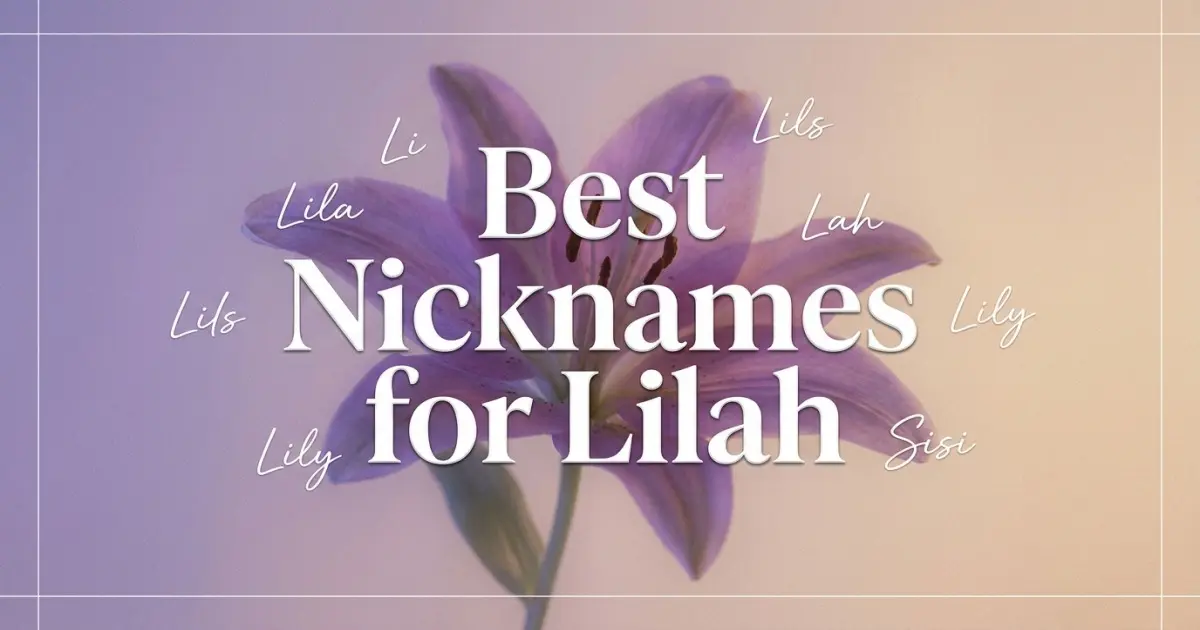
Nicknames are not just smaller names. They are social signals. They tell you who is allowed closer, who prefers tenderness over precision, who turns a name playful, and who leaves it untouched because the full form already says exactly what it needs to say. That is especially true with Lilah. Lilah already sounds intimate. It is short, soft, and lyrical from the start, so any nickname built from it is usually less about efficiency than about mood. The question is not how to save time saying Lilah. The real question is what kind of closeness the speaker wants the name to carry.
That is what makes Lilah an interesting nickname name. It does not behave like Elizabeth or Evangeline, where whole alternate identities sit clearly inside the formal form. Lilah is already near the level of affectionate speech. For many families, the full name will remain the everyday name for life. When nicknames do appear, they tend to come from one of three places: a softened spelling-based form, a repeated-sound pet name, or a family invention shaped by personality rather than strict logic. In other words, Lilah’s nickname life is usually less about cutting the name down and more about wrapping it in familiarity. Before judging which short form feels right, it helps to look again at the full identity of the name in Lilah meaning.
What Lilah’s nickname landscape reveals about a short, already-intimate name
| Group | Suggested Nicknames | Persona | Use Context |
|---|---|---|---|
| Full-form favorite | Lilah | Soft, complete, quietly distinctive | Everyday use, school, introductions, most of adult life |
| Short and familiar | Lil, Li, Lils | Casual, friendly, low-fuss | Siblings, close friends, texting, quick daily shorthand |
| Cute and affectionate | Lili, Lily, Li-Li | Sweet, playful, child-centered | Home life, grandparents, toddler years, family circles |
| Ending-led pet names | Lala, Lulu | Warm, sing-song, intimate | Very young children, private family use, bedtime speech |
| DIY personality forms | Lilah-Bee, Lilah-Lou, Liles | Relationship-based, individualized, affectionate | Inside jokes, parent-child speech, evolving family nicknames |
Lilah is already close to nickname territory, which changes how shortening works
Why many Lilahs simply stay Lilah
The first important thing about Lilah is that it often does not need a nickname at all. It is already short, already warm, and already socially easy. Names this compact frequently resist dramatic shortening because there is not much excess to remove. Lilah belongs in that category. It feels finished. That is one reason many families will use Lilah everywhere: at home, at school, in friendships, and later in adult life.
This does not mean the name lacks nickname potential. It means the full form is strong enough that nicknames become optional rather than necessary. That is usually a sign of a very wearable name. Lilah can be affectionate without any alteration. It can sound gentle without becoming childish. It can move into adulthood without requiring a more serious public form. Those are substantial advantages, and they explain why the base name often remains the most natural choice.
Why Lilah nicknames tend to be emotional rather than structural
Because Lilah is already so compact, families often make it sweeter through repetition, softening, or sound play rather than by finding a radically shorter form. This is how names like Lili, Li-Li, or Lala usually arise. They are not “better” or more efficient than Lilah. They simply signal affection. A grandmother saying Li-Li is not trying to solve a pronunciation problem. She is showing closeness.
That is an important distinction. For Lilah, nicknames usually tell you more about the relationship than about the name’s structure. They are often house-language, not public identity. That is why the nickname culture around Lilah feels intimate and lightly handmade rather than highly systematized.
The opening of Lilah creates the neatest short forms, but they stay very close to the original
Lil is the most natural clipped form
The strongest short-form option from the opening of Lilah is Lil. Even though Lilah is pronounced with the ly sound at the start, Lil still feels believable because English nickname habits often follow visual shape as much as strict phonetics. Lil is already familiar as a short affectionate form in English, which helps it feel socially plausible. On Lilah, it creates a more casual, less atmospheric version of the name. These nickname choices read more clearly once the spoken shape of the full name is in view, so see how to pronounce Lilah.
This makes Lil especially good for siblings, close friends, and quick speech. It is not as romantic as the full form. It is more grounded, more everyday, and a little less visibly poetic. That can be useful for someone who likes the full name but wants a simpler, faster social version in certain settings.
Li and Lils: the modern peer-group versions
Li and Lils feel even more peer-shaped. Li is very minimal, the kind of shorthand more likely to appear in a text thread or a family message than as a formal spoken introduction. Lils works especially well in casual friend circles, where adding an s sound is a common way of making a nickname feel lived-in and group-friendly. Neither one replaces Lilah for most people. They sit around it as convenience forms.
That is the right scale for Lilah. The short forms should stay close to the original. The farther they wander, the less convincing they usually feel.
The center of Lilah is where the softness lives, and that is why cute forms emerge so easily
Why Lili and Lily feel plausible even if they shift the sound slightly
Once families move from clipping to affection, Lili and Lily become very believable. They are not strict phonetic reductions of Lilah, but they emerge naturally from its spelling and its already soft sound-world. In real homes, that kind of drift is normal. Parents and grandparents often reshape a name toward a more playful or rhythmic version, especially in early childhood.
What makes Lili and Lily work is that they preserve the visual and emotional center of Lilah: softness, lightness, and warmth. They sound younger than the full form, but not absurdly so. They are especially plausible in toddlerhood or among relatives who instinctively make names gentler and more sing-song.
Li-Li as a pure intimacy form
Li-Li belongs even more clearly to private family speech. Reduplicated nicknames like this are common across languages because they are rhythmic, affectionate, and easy for young children to hear and repeat. Li-Li is unlikely to become the child’s main public identity, but it is exactly the sort of home nickname that could stick in a family for years.
This is where Lilah’s softness becomes an advantage. The full name already feels close to affection, so repeated-sound pet names do not feel forced. They feel like a natural extension of the original mood.
The ending of Lilah is what makes the sweetest pet names possible
Lala and Lulu belong to the nursery and the family sofa
The second syllable of Lilah is soft and open, which is why it lends itself so easily to names like Lala and Lulu. These are not public shorthand forms. They are affectionate family inventions, the kind of names that appear in bedtime routines, on handwritten lunch notes, or in the voice of a grandparent. Lala keeps some of the original vowel warmth. Lulu is more of an emotional cousin than a direct derivation, but it still feels plausible because it comes from the same soft, repetitive instinct.
These names work best when they stay intimate. A nickname like Lala does not need to prove anything structurally. Its job is tenderness. With Lilah, that tenderness feels especially believable because the base name is already quiet and lyrical.
Why ending-based nicknames rarely replace Lilah in public
Unlike some longer names, Lilah does not really contain a strong ending fragment that becomes a fully separate public identity. The second syllable is too soft and too slight for that. This is why most ending-based forms remain private. They are meaningful inside the relationship, not because they stand independently in the wider world.
That is not a weakness. It simply tells you the social truth about the name: Lilah does not need to split into multiple public selves. The full form is already doing most of the work beautifully.
Lilah nicknames shift more by setting than by life stage
Baby and toddler Lilah
In the earliest years, the richest nickname life tends to appear. Lili, Li-Li, Lala, Lilah-Bee, and Lilah-Lou all make sense here because they are affectionate and rhythmic. At this stage, cuteness is not a liability. It is part of how family language works. Because Lilah is already small and soft, these forms feel especially natural in the nursery.
School-age and teen Lilah
As a child enters wider social life, the nickname field usually narrows. Most Lilahs will remain Lilah publicly. Some may become Lil or Lils among close friends or siblings. A few may still carry Lili at home. But unlike names with more obvious internal branches, Lilah does not usually divide into a sharply different school name and home name. Its full form is already simple enough to survive public life without much adaptation.
Adult Lilah
In adulthood, the most realistic pattern is Lilah in formal settings, perhaps Lil or Lils among people who have known her a long time, and private pet names surviving only in family use. That is one of the name’s strengths. It never needs to become more grown-up than it already is.
Which Lilah nicknames feel most human in real life
If realism is the goal, the strongest shortlist is clear: Lilah, Lil, Lils, Lili, Lily, and a few highly private forms like Lala or Li-Li. These all feel like names people might actually say over and over, which is the best test of a nickname. The full name remains the most stable and most elegant option. The others are gentle variations around it, not replacements.
The weakest options are usually the ones that try to force Lilah into a more elaborate nickname system than it naturally wants. Lilah is a name that thrives on light touch. The best nickname culture around it respects that. It lets the full name stay luminous while allowing affection to gather at the edges in ways that feel human, playful, and true to daily life.