
Lance Name Meaning: Meaning, Legacy, and Style
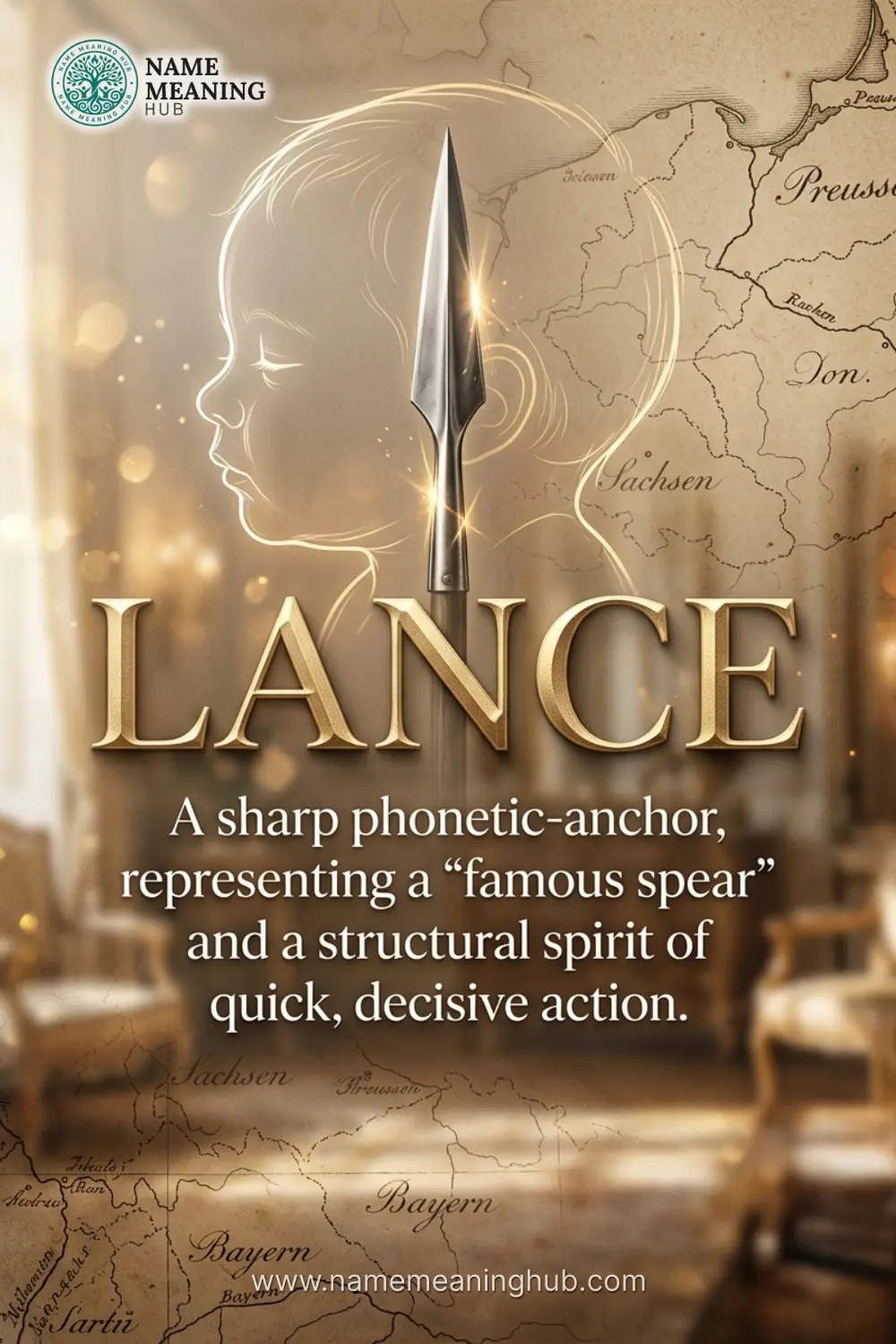
Lance is a name built from a striking contradiction. One half of its meaning points downward, toward ground, territory, and place: land. The other points forward, toward reach, force, and precision: spear. Very few names carry both of those directions at once. Most names either root a person somewhere or propel him outward. Lance does both. It suggests someone who belongs to the earth beneath his feet and also someone capable of moving through the world with intention. That is why the name feels so concentrated. It is not merely strong. It is directional.
This is also why Lance sounds more serious than many other one-syllable names. Its brevity is deceptive. Beneath that clipped surface sits an old dual image: possession and motion, ground and weapon, stability and thrust. In practical life, the name usually reads as clean, masculine, and athletic. But underneath that modern surface, Lance carries a deeper structure. It imagines masculinity not only as force, but as grounded force. The name does not merely strike. It stands somewhere first. That balance is what gives Lance its lasting shape.
Lance's U.S. popularity rank over time, 1899–2024
Popularity statistics are based on official data from the Social Security Administration baby name records.
Lance: A Chic and Noble Mid-Century Gem
Lance presents a chart pattern of a broader past with a clearer present, reflecting high naming momentum in 1970 that now offers the name long-running cultural familiarity. It continues to be a “safe but polished” choice that parents trust for its sharp sound and representation of a “land” or “spear.”
The absence of meaningful crossover into other tracks reinforces its firm, traditional masculine identity. Its simple single-syllable structure remains both polished and widely recognized across generations.
What Lance Reveals Before the Story Even Begins
| Key Facts | Information | Quick Insight |
|---|---|---|
| Name | Lance | Lance is short enough to feel modern and efficient, but its meaning structure is older and more layered than its size suggests. |
| Primary gender usage | Male | The name’s current use is firmly masculine, helped by its direct sound and its association with land and weapon imagery. |
| Origin | German | Its German root places the name in an older naming world where territory, battle, and standing often shaped masculine identity. |
| Meaning | Land; spear | This dual meaning gives Lance unusual tension: it is at once rooted and forceful, territorial and directional. |
| Pronunciation | LANSS | The compact sound makes the name feel disciplined and controlled, which suits its imagery better than a softer form would. |
| IPA (U.S.) | /læns/ | The American pronunciation feels brisk and athletic, with a flatter, sharper opening vowel. |
| IPA (U.K.) | /lɑːns/ | The British form broadens the vowel slightly, giving Lance a quieter, more formal finish without changing its core character. |
| Syllable count | 1 | Its one-syllable structure makes Lance feel decisive and unsentimental, which strengthens the name’s masculine profile. |
| Latest U.S. year | 2024 | This keeps Lance in current view, showing that it remains active rather than locked inside a previous era. |
| U.S. boys’ rank (2024) | No. 841 | Official data shows Lance is still recognizable, but it now sits outside the most crowded naming tier, which gives it more individuality. |
Lance Lives Between Ground and Thrust
Why “land” makes the name steadier than it first appears
The first side of Lance’s meaning is the one people tend to underestimate. Land sounds plain at first. It does not glitter. It does not arrive with a mythic animal, a celestial image, or a royal title. Yet land is one of the oldest and most durable ideas a name can carry. Land means place, belonging, inheritance, boundary, settlement, and continuity. It means that before a person acts, he already stands somewhere. That is not a small symbolic gift. It gives the name gravity before it gives it force.
Names built around landscape often feel calmer and more durable than names built only around glory or victory. Lance benefits from that. The land element inside it creates a sense of grounding. It suggests someone who is not drifting. He is situated. Even if modern listeners do not consciously hear “land” every time they hear the name, that sense of stability still shapes the emotional weather around it. Lance does not sound ornamental or abstract. It sounds anchored.
There is also something quietly civic about a land-rooted meaning. Land implies stewardship as much as possession. It points toward the structures that make a life inhabitable: territory, work, boundary, home, and duty. That gives Lance a more mature foundation than many one-syllable names with purely kinetic or stylish energy. The name begins in place, and that beginning matters.
Why “spear” gives Lance its sharper edge
If land grounds the name, spear gives it direction. A spear is not vague strength. It is one of the most precise weapon images available to naming language. A spear points. It reaches beyond the body. It suggests purpose, aim, and the ability to project force into the world. This is why Lance feels more exact than many other short masculine names. It is not merely sturdy. It is focused.
Historically, weapon meanings in names often carried more than violence. They also implied readiness, protection, public action, and social rank. A spear was a tool of force, but also a symbol of visible capability. That symbolic field still clings to Lance in softened modern form. Even when no one is imagining literal weaponry, the name preserves a sense of clean thrust. It sounds like a name that moves forward without apology.
This is part of what makes Lance so compelling. Land alone might make the name too static. Spear alone might make it too aggressive. Together, they create a name about force that begins from stability. The result is not wild aggression, but directed presence.
Why the two meanings make Lance unusually complete
When a name holds both land and spear, it begins to carry a whole theory of action. First there is ground, then there is motion. First there is belonging, then there is intention. Lance therefore feels complete in a way many short names do not. It contains both the place one stands and the force one extends from that place. That dual architecture makes the name feel fuller than its one syllable would normally allow.
This may be the deepest reason Lance has endured. It is not merely sleek or masculine in a surface sense. It contains a whole geometry of standing and striking. That makes the name feel self-possessed. It knows both where it is and what it is doing.
Lance Carries an Older Masculine Logic into Modern Speech
What Germanic naming patterns help explain
Lance’s German origin matters because Germanic naming traditions often built male names out of compact, functional symbolic materials: land, strength, weapons, rule, protection, fame, and battle. These were not decorative meanings. They described the world in which names were expected to carry standing and intention. Lance belongs to that older atmosphere even if its modern sound feels contemporary. For more names shaped by the same tradition, explore names by origin.
This gives the name a different kind of seriousness from names built around beauty or charm. Lance does not promise prettiness. It promises form. That is why the name can feel so clean in the modern ear. Its root logic is almost architectural. It is built from solid elements rather than decorative ones.
That older logic also explains why Lance still sounds adult-ready. It does not need a larger formal version behind it in order to sound complete. The name began in a naming world where compactness could still carry authority. That heritage has helped it age well, even as naming taste has changed around it.
Why Lance sounds contemporary despite its older core
One of the most interesting things about Lance is how current it can feel despite the age of its symbolism. A name built from land and spear could easily have sounded archaic or ceremonial by now. Instead, Lance sounds streamlined. That is because its one-syllable shape translates old material into modern speed. The older meaning remains, but the sound has been compressed into something immediate.
This makes Lance unusually adaptable. It can feel athletic, polished, outdoorsy, or quietly traditional depending on the context. It does not belong exclusively to one aesthetic tribe. The name’s older root gives it depth; its shorter modern sound keeps it agile.
That agility is one reason the name remains socially usable. It can belong to a child, an adult, a professional, or an artist without sounding misplaced. Lance is not fragile. It does not require careful styling to survive. That resilience often marks names with long life ahead of them.
Why Lance Sounds So Controlled
The sound is clipped, but not empty
Phonetically, Lance earns much of its character through compression. In American English, /læns/ begins with a light l, opens into a bright short vowel, and ends with the tight cluster ns. That closing matters. It gives the name firmness without making it heavy. In British English, /lɑːns/ broadens the vowel, which makes the name sound slightly more formal and spacious, but the underlying structure is still the same: quick entry, clean close, no wasted motion.
This sonic economy reinforces the meaning almost perfectly. Lance does not sound soft-edged or meandering. It sounds like it knows where to stop. That is one of the reasons the name feels more disciplined than many other male names with similar popularity. The sound is not only short. It is contained.
How the sound supports the meaning
There is a close relationship between Lance’s sound and its symbolism. The opening l keeps the name from sounding too blunt. The short central vowel in American speech gives it speed. The final ns gives it a clean point. In British speech, the broader vowel lowers the temperature a little, making the name sound more stately than sharp. But in both forms, the essential feeling is one of precision.
That precision matters because a name associated with spears and land could easily become too heavy or too martial if the sound were harsher. Lance escapes that trap by remaining clean and controlled. The sound suggests force, but not chaos. It suggests direction, but not noise.
The result is a name that sounds capable. It is not trying to overwhelm the room. It is simply arriving with shape.
Lance in the Modern Ear Feels Lean, Clear, and Slightly Underrated
What the 2024 ranking suggests now
Official Social Security Administration (SSA) data placing Lance at No. 841 for boys in 2024 says something important about where the name now lives. It remains recognizable, but it is no longer crowded. That gives the name a valuable kind of freedom. It can feel familiar without becoming generic. People know how to say it, know how to spell it, and know it belongs to the naming tradition, yet it still retains enough distance from the center to feel like a decision rather than a default. You can also compare Lance with other choices in timeless boy names.
That is often an excellent position for a name. When a name is too common, its details disappear. When it becomes too rare, it can feel forced or hard to carry. Lance currently lives in a more balanced zone. It is present, but it still has edges.
How Lance compares to its style neighbors
In style terms, Lance sits near names like Grant, Dean, Troy, Wade, and Cole. All of these names are short, masculine, and more about structure than ornament. But Lance is distinct because it contains both place and weapon imagery. Grant leans more civic. Dean leans more institutional. Wade leans more geographic. Cole leans more sleek. Lance alone feels both grounded and thrusting at once.
This helps explain why the name can still sound fresh. It does not rely on novelty. It relies on the clarity of its own line. In a naming culture often crowded with softness, elaboration, or deliberate quirk, Lance can feel almost bracingly clean. That is part of its appeal.
It may also be why the name often reads as confident without seeming overinflated. Lance does not sound like it is trying to be epic. It sounds like it already has enough structure to stand without exaggeration.
Where Lance Opens Next
Middle names that widen Lance without weakening it
Because Lance is so compact, the middle name can dramatically change the mood of the full name. A longer classic middle can add dignity and sweep, while a softer or more lyrical middle can bring warmth to the name’s naturally precise profile. If you want the full pairing logic behind that contrast, see Lance middle names.
Nicknames that reveal how much Lance softens in private life
Lance belongs to the group of names that may remain intact in public but become revealing in private. Nicknames can show whether the people closest to the child treat the name as tough, tender, playful, or simply efficient. To see how those different moods shorten in real life, explore Lance nicknames.
Pronunciation that shows why Lance feels so exact
LANSS is doing much of the character work here. The clean final consonant cluster and compact form make the name feel sharper and more disciplined than many other short male names. The pronunciation page shows why that clarity matters so much. If you want the full sound pattern behind that rhythm, read Lance pronunciation guide.
Why Lance Still Sounds Larger Than Lance
Lance endures because it carries an unusually complete masculine image in a very small verbal space. It begins with land, with place, with standing somewhere. It continues with spear, with direction, with force projected outward. That sequence gives the name a built-in balance between rootedness and action. It is not a one-note strength name. It is a name about how strength is properly oriented.
In the end, Lance is compelling because it understands that power without ground is unstable, and ground without motion is static. The name holds both. It sounds clean because its inner logic is clean. One syllable. Two old ideas. A place to stand and a way to move. That is what gives Lance its uncommon precision, and that is why it still feels sharper than many names that are trying much harder to sound strong.