
Kevin Name Meaning: Its Roots, Symbolism, and Lasting Identity

Some names are impressive because they sound rare. Others endure because they sound trustworthy. Kevin belongs to the second kind, but its roots are more beautiful than its everyday plainness first suggests. The central tension inside the name is this: it means handsome birth, yet it has spent generations sounding practical, reachable, and socially unpretentious. That contrast is precisely what gives the name its staying power. Kevin carries beauty without vanity. It begins in radiance and ends in usability.
That makes Kevin more interesting than its familiarity can sometimes allow people to notice. Historically, the name is tied to Irish tradition and to the saintly figure of Caoimhín of Glendalough, a founder, ascetic, and animal-loving holy man whose legends remained alive in local memory long after his death. In modern life, by contrast, Kevin sounds straightforward and democratic. It is easy to say, easy to spell, and easy to imagine in almost any social setting. What other names spend centuries trying to achieve, Kevin does almost by accident: it keeps a luminous origin hidden inside an ordinary voice. That is why it remains so durable. It is an attractive meaning wrapped in a usable life.
Kevin's U.S. popularity rank over time, 1912–2024
Popularity statistics are based on official data from the Social Security Administration baby name records.
Kevin: A Mid-Century Irish Classic
Kevin presents as a name with one dominant tradition, maintaining a steady home base on the boys’ side of the chart. Its era signal shows its strongest momentum belonged to the mid-1960s, behaving now as a familiar and “handsome” legacy favorite .
While the girls’ lane shows trace usage, it behaves more like experimentation than a broad identity shift. Meaning “handsome birth,” its punchy two-syllable sound helps the name travel well while remaining grounded in its Irish roots.
What Kevin reveals before the biography begins
| Key Facts | Information | Quick Insight |
|---|---|---|
| Name | Kevin | The form is short, direct, and highly legible, which helps the name feel dependable rather than stylized. |
| Primary meaning | Handsome birth | The meaning suggests beauty or grace at origin, but the name’s public life has made that beauty feel grounded rather than ornamental. |
| Primary origin | Irish | Irish origin gives the name cultural depth and saintly history without making it difficult in modern English use. |
| Pronunciation | KEV-in | The firm opening and quick ending make the name sound clear, social, and easy to trust. |
| Syllable count | 2 | Its brevity is part of its appeal: the name feels compact and efficient, never overworked. |
| U.S. boys’ rank (2024) | No. 196 | The name is still clearly established, but it no longer feels overexposed at the top, which gives it renewed breathing room. |
| Style position | Classic modern Irish with strong mainstream familiarity | Kevin reads as normal in the best sense: grounded, proven, and adaptable across generations. |

Kevin takes a beautiful origin and turns it into something sturdy
Why “handsome birth” feels more human than it sounds on paper
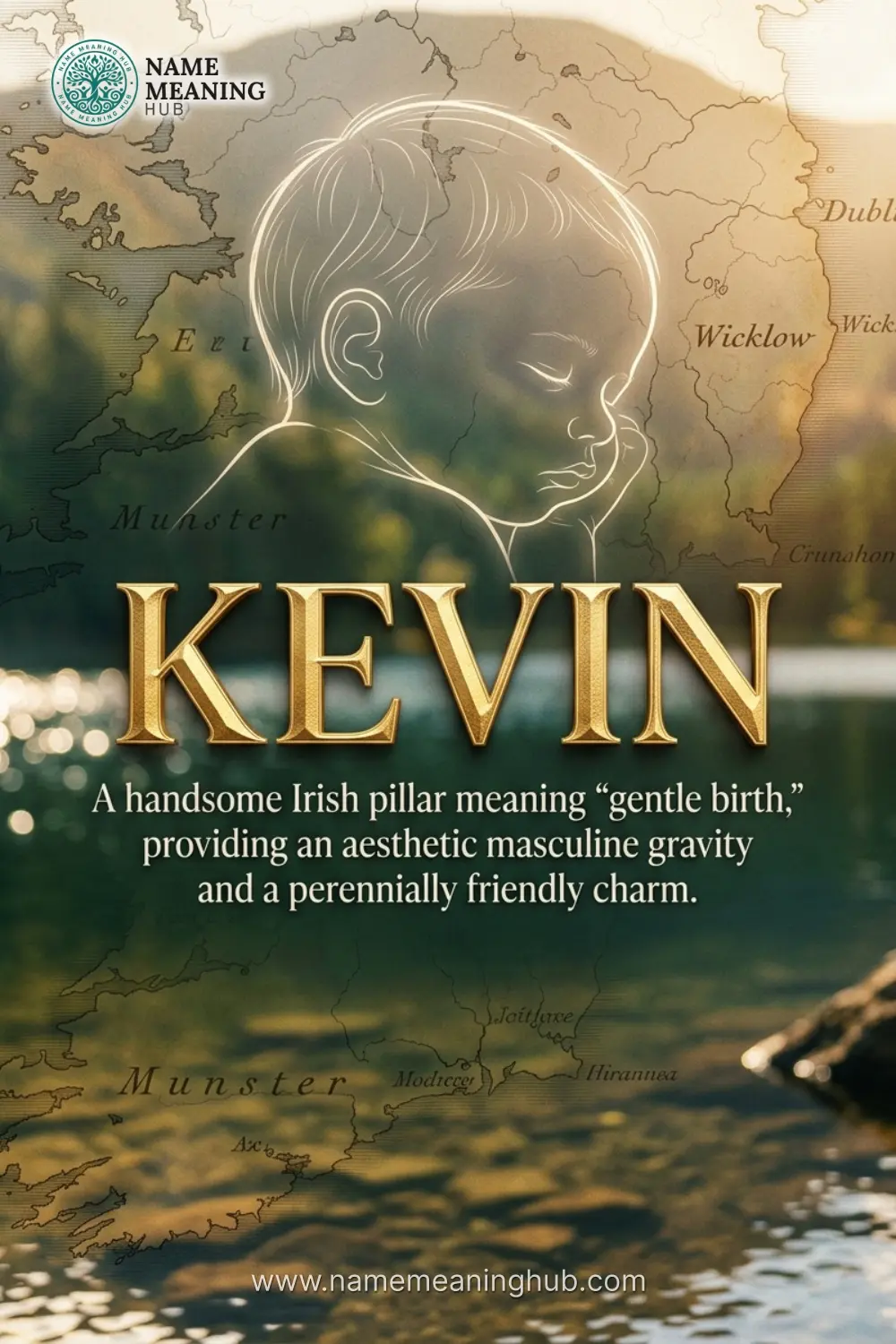
At first glance, the meaning of Kevin can sound more decorative than the name itself. “Handsome birth” is not a phrase modern parents use in ordinary conversation, and it can seem almost too refined for a name that has lived so long in everyday public life. But this is exactly why Kevin is worth looking at more closely. The name preserves an older idea of beauty that feels less like vanity than like blessing. It suggests that something fine, good-looking, or graceful marked the arrival of the child from the very beginning.

Historically, Irish naming traditions often preserved compressed images rather than the broad abstract words many modern people expect from name dictionaries. The old Irish form behind Kevin, Caoimhín, carries that older texture. Some naming books gloss the root family around caomh in terms of beauty, gentleness, dearness, or preciousness, while the saint-name tradition connected to Kevin gives the more specific explanation of “beauteous birth.” The exact phrasing can vary from one book to another, but the emotional field is remarkably consistent: beauty, welcome, favor, and a child marked from the beginning as good to behold.
That gives Kevin a more layered interior than people sometimes assume. The name may look plain in modern use, but its meaning is not plain at all. It does not come from battle, from rank, or from cold authority. It comes from attractiveness at the moment of arrival, and that lends the name an unusually gentle core.
Why the modern sound keeps the meaning from becoming sentimental
One of the reasons Kevin has lasted is that the sound of the name corrects the softness of the meaning. A name meaning “handsome birth” could easily become too pretty, too polished, or too obviously ornamental. Kevin avoids that through sheer phonetic economy. KEV-in is short, sturdy, and stress-first. The opening consonants are firm. The ending is light but not airy. That balance matters because it keeps the name from sounding self-conscious.
In social terms, this is one of Kevin’s deepest strengths. The meaning offers beauty. The sound offers usefulness. Together, they create a name that can move through life without strain. On a child, Kevin sounds warm and approachable. On an adult, it sounds competent, clear, and entirely believable in the boardroom, on a sports team, or in a parish hall. The beauty stays in the hidden history of the name, while the surface remains highly livable.

Kevin in Irish memory is not just a name, but a saint-shaped inheritance
How Caoimhín became Kevin
The attached Irish names book identifies Caoimhín, earlier Cáemgen, as the source form that became Kevin in English. That anglicization matters because it tells the story of the name’s movement from specifically Irish cultural memory into much broader international use. Kevin is not merely a modern invention with Irish flavor. It is the English-facing life of an older Irish saint’s name.
This matters for more than etymology. Anglicized Irish names often survive because they solve a practical problem: they keep the cultural and historical body of the original name, but give it a spoken and written form that moves more easily in English-dominant life. Kevin is one of the most successful examples of that transition. It retains an unmistakably Irish ancestry while sounding fully natural in contemporary English. For more names shaped by the same tradition, explore Irish-origin names.
That partly explains why Kevin has traveled so far beyond Ireland. It is culturally grounded, but socially frictionless. Names with too much local texture can struggle to cross borders. Names with too little texture can feel empty. Kevin sits in the ideal middle ground.
Saint Kevin and the moral atmosphere around the name
The saint connected to the name gives Kevin much of its deeper atmosphere. The Irish names book describes him as the famous abbot and founder of the monastic settlement at Glendalough in County Wicklow, a holy man whose surviving biographies are late and embellished, but whose presence in Irish memory is unmistakable. His death is placed around the year 618. That alone would be enough to make the name historically thick. But the legends attached to him make the name even more vivid.
He is remembered as an animal lover. He is associated with the valley of the two lakes. Most famously, tradition says that while he stood in prayer with his hands outstretched, a blackbird came and built her nest in the palm of his hand, and he kept still until the young birds fledged. This is not merely picturesque folklore. It matters because it gives the name a moral image that is both strong and tender. Kevin is not just a saint’s name in the abstract. It is a name tied to endurance, stillness, care for living creatures, and a kind of disciplined gentleness.
That is one reason the name continues to feel more substantial than its modern plainness might suggest. Behind the short English form stands a saintly figure linked to learning, wilderness, animals, and monastic devotion. Kevin sounds ordinary, but it carries an inheritance of unusual tenderness and resilience.
Kevin sounds modern and social, even though its history is very old
Why the sound of Kevin feels so usable
Phonetically, Kevin has almost perfect everyday balance. The name begins with a strong K, which gives it immediate clarity. It then moves through the short vowel and voiced consonant cluster of Kev-, creating a sound that is grounded without being heavy. The final syllable is lighter and quicker, which keeps the whole name from sounding blunt. This structure helps Kevin feel competent, relaxed, and very easy to remember.
That ease is not trivial. A great many historically rich names become socially limited because they sound too formal or too archaic for ordinary life. Kevin does the opposite. It takes old Irish and saintly material and turns it into something that feels modern almost every time it is spoken. The name can sit in classrooms, offices, and sports rosters without anyone feeling the burden of its antiquity.
How Kevin differs from other “handsome” names
Several name books in the project’s files group Kevin among names meaning handsome, beautiful, attractive, or fair. That is revealing. There are many such names in global naming traditions, but not many of them sound as practically solid as Kevin does. Some handsome names are flamboyant. Some are poetic. Some are highly culture-specific. Kevin is unusually plainspoken. It hides the idea of beauty inside a name that feels close to everyday speech.
This is part of why the name has had such staying power. It does not ask the bearer to perform beauty. It lets the meaning remain background music rather than costume. That restraint is often what makes a name durable.
Kevin in modern American life is familiar enough to trust, but no longer crowded
What the 2024 ranking suggests about Kevin now
Official Social Security Administration (SSA) data places Kevin at No. 196 for boys in the United States in 2024. That rank says something socially useful. Kevin is still deeply recognizable. It has not vanished into obscurity, and it does not feel risky. At the same time, it is no longer sitting in the hottest center of naming fashion. That can actually strengthen the name. It means Kevin can feel familiar without feeling overhanded or overrepeated. To see how Kevin fits within this category, browse strong boy names and meanings.
This middle position is often ideal for a well-built classic. A name that is too rare can feel difficult. A name that is too dominant can feel socially flattened. Kevin now occupies a more relaxed zone. It carries the benefits of widespread recognition while regaining some individuality simply because fewer new parents are choosing it than in its peak decades.
Why Kevin feels more durable than trendy
Some names belong unmistakably to a narrow time window and never fully escape it. Kevin has enough historical depth to resist that trap. Its modern popularity rose and fell in different countries and decades, but the name itself does not feel made by any one of those peaks. Because it is anchored in Irish tradition and saintly history, it has a longer spine than trend-driven names usually do.
This is why Kevin can often return to parents who want something proven rather than fashionable. It is known, but not fragile. Familiar, but not empty. The rank in current American data confirms that the name still lives in active circulation, but with enough distance from saturation to feel freshly available again.
Kevin has a democratic quality that helps it cross classes, ages, and regions
What people often hear in Kevin before they know the meaning
Before anyone is told the origin or the saintly history, most people already hear something stable in Kevin. It sounds approachable, straightforward, and socially equalizing. It is not aristocratic. It is not delicate. It does not sound ornamental or exotic. And that democratic tone is one of the name’s great hidden assets. It allows the name to travel through many kinds of communities without becoming socially narrow.
That broad usability also explains why the meaning never overwhelms the bearer. “Handsome birth” remains beautiful, but Kevin’s public sound keeps the name from becoming a performance of attractiveness. The man named Kevin is allowed to be ordinary in the fullest and healthiest sense of that word. The name does not force an image. It supports a life.
Why Kevin ages well
A name ages well when it can sound natural on a child, a teenager, a father, and an older man without having to reinvent itself. Kevin does that easily. On a child, it sounds energetic and clear. On an adolescent, it sounds familiar without being babyish. On an adult, it has total functional credibility. It does not depend on cuteness in youth or grandeur in maturity. It simply remains solid.
That is often the mark of a very well-made name. It never asks to be excused for one phase of life or another. Kevin carries itself straight through.
Where Kevin opens next
Middle names that sharpen or deepen Kevin
Because Kevin is short and socially direct, the middle name behind it can do especially visible shaping work. A classic middle can make the full combination feel steadier and more formal, while a softer or longer middle can widen the name’s gentler Irish and saintly undertones. If you want the full pairing logic behind that contrast, see Kevin middle names.
Nicknames that make Kevin warmer or more casual
Kevin already feels complete, but it supports a familiar nickname life with ease. Short forms and friendly variants can make the name more intimate or more playful without taking away its basic solidity. To see how those different moods shorten in real life, explore nicknames for Kevin.
Pronunciation cues that keep Kevin clear and grounded
The pronunciation KEV-in is one of the name’s quiet advantages: two syllables, stress first, no visual fuss, no hidden strain. That compact rhythm is part of what keeps Kevin so socially useful. If you want the full sound pattern behind that rhythm, read how to pronounce Kevin.
Why Kevin still sounds like beauty made usable
Kevin lasts because it performs a difficult balancing act without ever seeming to try. It preserves a meaning rooted in beauty and favorable beginnings, carries the history of an Irish saint associated with Glendalough and the blackbird’s nest, and still moves through modern life as an easy, ordinary, unpretentious name. Few names manage that blend of radiance and usability so cleanly.
That is the deepest strength of Kevin. It does not wear its beauty on the outside. It keeps it in reserve, inside the history, the saint-story, the old Irish shape beneath the anglicized form. Outwardly it sounds practical. Inwardly it remains luminous. In the end, Kevin still feels persuasive because it turns an old blessing of attractive beginning into a name sturdy enough for ordinary life. It is beauty that learned how to work.