
Kelly Pronunciation: Easy Breakdown and Speaking Tips

The most revealing pronunciation moment for Kelly is rarely dramatic. It happens at a coffee counter, on the first day of school, or when a receptionist glances at a form and says the name without stopping. That kind of ordinary fluency tells you something important: Kelly is one of those names that lives easily in spoken English. People do not usually circle around it, test several versions, or ask for phonetic rescue. They say it once, and it lands. That everyday smoothness is part of the name’s appeal. Whatever depth its Irish history carries, the spoken form remains strikingly simple and socially effortless.
In current English use, Kelly is pronounced KEL-ee. The first syllable takes the stress, and the second syllable is lighter and quicker. Official pronunciation notation gives essentially the same pattern in American and British English: /ˈkɛli/. That stability matters. It means Kelly is not one of those names whose spelling invites multiple competing pronunciations depending on region or fashion. The sound stays steady. Even when accents shift, the underlying structure remains the same: two syllables, first beat strong, clear l in the center, bright -ee finish.
How Kelly is actually heard when people say it naturally
| Element | Phonetic Detail | Quick Tip |
|---|---|---|
| Everyday pronunciation | KEL-ee | Say it in two clean beats, with the emphasis on the first. |
| IPA (US) | /ˈkɛli/ | The first vowel sounds like the e in “bed,” not the a in “bake.” |
| IPA (UK) | /ˈkɛli/ | British English keeps the same stress and nearly the same vowel shape. |
| Syllable count | 2 syllables | Think of it as KEL + ee, not as one long blended sound. |
| Stress pattern | First syllable stressed | If the second syllable gets the emphasis, the name immediately sounds off. |
| Opening consonant | /k/ | Keep the opening crisp and clear, not softened into a breathy sound. |
| Middle consonant | /l/ | The l helps the name flow, so do not swallow it between the vowels. |
| Ending sound | /i/ | The ending rhymes with “see” and should stay light, not overdrawn. |
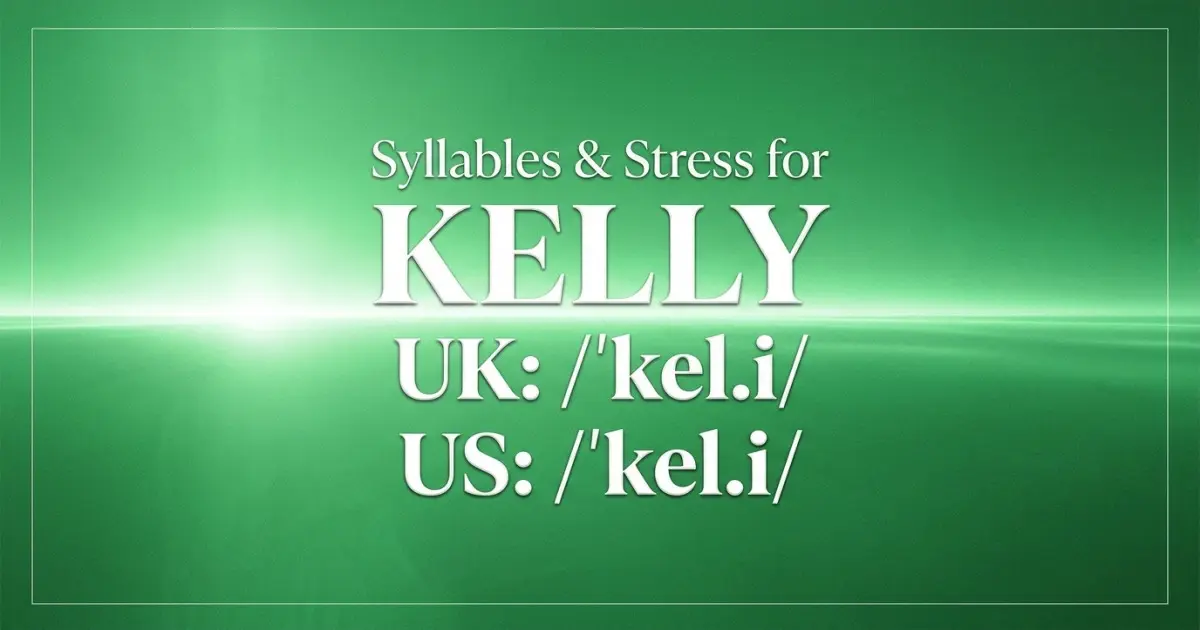
Kelly works because its stress and syllables are uncomplicated
The first syllable carries the whole name
The easiest way to hear Kelly correctly is to notice where the weight falls. It falls immediately. KEL is the strong syllable, and -ee follows it lightly. This first-syllable stress is one reason the name travels so well in English-speaking settings. English is highly comfortable with two-syllable names that begin strongly and end with a lighter release. Kelly fits that pattern perfectly. Pronunciation lands more fully when the name’s roots and history are already in view, so begin with Kelly meaning.
The opening consonant k also helps. It is a voiceless stop, which means the airflow is briefly blocked and then released. In ordinary terms, that gives the name a clean, defined start. Kelly does not drift in quietly. It begins neatly and clearly. That clarity is one reason the name feels so usable in fast social settings.
The liquid consonant is what makes Kelly sound friendly
One of the most important parts of the name is the l in the middle. Linguists call l a liquid consonant, and liquid consonants often soften the movement between sounds. In Kelly, that liquid center keeps the name from sounding blunt. Without it, the name would feel harder and more abrupt. With it, Kelly moves smoothly from the stressed opening into the lighter ending.
This is a subtle point, but it explains a lot about the name’s personality in speech. Kelly begins firmly, then relaxes. That pattern is part of why it sounds approachable rather than severe. The meaning may suggest strength, but the phonetics make the name socially easy.
Where Kelly is most likely to be misheard
Common mistake patterns are minor, not structural
Kelly is not a name that usually suffers from serious pronunciation confusion. Most mistakes happen not because the name is difficult, but because speakers rush. In fast speech, some people flatten the first vowel so that KEL-ee starts edging toward KILL-ee or a more neutral, reduced vowel. Others may clip the second syllable too sharply, making the ending sound almost incomplete. These are small distortions rather than true alternate pronunciations.
The most reliable form remains the same: a clear kel sound, like the start of Kelly in standard dictionary speech, followed by a light ee. Because the name is so familiar, even small deviations are usually corrected by context almost instantly.
Why Kelly is easier than some similar-looking names
It helps to compare Kelly with nearby names that do cause more hesitation. Names like Kaylee, Kylie, Kelsey, or Keely involve vowels that shift more obviously across spellings. Kelly is easier because its spelling and sound line up in a very ordinary way for English readers. The first vowel is the short e of bed, the doubled l gives a stable middle, and the final y naturally reads as ee.
That simplicity is one reason the name has endured. It does not ask the speaker to decode anything unusual. A familiar sound pattern lowers social friction, and Kelly benefits from that every time it is introduced aloud.
Kelly across accents still sounds like itself
American and British English are very close here
Kelly is one of those names that remains remarkably stable across major English accents. Both American and British pronunciation guides give /ˈkɛli/, which means the first vowel, stress placement, and final -ee sound stay essentially the same. Of course, accent always colors the exact texture of a vowel. A speaker in one region may sound slightly broader or tighter than a speaker in another. But these are fine-grained accent differences, not meaningful pronunciation splits.
That stability makes Kelly especially portable. It does not need regional retraining. It does not sound British in one place and Americanized in another. It remains itself with very little adjustment, which is a useful feature for a name that continues to circulate internationally.
Sound neighbors help explain Kelly’s feel
Kelly sits close to several familiar sound-neighbors: Nellie, Shelly, Kelsey, and Ellie. What separates Kelly from them is the crisp k opening and the stress concentration on the first syllable. That opening gives Kelly more definition than a softer name like Ellie. At the same time, the liquid l and the bright ending keep it friendlier than a harsher two-syllable name might feel. The way the name resolves at the end often decides which short forms feel natural in speech, and that becomes clearer in Kelly nicknames.
This mix of firmness and ease is central to the way Kelly sounds in the ear. It is not dramatic. It is dependable. And that is often exactly what makes a name last.
How to practice Kelly until it feels completely automatic
Use real sentence frames, not isolated repetition
The best way to internalize a name is to hear it inside ordinary speech. Kelly is already easy, but sentence practice still helps because it fixes the rhythm naturally. Try saying:
“This is Kelly.”
“Kelly is here.”
“Can you help Kelly?”
“I’m looking for Kelly.”
These short lines preserve the name’s natural stress and make the pronunciation feel ordinary rather than performed. That matters because names are usually spoken in context, not as isolated vocabulary items.
The fastest memory guide
If someone needs a quick reminder, KEL-ee is enough. The first syllable rhymes with words like bell or tell, and the second is the same ee sound heard in see. There is no need to over-explain the phonetics because the spoken form is so direct. Kelly is one of those names that becomes effortless almost immediately once heard once or twice.
That is ultimately the pronunciation story of Kelly. It is a historically rich name with a remarkably low-maintenance spoken form. The sound is stable, the stress is obvious, the accent differences are minimal, and the social usability is high. Kelly does not demand performance from the speaker. It asks only for clarity, and English gives it that with very little resistance.
Common Questions About Saying Kelly
How do you pronounce Kelly in everyday English?
Kelly is pronounced KEL-ee, with the stress on the first syllable and a light -ee ending.
Is Kelly pronounced differently in American and British English?
Usually no. Both American and British English commonly use the same pronunciation pattern, shown as /ˈkɛli/.
What is the most common pronunciation mistake with Kelly?
The most common issue is not a totally different pronunciation, but rushed speech that weakens the first vowel or clips the ending too much. The clearest version stays KEL-ee.
Why does Kelly sound so easy to say?
Kelly has a very familiar English sound pattern: two syllables, first-syllable stress, a clear opening consonant, and a smooth liquid l in the middle. That combination makes it easy to recognize and repeat.