
How to Pronounce Kathryn: Sound Breakdown for Confident Speech
The real pronunciation test for a name usually happens in ordinary public life. It happens when a teacher pauses over the attendance sheet, when a nurse steps into a waiting room, or when a stranger reads the name from a form and has only one chance to say it naturally. Kathryn does very well in those moments. It is visually substantial, but the spoken form is far less complicated than the spelling may briefly suggest. In everyday English, the name is said as KATH-rin, with the stress landing clearly on the first syllable and the whole name moving in one clean two-beat line.
That stability is one of Kathryn’s quiet advantages. The name has history, structure, and a slightly tailored look on the page, yet the sound itself is brisk and highly manageable. Once spoken, it rarely needs explanation. The opening is strong, the middle consonant is distinctive without being difficult, and the ending is light enough to keep the name from sounding heavy. This is why Kathryn can feel formal in writing but easy in the mouth. It carries authority without demanding special handling.
What Kathryn clarifies the moment it is spoken aloud
The fastest way to understand Kathryn is to separate the parts that matter most in actual speech. The name is short, but its rhythm and consonants give it a clearer personality than many other two-syllable classics.
| Element | Phonetic Detail | Quick Tip |
|---|---|---|
| Everyday Pronunciation | KATH-rin | Keep the first syllable strong and let the second syllable finish lightly and quickly. |
| Syllable Count | 2 syllables | Think of the rhythm as strong-weak, not two equally stressed beats. |
| Main Stress | First syllable: KATH | If the emphasis shifts later, the name starts to lose its natural English shape. |
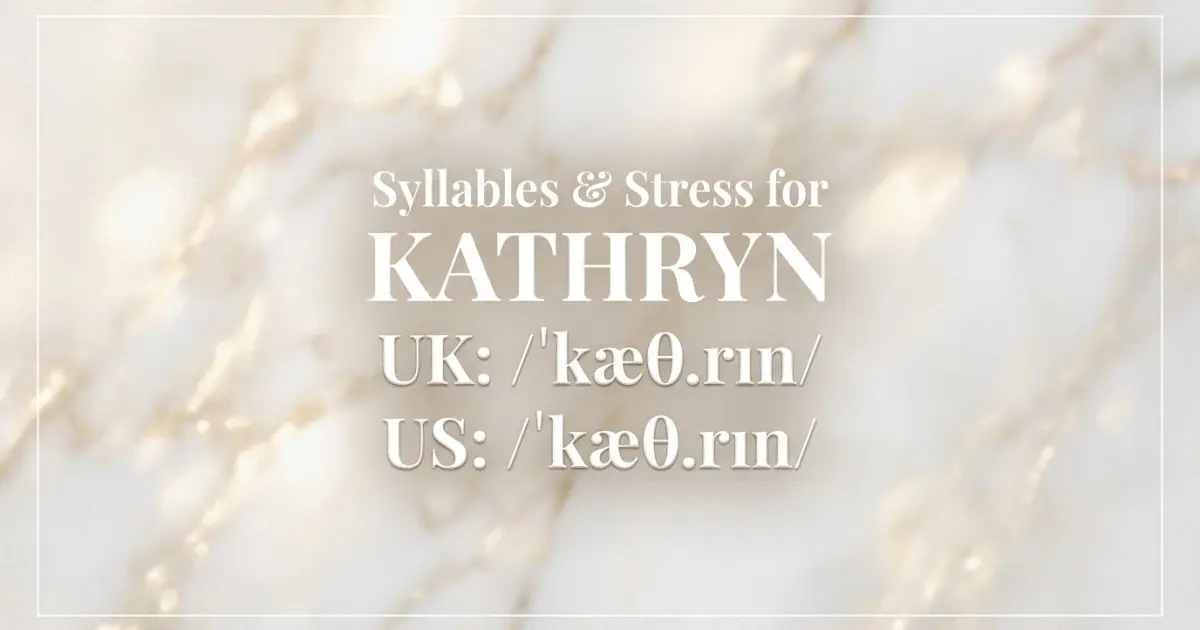
| US IPA | /ˈkæθrɪn/ | The a sound is short and open, like the vowel in “cat.” |
| UK IPA | /ˈkæθrɪn/ | The U.S. and U.K. forms align closely, which makes Kathryn very stable across accents. |
| Ending | -rin | Keep the ending compact and neutral; it should not expand into an extra syllable. |
Why Kathryn sounds firm even when the name itself feels classic
Kathryn is a name whose pronunciation depends more on rhythm and consonant clarity than on length. The correct everyday form is KATH-rin. The first syllable does the main work, and the second trails it lightly. This is one reason the name feels so grounded. It does not flutter. It lands. Before focusing only on syllables and stress, it helps to step back into the fuller frame of Kathryn meaning.
The opening of Kathryn gives the name its authority
The first sound is the hard k, which gives the name a crisp start. That opening consonant is immediately followed by the short a in KATH, and that vowel gives the first syllable breadth without making it slow. Together, those sounds make the opening feel clear, stable, and recognizably English. Parents do not usually need to teach this part more than once. People hear it and understand it quickly.
This front-loaded quality is important socially. A name with a strong first syllable tends to be heard as confident and easy to remember. Kathryn benefits from that. It announces itself without sounding theatrical.
The “th” in Kathryn is the sound that makes the name distinctive
The most interesting phonetic feature in Kathryn is the th. In the IPA, this is /θ/, the same unvoiced fricative heard in words like “thin” and “thought.” A fricative is a sound made by pushing air through a narrow gap, which creates a gentle friction. That is why the middle of Kathryn feels slightly textured rather than purely smooth.
This matters because the th keeps the name from sounding too soft. Without it, Kathryn might feel much looser or more blurred. With it, the name gains precision. The fricative gives the first syllable a subtle edge, and that edge is one reason Kathryn feels more tailored than many other classic feminine names.
The second half of Kathryn should stay compact
The final syllable, -rin, is brief and lightly stressed. It is not supposed to compete with the opening. The vowel here is shorter and more reduced, which helps the name close quickly. That compact ending is part of what makes Kathryn so practical in everyday speech. The name has enough sound to feel complete, but not so much that it drags.
The liquid quality of the r helps bridge the name smoothly from the textured th to the final n. This is why Kathryn sounds firm without sounding harsh. The line is shaped, but not rigid.
Where Kathryn can be misheard, and why most corrections are simple
Kathryn is not a difficult name, but even familiar names can attract small pronunciation errors when speakers overthink the spelling or soften the consonants too much. Most of those errors are minor, and most are corrected instantly once the rhythm is heard.
Common mistake patterns with Kathryn
The most common problem is not getting the first syllable strong enough. If the opening becomes too weak, the name can sound flatter and less defined. Another frequent issue is blurring the th into a simple t or d-like sound. That usually happens in very fast speech, not because the name is hard, but because speakers simplify what they already think they know. The result still resembles Kathryn, but it loses some of the name’s character.
A smaller issue is over-expanding the ending, turning the final syllable into something heavier than -rin. Kathryn works best when the second syllable stays light. It is there to finish the name, not to create a second focal point.
Kathryn and its sound neighbors
Kathryn lives in a sound neighborhood that many English speakers already know well. Names like Katherine, Catherine, Kate, and Kathy create a familiar phonetic field around it. That helps with pronunciation because listeners rarely feel as though they are encountering something entirely new. Even when the spelling makes them glance twice, the mouth already knows the route. Because the strongest energy lands early, the shorter forms often grow from the opening of the name, and that pattern is easier to see in Kathryn nicknames.
That said, Kathryn has its own compact identity. It does not sound as extended as Katherine, and it does not feel as clipped as Kate. Its precise place in that family is part of why the pronunciation feels so satisfying: familiar enough to be easy, distinct enough to feel exact.
Kathryn travels well because the accent differences are minimal
The U.S. and U.K. IPA forms are the same here: /ˈkæθrɪn/. That is more than a technical note. It means that across major English accents, Kathryn keeps its basic architecture. A speaker may color the short a very slightly differently depending on region, but the structure of the name remains stable: strong first syllable, clear th, quick second syllable.
Accent notes that matter less than parents often think
Parents sometimes worry that names with traditional spellings or consonant clusters will shift too much from one country or region to another. Kathryn is not especially vulnerable to that. Because the sound pattern is so established in English, accent differences usually stay cosmetic. The name does not become something else when it crosses from American to British usage. It remains recognizably Kathryn.
That makes the name particularly reliable in a mobile world. Teachers, relatives, colleagues, and strangers in different English-speaking places are all likely to land very close to the same pronunciation.
Practice lines that make Kathryn sound natural immediately
Names are often easiest to learn when they are spoken as part of a real sentence rather than isolated like dictionary entries. Try these aloud:
“Kathryn is here.”
“This is Kathryn.”
“Can Kathryn come with us?”
“Kathryn, your table is ready.”
Each line teaches the same essential pattern: strong first syllable, clear fricative in the middle, light final syllable. Once that rhythm is heard, the name usually sticks at once.
How to correct Kathryn without making the moment awkward
The easiest correction is the briefest one: “It’s KATH-rin.” Most people do not need a deeper explanation than that. They simply need the stress pattern and the clean th. After hearing it once, speakers usually keep it.
That is part of Kathryn’s enduring practicality. It looks substantial, sounds clear, and rarely becomes a burden in daily introductions. In the end, Kathryn is not just easy to pronounce. It is easy to pronounce well.
Common Questions About Pronouncing Kathryn
How do you pronounce Kathryn correctly?
The standard pronunciation is KATH-rin, with the stress clearly on the first syllable.
Is the “th” in Kathryn actually pronounced?
Yes. The th is a real part of the name’s sound and helps give Kathryn its distinctive texture and precision.
Do American and British speakers say Kathryn differently?
Not in any major way. The U.S. and U.K. phonetic forms are effectively the same, so the name stays very stable across both accents.
What is the most common pronunciation mistake with Kathryn?
The most common issue is softening or blurring the th too much. Keeping the opening strong and the th clear preserves the name’s natural sound.