
Katherine Pronunciation: A Fast Pronunciation Guide That Helps
You can hear the real shape of Katherine in ordinary places: a teacher pausing over a class list, a nurse calling a patient from a waiting room, a master of ceremonies reading names before an audience that expects no rehearsal. Katherine is the kind of name most English speakers recognize instantly, yet it still reveals something interesting about speech. On paper it looks long enough to invite uncertainty. In the mouth, though, it usually settles into a pattern that feels remarkably stable: a strong first beat, a softened middle, and a light ending. That is why Katherine so often sounds confident rather than complicated.
Its stability comes from structure. Katherine begins with a stressed syllable that does most of the work. The middle portion relaxes, and the ending does not fight for attention. Research on name use repeatedly shows that people are more comfortable with names that give clear stress and familiar sound cues, and Katherine has both. Even when accents change its texture slightly, the name remains recognizable. The spelling may look formal and historical, but the pronunciation is practical, teachable, and surprisingly forgiving in everyday speech.
What Katherine is actually asking your mouth to do
| Element | Phonetic Detail | Quick Tip |
|---|---|---|
| Everyday pronunciation | KATH-er-in | Say the first syllable clearly, then let the rest of the name relax rather than over-enunciate every letter. |
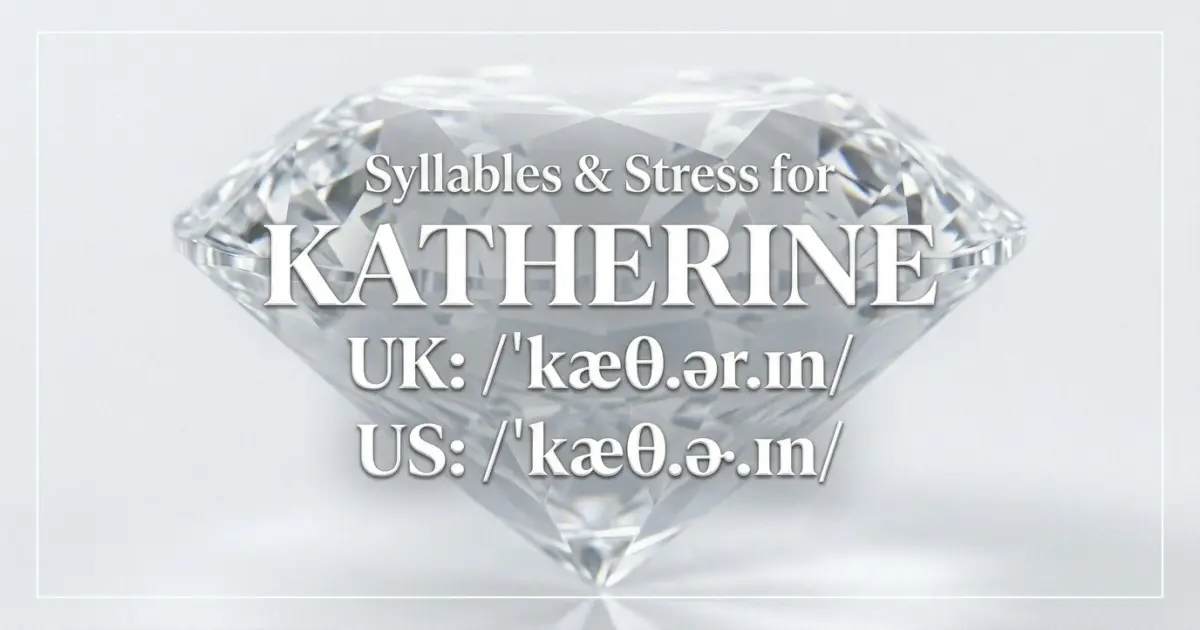
| US IPA | /ˈkæθərɪn/ | In American speech, the middle vowel is often heard as a soft schwa, so the name moves in three clean beats. |
| UK IPA | /ˈkæθrɪn/ | In many British pronunciations, the middle vowel reduces more sharply, making the center sound tighter and brisker. |
| Syllable count | 3 syllables | Think of it as KATH + er + in, with the first part carrying the weight. |
| Stress pattern | Primary stress on the first syllable | If you stress the end, the whole name starts to sound like a different form altogether. |
| The “th” sound | Voiceless dental fricative /θ/ | Use the same th sound heard in “thin,” not a hard t or d. |
| The “r” sound | Liquid consonant after the middle vowel | Do not over-roll it. Let it connect the softened middle to the last syllable naturally. |
| Final ending | Short unstressed -in | Keep the ending light. Katherine usually closes gently rather than with a dramatic finish. |
Katherine works because the stress arrives early
The first syllable carries the name
The most important thing to know about Katherine is that the first syllable does the anchoring. The stress falls on KATH, not on the middle or the end. That first syllable gives the name its authority. Once speakers land there correctly, the rest tends to organize itself. This is one reason Katherine feels easier in practice than its spelling might suggest. You do not need to pronounce every written unit with equal force. In fact, doing so makes the name sound less natural. Before focusing only on syllables and stress, it helps to step back into the fuller frame of Katherine meaning.
The opening vowel in American English is the same broad short vowel heard in words like “cat.” After that comes the th, a fricative made by placing the tongue near the teeth and letting air pass through gently. It is not explosive. Katherine does not begin with a punchy stop in the middle of the first syllable. It begins with a release of air, which helps explain why the name sounds clear rather than blunt.
The middle and ending are meant to soften
After the stressed opening, Katherine relaxes. In the American pattern, the middle is often a schwa-like sound, the neutral vowel heard in many unstressed syllables. That is why KATH-er-in sounds natural while an overcareful KATH-eh-rin can sound stiff. The name is not slurred, but it is allowed to reduce. English speech does this constantly. Katherine fits comfortably inside that habit.
The final -in also matters. It should be short and light, not stretched into something like -een. That final distinction keeps Katherine separate from longer neighboring forms such as Katarina or Katerine-style pronunciations in other languages. If the last syllable becomes too strong, the whole name drifts away from standard English usage.
Why Katherine stays recognizable from one accent to another
American Katherine tends to keep the middle vowel
In the United States, Katherine is commonly pronounced /ˈkæθərɪn/. That means many speakers hear three fairly clear parts: KATH, a soft middle vowel, and in. The rhythm is even, and the name often feels calm and fully articulated. This helps explain why the pronunciation guide commonly written as KATH-er-in feels intuitive to American readers. The name sounds complete without sounding slow.
British Katherine often compresses the center
In the United Kingdom, Katherine is often given as /ˈkæθrɪn/, where the middle vowel reduces more sharply and the name moves more quickly through the center. The practical effect is not that the name changes identity, but that it tightens. Some speakers will produce something closer to KATH-rin than KATH-er-in. This is a very normal accent difference, not a mistake. It is one of the reasons Katherine feels internationally sturdy within English: the skeleton of the name remains intact even as the center contracts slightly.
This is also where a useful linguistic term helps. The r in Katherine is a liquid consonant, which means it flows rather than stops. Liquids often help a name absorb accent variation gracefully. When speakers reduce vowels around them, the name can still remain smooth and identifiable. Katherine benefits from that. The r helps hold the middle together even when pronunciation becomes brisker.
Catherine, Katherine, and Kathryn are often spoken alike
One of the most practical pronunciation notes is that spelling does not always predict a major sound difference here. Katherine and Catherine are very often pronounced the same in modern English. Kathryn frequently lands close to the same spoken form as well, especially when the center is reduced. That means listeners usually rely on spelling only after hearing the name, not while hearing it. In conversation, these forms are neighbors. On paper, they are distinctions of style and tradition more than radically separate sound identities.
Where Katherine gets misread, mis-stressed, or overcorrected
The most common mistake patterns
The first common mistake is shifting the stress too far to the right. If someone says kath-er-EEN, the name begins to sound like another variant rather than Katherine. The second mistake is overpronouncing the middle, giving every vowel equal weight. Katherine is not difficult because English does not expect every syllable to be equally strong. The natural form uses reduction. The third mistake is turning the final syllable into -een or -ine. That changes not just texture but category.
Another mistake is replacing the th with a hard t or d. This can happen in fast speech or in accents that handle the fricative differently, but in standard English pronunciation the th is part of what keeps Katherine sounding recognizably Katherine. If that sound disappears completely, the name may feel clipped or less familiar to English-speaking ears.
Sound neighbors that can pull Katherine off course
Katherine sits near several other names that can influence how people guess its pronunciation: Katrina, Katarina, Catrin, Kathleen, and Katie among them. That matters because readers often borrow sound patterns from familiar neighbors. If someone knows Katrina well, they may expect a stronger second syllable in Katherine than the name actually uses. If they know Kathleen, they may overlengthen the ending. The safest correction is simple: say Katherine as a front-stressed three-syllable name with a softened middle. Once the sound pattern is clear, some shortenings stop feeling optional and start feeling natural, and the clearest map is in Katherine nicknames.
Practicing Katherine until it sounds effortless
A three-step mouth pattern
The easiest way to practice Katherine is to think in three motions. First, land firmly on KATH. Second, relax the center into a soft connecting sound. Third, close lightly on in. If you try to drive each syllable with equal force, the name becomes mechanical. If you let the first syllable lead and the rest follow, it becomes natural very quickly.
Practice lines for real speech
Practice works best in phrases, not in isolation. Try these aloud:
“Katherine is here.”
“I’m looking for Katherine.”
“Katherine, your table is ready.”
“This is Katherine Ross.”
These lines are useful because they place Katherine in the kinds of social settings where names are actually spoken: introductions, roll calls, appointments, and direct address. If the name feels smooth in these phrases, you are already saying it naturally.
The best final check is speed. Say Katherine slowly once, then at conversational pace. The stressed opening should remain clear in both versions. The middle should not vanish, but it should become lighter at normal speed. That is the sign you have found the living pronunciation rather than the overexplained one.