
Best Middle Names for Kate: Elegant, Classic, and Sweet Ideas
A middle name often carries the emotional work that a first name cannot afford to do in public. The first name has to step into classrooms, forms, introductions, and daily speech with enough clarity to survive repetition. The middle name is where parents often place memory, softness, ambition, repair, or balance. It is the quiet second movement of a full name: the place where a sharp first name can be gentled, where a delicate first name can be steadied, where family history can be carried without burdening everyday use. In practical terms, the middle name is often less about beauty in isolation than about how it changes the whole line.
That is especially true with Kate. Because Kate is short, crisp, and one-syllable, it arrives with unusual force. It does not need help becoming clear. What it often needs is modulation. A middle name can widen Kate, soften it, historicize it, romanticize it, or keep it lean and modern. Without that second piece, Kate can feel very exact—which is part of its appeal, but also why the middle name matters so much. When parents choose a middle for Kate, they are not merely adding ornament. They are deciding how much air, history, and warmth the full name will carry. To make sure the middle name does not pull against the first name’s roots, it helps to check the heritage and tone carried in Kate meaning.
What kinds of middle names let Kate open up
Kate is structurally simple, but that simplicity makes the pairing logic more important, not less. The table below shows the main directions a middle name can take the name.
| Style | Recommended Names | Why it works with Kate |
|---|---|---|
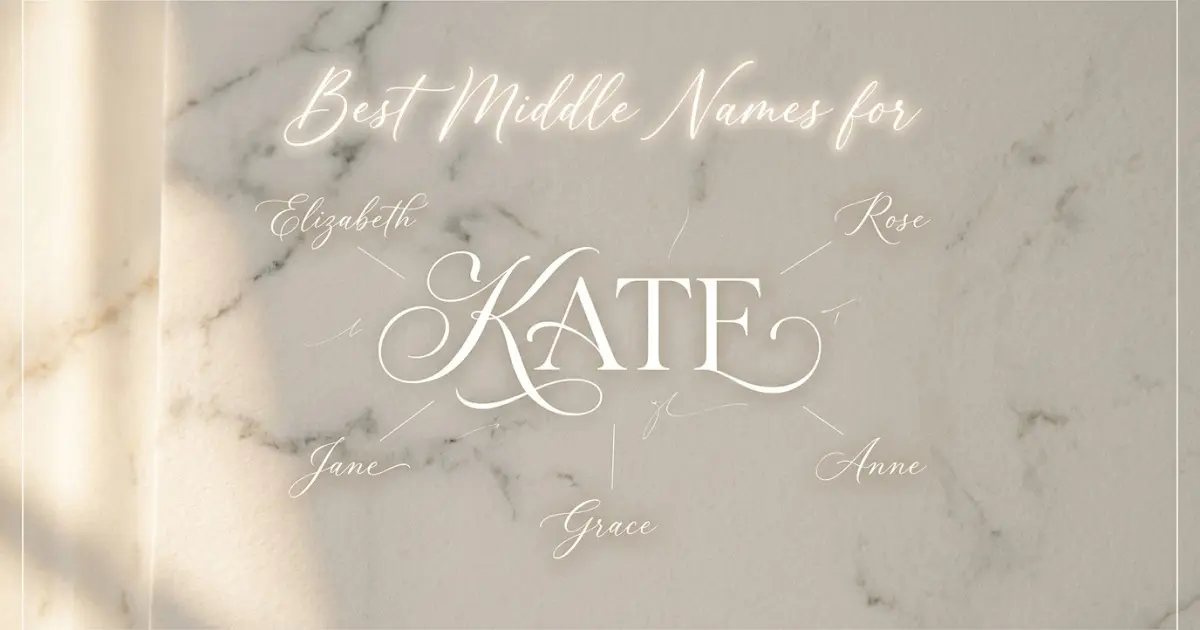
| Classic and graceful | Elizabeth, Louise, Eleanor, Marie | These names lengthen Kate elegantly and give the full name historical depth without disturbing its clean first beat. |
| Romantic and lyrical | Noelle, Celeste, Juliet, Emilia | They soften Kate’s clipped edge and create a more flowing, literary cadence. |
| Modern and neat | Blair, Reese, Quinn, Sage | These middles keep Kate sleek and contemporary, especially with longer surnames. |
| Gentle traditional | Anne, Rose, Claire, Jane | Short classic middles preserve Kate’s restraint and work well when the surname provides the rest of the shape. |
| Family-honoring staples | Margaret, Catherine, Josephine, Frances | Longer inherited names give Kate emotional and genealogical weight while allowing the first name to stay brisk in everyday life. |

Kate sounds best when the middle name changes the tempo
Kate is one syllable, and that fact governs almost everything. One-syllable first names tend to sound strongest when the middle name either lengthens the rhythm or changes the texture. If the middle name simply repeats the same clipped energy, the full name can become overly hard or too compressed. That does not mean short middles are wrong. It means they need to be chosen deliberately. If you want the IPA, accent detail, and stress pattern behind the flow advice, the next stop is how to pronounce Kate.
Why longer middles often flatter Kate
In most cases, Kate pairs beautifully with two-, three-, and four-syllable middles because they give the name somewhere to travel. Kate Elizabeth, Kate Eleanor, Kate Amelia, and Kate Josephine all work for the same reason: the first name strikes cleanly, then the middle unfolds. The result is balanced and satisfying. The first name remains memorable, but the middle supplies resonance.
This is one reason Kate has such a strong formal life. It can handle an elaborate middle without sounding overburdened. In fact, the contrast is often the point. A name like Kate Josephine feels stylish precisely because it combines restraint and richness in one line.
When short middles still work with Kate
Short middles can absolutely succeed, especially when the surname is longer or more complex. Kate Rose, Kate Anne, Kate Blair, and Kate Quinn all have clarity and strength. The key is to avoid making the entire full name feel too clipped. If the last name is also short, a one-syllable middle may create a sequence that sounds more abrupt than elegant. In those cases, even a modest two-syllable middle can improve the balance immediately.
The simplest test is to say the full name aloud in one breath. If it sounds like three hard knocks in a row, the middle may need more fluidity.
Kate becomes especially beautiful when the middle brings grace
Because Kate is so disciplined, it responds well to middles that carry a little more lyricism. This does not mean the combination has to become ornate. It means the middle can introduce softness that the first name intentionally withholds.
Romantic middles that soften Kate without weakening it
Kate Noelle works because the long vowels broaden the line after the clipped first beat. Kate Celeste lifts the whole combination and gives it a slightly more luminous quality. Kate Juliet is especially strong because the literary texture of Juliet meets the plain confidence of Kate in a way that feels balanced rather than theatrical. Kate Emilia and Kate Elena do similar work, adding movement and warmth without overwhelming the first name.
These pairings succeed because Kate stays in charge of the full name. The middle adds atmosphere, but the name still begins from a place of clarity. That is the ideal effect with lyrical middles: to widen Kate, not to dilute it.
Why some romantic pairings go too far
Parents should be more careful with middles that are both highly decorative and heavily breathy, especially if the surname is also long. A full combination like Kate Evangeline Montgomery may sound beautiful on paper but feel overextended in use. The problem is not that Kate cannot support a long middle. It can. The problem is that the rest of the line must still move. If every part after Kate becomes languid, the first name’s clean force gets swallowed.
With Kate, the best romantic pairings are controlled ones. The contrast should feel elegant, not indulgent.
Kate can stay crisp if the middle name knows not to compete
There is another powerful route: keep the whole combination lean. For parents who love Kate because it is precise, modern-feeling, and free of frills, the middle name can reinforce that identity instead of softening it. This works especially well with surnames that are longer, more traditional, or visually dense.
Kate Blair feels urban and assured. Kate Quinn is concise and stylish. Kate Reese has a cool brightness. Kate Sage brings in softness without losing the streamlined feel. In each case, the middle does not try to outsing Kate. It simply sharpens the silhouette.
This approach is often best when the surname already carries heritage or complexity. Kate Quinn Harrington, for example, has a very different social posture from Kate Eleanor Harrington, but both can work. The first keeps the center of gravity tight. The second expands it. The choice depends on whether the family wants the overall name to feel sleeker or more traditional.
Kate with your surname is where the decision becomes real
No middle-name advice is worth much until the surname is included. Kate is unusually sensitive to surname harmony because the first name is so compact. A longer, heavier surname often welcomes a simpler middle. A short surname often benefits from a more developed middle to avoid making the whole name feel too abrupt.
With short surnames, Kate often needs more middle-name substance
If your last name is one syllable or very brief, Kate usually sounds strongest with a middle that adds a second layer. Kate Eleanor Shaw, Kate Louise Grant, and Kate Emilia Brooks all gain from that extra measure. The middle creates shape that the surname may not provide.
With long surnames, Kate can afford restraint
If the surname is long or double-barrelled, Kate often benefits from a more compact middle. Kate Anne Whitmore, Kate Blair Donnelly, and Kate Rose Montgomery keep the full name from becoming overloaded. In these structures, the surname is already doing enough work. The middle only needs to bridge.
Sound transitions matter too. Kate ends with a firm t, so middles that begin with a vowel or a liquid consonant often produce especially attractive movement. Kate Eleanor, Kate Olivia, and Kate Louise all glide cleanly out of the final t. Middles beginning with another hard consonant can still work, but they create a more percussive line. That can be appealing if intentional, but it is worth hearing aloud before deciding.
Kate initials and caution notes deserve a serious look
Because Kate is so short, every other element becomes more visible. Initials matter. Repetition matters. Overly clever pairings matter. Before settling on a middle, write the full initials and say the full name as though it belonged to a real child, not a list of favorites. The beauty of Kate is that it feels effortless. A poor pairing can undo that quickly.
There are three common caution zones. The first is overcompression: Kate Rose Lee may be simple, but with certain surnames it can feel too slight. The second is overornamentation: Kate Anastasia Worthington may look lovely, but if the family wants everyday ease, it may feel more ceremonial than usable. The third is tonal mismatch: a very whimsical middle can make Kate feel less coherent, because Kate itself is not whimsical. It is clear and exact. The best middles either complement that quality or offset it with controlled softness.
Family honor names deserve special mention. Kate is one of the best first names for carrying a longer inherited middle because it leaves so much room. If you want to use Margaret, Teresa, Josephine, Beatrice, or Frances after Kate, the pairing can feel purposeful rather than crowded. That is one of Kate’s hidden strengths. It can carry history lightly.
The best middle names for Kate are the ones that understand Kate’s discipline
Kate does not need embellishment for its own sake. What it needs is a middle name that understands what the first name already brings: one clean beat, one clear identity, and a style built on exactness. The strongest middles either lengthen that exactness into grace—Elizabeth, Louise, Eleanor, Noelle—or preserve its sleekness with equal confidence—Blair, Quinn, Reese, Anne.
The choice depends on the life you want the full name to have. If you want warmth and history, Kate Josephine or Kate Margaret may be the right answer. If you want literary elegance, Kate Juliet or Kate Celeste may do the work. If you want a polished modern line, Kate Blair or Kate Quinn may fit best. What matters is not which middle is most fashionable, but which one makes Kate feel fully itself in the context of your surname.
When the pairing is right, the effect is unmistakable. Kate stays clear, but the whole name gains dimension. That is what a good middle name is supposed to do: not steal the line, but finish it.
Middle Name FAQ for Kate
Does Kate need a longer middle name?
Often, yes. Because Kate is only one syllable, a longer middle name can create a more balanced and elegant full-name rhythm. It is not required, but it is usually the easiest way to give the name more depth.
Can Kate work with another one-syllable name in the middle?
Yes, especially with longer surnames. Pairings like Kate Rose, Kate Anne, and Kate Quinn can sound strong and stylish. The key is to make sure the full name does not become too clipped when the surname is added.
What should I avoid when pairing a middle name with Kate?
Be careful with middles that are either too slight, too decorative, or too tonally disconnected from Kate’s clean style. The best pairings preserve the first name’s clarity while adding either grace, weight, or smoother rhythm.