
Kale Pronunciation: Sound Breakdown for Confident Speech

Imagine a name being read from a camp sign-in sheet: “Kale.” For most English speakers, the spelling gives a quick clue, but the word association may make them pause for a second. Is it said like the leafy green? Is it a short form of another name? In this case, the pronunciation is simple and direct: KAYL, one syllable, rhyming with “sale,” “tail,” and “mail.”
That clarity is one of Kale’s practical strengths. The name has Hawaiian origin, carries the meanings “free man; cabbage,” and sounds exactly as its clean four-letter spelling suggests in everyday English. There is no hidden second syllable, no final “ee” sound, and no alternate stress pattern to manage. Kale is brief, bright, and smooth: a one-beat name with a crisp opening and a liquid ending.
How Kale is actually said when the simple spelling does all the work
| Element | Phonetic Detail | Quick Tip |
|---|---|---|
| Standard pronunciation | KAYL | Say it in one syllable, rhyming with “sale” and “tail.” |
| US IPA | /keɪl/ | The vowel is the long a sound, like the vowel in “day.” |
| UK IPA | /keɪl/ | The same IPA structure keeps the name stable across major English accents. |
| Syllable count | 1 syllable | Do not add another beat; Kale is not “KAY-lee.” |
| Stress pattern | Full stress on the only syllable | Because Kale has one syllable, the whole name receives the emphasis. |
| Opening sound | /k/ | Begin with a clean hard k, as in “kite.” |
| Vowel sound | /eɪ/ | Use the bright long a sound heard in “make” and “lake.” |
| Final sound | /l/ | End with a smooth liquid consonant, not a hard stop. |
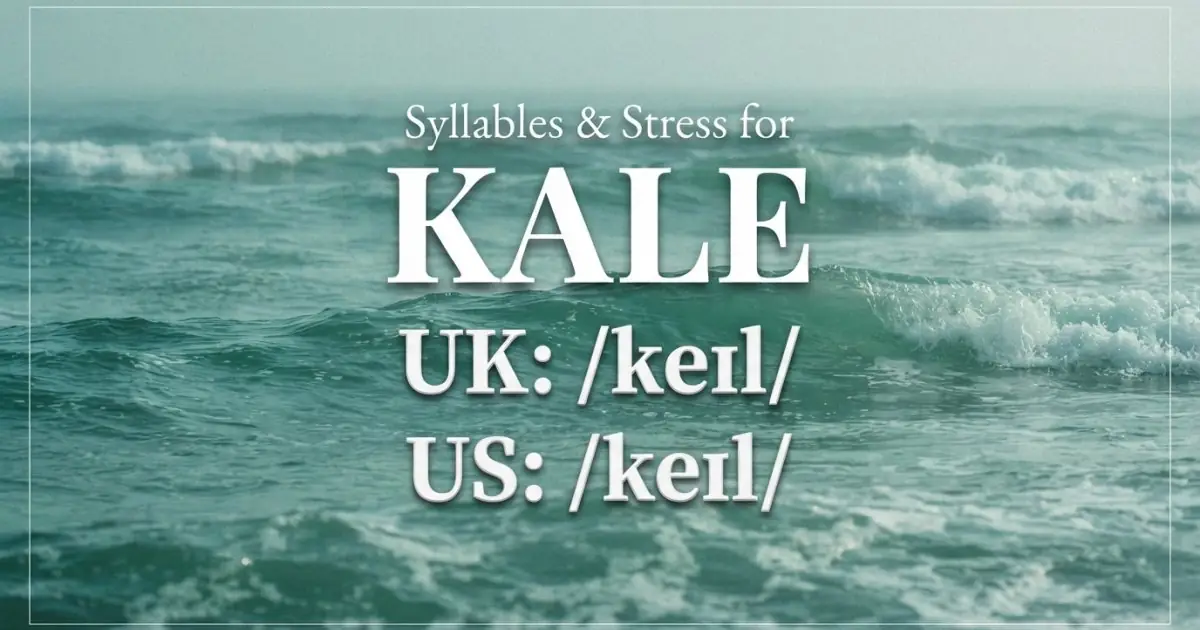
The one-syllable clarity that gives Kale its strength
Kale is pronounced in one clean beat: KAYL. That one-syllable structure makes it easy to call, easy to remember, and easy to use in daily life. It does not need a shortened form to become practical, and it does not ask speakers to learn an unfamiliar stress pattern. Before focusing only on syllables and stress, it helps to step back into the fuller frame of Kale meaning.
The IPA form /keɪl/ shows three simple sound pieces: /k/, /eɪ/, and /l/. In ordinary language, the name begins with a firm k, opens into the long a sound, and closes on l. That gives Kale a sound that is crisp at the start and smooth at the finish.
The hard K gives Kale a precise opening
The first sound in Kale is /k/, a voiceless stop consonant. A stop consonant briefly blocks the airflow and then releases it. That release gives the name a clean, decisive beginning. The sound is familiar from words like “kite,” “key,” and “kind.”
This opening helps Kale feel strong despite its softness elsewhere. A name that begins with k often has immediate clarity in speech. It cuts through background noise more easily than a name beginning with a very soft vowel or breathy sound.
The final L keeps Kale from sounding blunt
The ending of Kale is /l/, a liquid consonant. In accessible terms, a liquid consonant is a smooth sound, like l or r, that lets the voice flow rather than stop sharply. This is why Kale does not feel as clipped as names ending in hard consonants such as Jack, Beck, or Knox.
The final l gives the name a gentle close. It still feels complete, but it does not snap shut. That balance makes Kale sound bright, calm, and self-contained.
Kale across American and British accents
Kale has the same IPA pronunciation in U.S. and U.K. English: /keɪl/. That means the broad structure stays stable across major English accents. Speakers may vary slightly in vowel color depending on region, but the name remains KAYL.
The long-a sound stays recognizable
The vowel in Kale is the long a sound heard in “day,” “lake,” and “name.” In some accents, this vowel may sound slightly narrower or broader, but it remains the same basic diphthong. The name should not be pronounced with the short a of “cat” or “back.”
This distinction helps separate Kale from names or words with similar letters but different vowels. The easiest model is the word “kale” itself: KAYL.
Why Kale is easy to teach aloud
Kale is highly teachable because it has no silent letters and no complex consonant cluster. The spelling points clearly toward the pronunciation. If someone hesitates, a simple guide works: “Kale, like the word, rhyming with sale.”
That makes the name practical in classrooms, appointments, sports rosters, travel documents, and introductions. The main issue is not pronunciation difficulty, but whether people notice the familiar vegetable word. Sound-wise, Kale is straightforward.
Common pronunciation mistakes with Kale
Kale is simple, but a few mistakes can still happen when people meet it as a personal name rather than a food word. Most errors come from adding sounds that are not there or guessing a different vowel.
Mistake 1: saying Kale like “KAL”
One possible mistake is using a short a, making the name sound like “Kal.” That is not the intended pronunciation. Kale uses the long a sound: KAYL.
A clear correction is: “It rhymes with sale.” This gives the listener the vowel and the ending in one familiar comparison.
Mistake 2: adding an extra syllable
Another mistake is turning Kale into “KAY-lee” or “KAY-luh.” Kale has one syllable only. It should not have an added vowel at the end.
This matters because adding a second syllable changes the whole style of the name. KAYL feels clean and modern. “KAY-lee” feels like a different name entirely.
Mistake 3: over-softening the opening
The opening should be a clear k sound. It should not drift toward a soft g or a vague vowel beginning. The name starts firmly, then smooths out at the end.
That contrast is part of Kale’s sound identity: clear beginning, bright vowel, gentle finish.
Sound neighbors that make Kale easier to place
Kale is easy to explain through sound neighbors. It rhymes with sale, tail, mail, and scale. It also sits near names such as Cale, Kail, Cade, Cole, and Dale, though each has its own sound and style. Because the strongest energy lands early, the shorter forms often grow from the opening of the name, and that pattern is easier to see in nicknames for Kale.
Kale and Cale
Kale and Cale are pronounced the same way in this guide: KAYL. The difference is spelling and visual impression. Kale has the recognizable word-name spelling, while Cale looks more like a traditional name form.
This distinction may matter in writing, but not in speech. If someone knows the name Cale, they already understand the pronunciation of Kale.
Kale beside Cole and Dale
Cole and Dale are useful comparisons because they share Kale’s one-syllable structure and final liquid sound. Cole has a darker oh vowel; Dale has the same long a vowel but begins with a softer d. Kale feels brighter and crisper because of the k opening.
These neighbors help show why Kale is easy to wear as a name. Its sound belongs to a familiar English pattern, even if its exact use as a given name is rare.
Practice lines for saying Kale naturally
Because Kale is so short, it is best practiced inside real sentences. The name should sound relaxed, not overexplained. Keep the vowel bright and the final l smooth.
Everyday practice
- “Kale is ready for school.”
- “Can you give this to Kale?”
- “Kale, your jacket is by the door.”
- “This is my son, Kale.”
- “Kale has a one-syllable name.”
Full-name practice
- “Kale Alexander has a strong formal rhythm.”
- “Kale Thomas sounds classic and grounded.”
- “Kale Everett gives the name a polished shape.”
- “Kale Makai deepens the Hawaiian feeling.”
- “Kale Jude is short, clean, and easy to say.”
The simplest memory aid is this: Kale is pronounced KAYL, rhyming with “sale.”
Pronouncing Kale: Common Questions
How do you pronounce Kale?
Kale is pronounced KAYL. It has one syllable and rhymes with “sale,” “tail,” and “mail.”
What is the IPA pronunciation of Kale?
The IPA pronunciation of Kale is /keɪl/ in both U.S. and U.K. English.
Is Kale pronounced like the vegetable?
Yes. Kale is pronounced like the vegetable word: KAYL.
How many syllables are in Kale?
Kale has one syllable. The whole name is spoken in one beat: KAYL.
What is the most common pronunciation mistake for Kale?
The most common mistake is adding an extra syllable or using a short a. The correct pronunciation is KAYL, rhyming with “sale.”