
How to Pronounce June: Syllable Guide and Easy Stress Tips

The real test of a name’s pronunciation rarely happens in a quiet study. It happens at a front desk, in a waiting room, on the first day of school, or in that small pause before someone says a name aloud for the first time. June has an advantage in these ordinary moments. It is visually short, phonetically stable, and immediately familiar to most English speakers. A teacher looking down at a class list is unlikely to hesitate for long. A barista calling it across a crowded room will almost always land it correctly. That ease is part of the name’s enduring usefulness: June is one of those names that does not ask the wearer to supervise it constantly.
But ease should not be confused with emptiness. June is simple because it is well built. It has one syllable, one long vowel, and a clear closing consonant. There is no decorative complexity to hide behind. If the sound works, it works because every part of the word is pulling its weight. That is why pronunciation matters even for a name this short. June is not difficult, but its entire elegance depends on getting that one syllable right: the opening j should be smooth, the vowel should stay long and open, and the final n should close the sound neatly rather than vanish.
What People Are Actually Hearing When They Hear June
Because June is so compact, a pronunciation guide is less about decoding and more about precision. The table below clarifies the small elements that make the name sound polished rather than flat.
| Element | Phonetic Detail | Quick Tip |
|---|---|---|
| Common spoken guide | JOON | Think of one clean beat, not two. The name should feel smooth and complete in a single breath. |
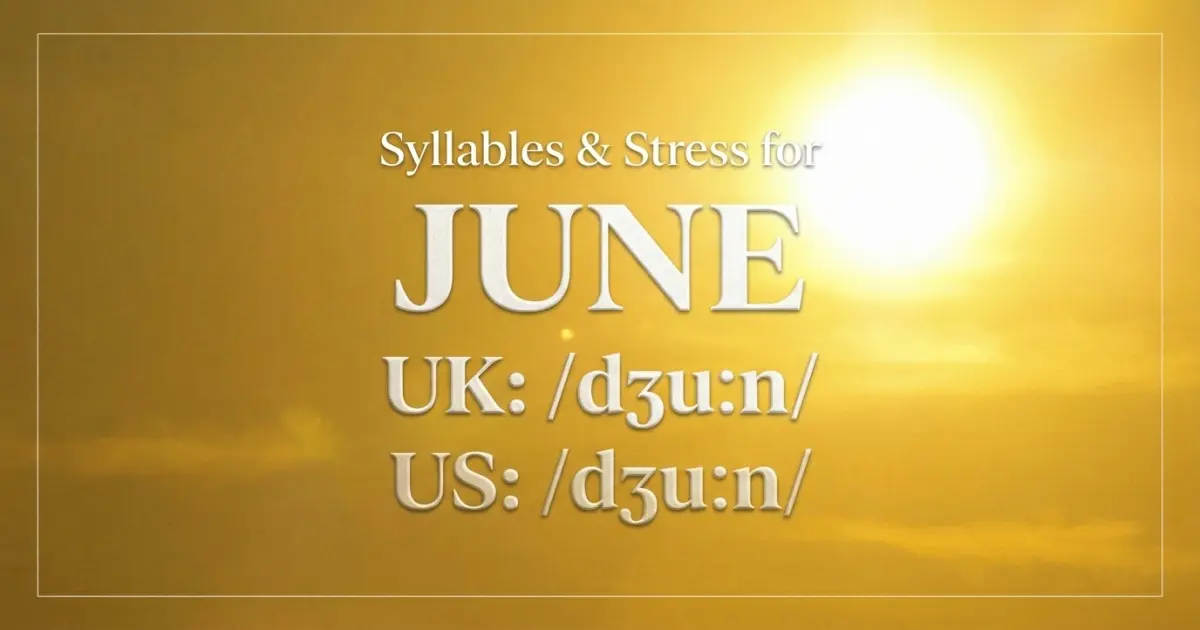
| IPA (US) | /dʒuːn/ | The opening sound is the same family as the start of “joy,” followed by a long “oo” vowel. |
| IPA (UK) | /dʒuːn/ | The pronunciation is stable across both major forms of English, which makes the name especially easy to carry internationally. |
| Syllable count | 1 syllable | There is no secondary stress to manage. The whole name arrives at once, which is part of its crisp charm. |
| Opening consonant | Voiced affricate /dʒ/ | Start it softly, as in “June,” “jewel,” or “Juneau,” not with a hard stop or exaggerated “ch” sound. |
| Main vowel | Long /uː/ sound | Keep the vowel long, like “moon,” not clipped or flattened. |
| Ending consonant | Final /n/ | Let the name close lightly and clearly. Do not swallow the ending or blur it into the next word. |
June Works Because It Is a One-Syllable Name with Room Inside It
One-syllable names can be deceptive. Some are abrupt and almost percussive. Others are so slight that they disappear in conversation. June succeeds because it has internal space. The voiced affricate at the front gives the name a gentle but distinct start, the long vowel stretches the sound open, and the final nasal consonant gives it a soft landing. That combination creates a name that is brief without sounding clipped. Pronunciation lands more fully when the name’s roots and history are already in view, so begin with June meaning.
The vowel is doing more work than most people realize
The emotional tone of June lives largely in its vowel. A long oo sound tends to feel rounder and calmer than a short front vowel. That is part of why June sounds gentle rather than brisk, even though it is only one syllable long. If the vowel is shortened too much, the name loses that calmness and begins to sound less elegant. In practical terms, say it with the same sustained vowel you would use in moon or tune, not a rushed version.
The final consonant should finish the name, not vanish
Because June ends in n, there is a temptation in very fast speech to let the name blur into the next word. That does not usually create confusion, but it can make the name sound less polished. A clear final nasal keeps the one-syllable structure intact. June should feel finished, not abbreviated by accident.
Where June Can Still Go Slightly Wrong in Everyday Speech
June is not a high-risk pronunciation name, but even highly familiar names can be flattened by speed, regional habit, or careless imitation. Most mistakes do not come from ignorance. They come from under-articulation.
Common mistake patterns around June
The first minor error is clipping the vowel so much that June loses its brightness. This usually happens in rushed speech, where the long oo gets compressed. The second is turning the opening into a slightly harsher sound than necessary. The j in June is not a fricative like the zh sound heard in some foreign borrowings, and it is not the sharp ch of chew. It is the familiar English affricate /dʒ/: smooth, voiced, and easy.
The third issue is not exactly a mispronunciation but a misplacement of tone. Some speakers, seeing such a short name, overdo its cuteness and make it sound smaller than it is. June is gentle, but it is not babyish. Spoken well, it sounds calm and self-possessed, not sing-song.
Accent notes for June
One reason June is so durable is that accent differences do very little damage to it. In both American and British English, the IPA remains /dʒuːn/. Regional accents may color the vowel slightly or alter the speed of the final consonant, but the overall identity of the name remains stable. That stability is socially valuable. It means the name is easy to recognize, easy to repeat, and unlikely to require constant correction when spoken by people from different English-speaking backgrounds.
This is not true of every short name. Some short names change character dramatically across accents. June does not. It keeps its center.
June Has Familiar Sound Neighbors, and That Helps People Say It Right
Names are often easier to pronounce when they sit near familiar words in the sound system of a language. June benefits from this. English speakers already know how to produce its opening affricate, its long vowel, and its final nasal from common words such as June, june, moon, tune, and spoon. That means the name does not require anyone to learn a new mouth shape. It only asks them to use an existing one cleanly. Once the sound pattern is clear, some shortenings stop feeling optional and start feeling natural, and the clearest map is in June nicknames.
This familiarity is part of why June sounds both classic and accessible. It belongs comfortably inside English phonetics. There are no silent letters, no unstable stress patterns, no hidden liquid consonants, and no difficult clusters. Even its softness is built from highly familiar sounds. That makes the name friendly to the ear in a way many more elaborate names are not.
How to Practice Saying June So It Sounds Like a Name, Not Just a Word
The best way to practice a short name is not to isolate it endlessly, but to put it into the situations where names are actually spoken. June should feel natural in greeting, calling, introducing, and checking in. Practice it inside ordinary sentences, and the rhythm settles almost immediately.
Simple practice lines for June
- “June, your table is ready.”
- “Have you met June yet?”
- “June will be joining us this afternoon.”
- “Can June come to the front office?”
- “I’m so glad to see you, June.”
In each line, the goal is the same: one smooth syllable, a clear long vowel, and a gentle but complete ending. If the name sounds natural in these everyday phrases, it is being pronounced correctly.
Why June sounds more formal when over-enunciated
There is one final subtlety worth noting. Because June is so short, over-enunciating it can make it sound oddly stiff. The name should be clear, but it should not be performed. Its charm lies in natural precision. A smooth beginning, a calm long vowel, and a light close are all it needs.
Why June Sounds Easy Because It Is Well Designed
The best thing about June’s pronunciation is that it does not have to be defended. It does not demand a lesson, a correction, or a performance of special knowledge. And yet the name is not careless or plain. It is a tightly shaped, phonetically balanced syllable that carries softness, clarity, and poise at once. The opening sound gives it presence. The long vowel gives it light. The final consonant gives it finish.
That is why June continues to feel useful in real life. It can be called in a crowded hallway, typed into a calendar, spoken in love, or said in a formal introduction, and it remains recognizably itself. In pronunciation terms, that is not trivial. It is one of the quiet marks of a name built to last.
Saying June Correctly: FAQ
How do you pronounce June correctly?
June is pronounced JOON, with one syllable, a soft English j sound, a long oo vowel, and a clear final n.
What is the IPA pronunciation of June?
The IPA is /dʒuːn/ in both American and British English, which shows how stable the pronunciation is across accents.
Is June hard to pronounce in English?
No. June is one of the easiest names for English speakers to say because it uses familiar sounds and a single clear syllable.
What is the most common pronunciation mistake with June?
The most common issue is not a major misreading but a rushed delivery that clips the long vowel or swallows the final n. June sounds best when spoken cleanly and without haste.