
How to Pronounce Judah: Syllables, Stress, and Common Mistakes
You can hear the whole pronunciation problem of Judah in a clinic waiting room or on the first morning of school. Someone sees the name on paper, recognizes that it is biblical, and then has to decide in one quick breath whether it should sound solemn, foreign, or simply familiar. That is where names either keep their shape or lose it. Judah usually keeps it, but only when the speaker trusts its simplicity. The name is not elaborate. It is not hidden behind difficult consonants. It is just easy enough that people sometimes overthink it.
That is why Judah is worth pronouncing with care. Its meaning belongs to the language of praise, but its sound is warmer and more grounded than many people expect from a spiritually loaded name. Said correctly, Judah feels strong without sounding severe. The first syllable opens the name broadly; the second lets it settle gently. The result is one of the reasons the name works so well today. It sounds ancient in inheritance, but completely natural in everyday speech.
What Judah is actually doing when spoken aloud
The name feels straightforward because its sound pattern is orderly. Once the main stress and vowel shape are clear, the rest of the pronunciation falls into place quickly.
| Element | Phonetic Detail | Quick Tip |
|---|---|---|
| Everyday pronunciation | JOO-duh | Keep the first syllable full and rounded, then let the second soften naturally. |
| Syllable count | 2 syllables | Think of it as one strong beat and one lighter release: JOO | duh. |
| Primary stress | First syllable | The opening carries the weight. If the second syllable grows too strong, the name starts to sound forced. |
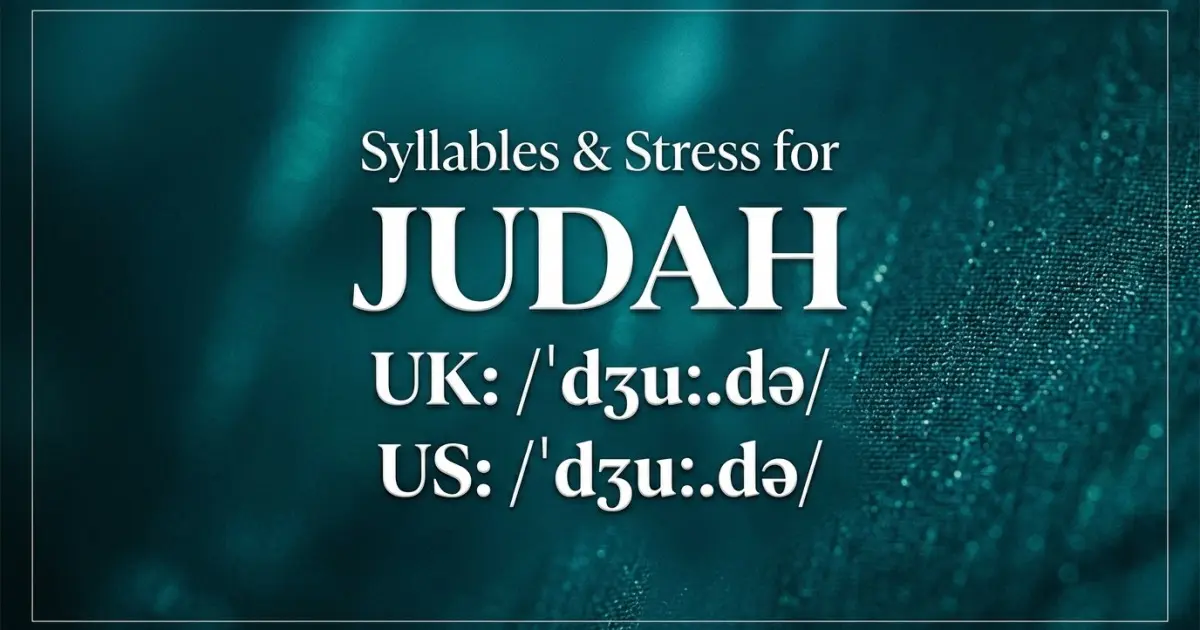
| U.S. IPA | /ˈdʒuːdə/ | The first vowel is long and clear, like the vowel in “blue” or “true.” |
| U.K. IPA | /ˈdʒuːdə/ | The core pronunciation is essentially the same in British and American English, which makes Judah easy to carry across accents. |
| Opening consonant | /dʒ/ affricate | Start with the same initial sound you hear in “June,” not a harder “juh” and not a softer “zh.” |
| Ending vowel | Reduced schwa sound | The second syllable is usually lighter than people expect, closer to “duh” than a fully stressed “dah.” |
| Closest sound guide | “Joo” + “duh” | If the first half is warm and rounded and the second half relaxes, the name will sound natural. |
Judah sounds strongest when the first syllable stays open
The most important part of Judah is the first syllable. That is where the name gets its warmth, its memorability, and much of its masculine presence. The long oo vowel is doing real work. It keeps the name from sounding clipped or dry, and it helps balance the spiritual seriousness of the meaning with an everyday human sound. Pronunciation lands more fully when the name’s roots and history are already in view, so begin with Judah meaning.
Why the opening of Judah matters so much
In phonetic terms, Judah begins with an affricate: the j sound in words like “joy” or “June.” That opening immediately gives the name clarity. Then the long vowel broadens the sound. Because the name is only two syllables, that first syllable has to establish nearly everything the listener needs to know. It is the center of gravity. The way the name resolves at the end often decides which short forms feel natural in speech, and that becomes clearer in nicknames for Judah.
If the vowel is shortened, the name becomes harsher and less settled. If the opening consonant is weakened, the whole name can sound vague. Judah needs that strong, rounded beginning to sound like itself.
Why the second syllable should not try to compete
The second syllable of Judah is intentionally lighter. In ordinary English speech, it usually carries a schwa, the relaxed vowel sound that appears in countless unstressed syllables. That means the name ends softly, not dramatically. This is one of Judah’s hidden strengths. The softness of the ending keeps the name from becoming too hard or ceremonial.
When people over-pronounce the second syllable, Judah starts to sound more rigid than it should. The best version of the name lets the first syllable lead and the second syllable release.
Where Judah usually gets misread or over-pronounced
Because Judah is familiar-looking and biblically loaded, most pronunciation mistakes come from overcorrection rather than ignorance. People sense that the name carries history, then speak it as if it needs extra reverence. Usually it does not.
When Judah becomes too formal
A common mistake is to pronounce the second syllable too fully, turning the name into something heavier than everyday English naturally supports. Instead of a light duh, the speaker lands on a more emphatic ending. The result can sound stiff, almost as if the name is being recited rather than spoken. Judah does not need that. Its dignity already lives inside the first syllable and the overall shape.
If you keep the first syllable strong and let the second remain relaxed, the name sounds much more natural and much more confident.
When Judah gets pulled toward neighboring names
Another issue is confusion with sound neighbors and biblical neighbors. People sometimes lean toward pronunciations that feel closer to names like Jude or even other ancient forms they already know. But Judah is not just Jude with an extra syllable attached. The final syllable changes the rhythm and softens the overall impression. That is exactly why the name feels more grounded and more familial than some of its sharper relatives.
Hearing Judah as its own two-beat name, rather than as a variation on a shorter name, usually fixes the problem.
Accent notes: why Judah travels well
One practical strength of Judah is how little it changes between standard American and British speech. The IPA is the same, and in ordinary life the differences are usually minor. Some speakers may make the final vowel slightly broader or slightly more neutral, but the identity of the name remains intact. That stability makes Judah easy to carry across classrooms, workplaces, and countries without constant correction.
For parents, that matters more than it may seem. A name with strong pronunciation stability often feels more confident in public life because it spends less time apologizing for itself.
Judah is simple, but the sound still carries personality
Short names often depend heavily on tiny sound details because there is no extra syllable to absorb a sloppy delivery. Judah is not difficult, but it is not neutral either. It sounds open, warm, and quietly strong because of the way its sounds are arranged. That arrangement is part of its personality.
Why Judah sounds warmer than many biblical names
Some biblical names enter English with dense consonants, sharper endings, or more overtly formal rhythms. Judah feels easier. The long opening vowel gives it air, and the softened ending makes it feel more domestic and conversational. This is one reason the name can sit comfortably in modern life despite its ancient roots. It sounds lived-in.
How the lack of harsh consonant clusters helps Judah
Judah has no complicated cluster to trip over. There is no abrupt stop in the middle, no liquid consonant to drag the sound around, and no heavy final consonant to make the name snap shut. The name moves cleanly from its affricate opening to its vowel center and then relaxes. That ease is part of what makes it memorable. It sounds serious, but not effortful.
How to practice Judah so it sounds natural, not rehearsed
The best pronunciation test is always a sentence. Names do not live as dictionary entries. They live in spoken life.
Practice lines that make Judah feel real
- “Judah is here.”
- “Did Judah call already?”
- “Judah, your table is ready.”
- “We’re waiting for Judah.”
- “Judah starts next week.”
These lines help because they force the name into natural rhythm. You will hear immediately whether the first syllable still sounds open and whether the second syllable is staying light enough.
A quick memory trick for Judah
The easiest guide is still the most useful one: JOO-duh. Think of a rounded first syllable like “joo,” then let the second syllable relax. If the name begins warmly and ends lightly, it will almost always sound right.
That is the quiet brilliance of Judah as a spoken name. It does not ask for complex technique. It asks for trust in its proportions. One clear opening, one softened ending, and the whole name reveals what it has been doing all along: sounding ancient without sounding distant, and strong without sounding hard.