
Nicknames for Juan: Easy Nickname Ideas That Really Work
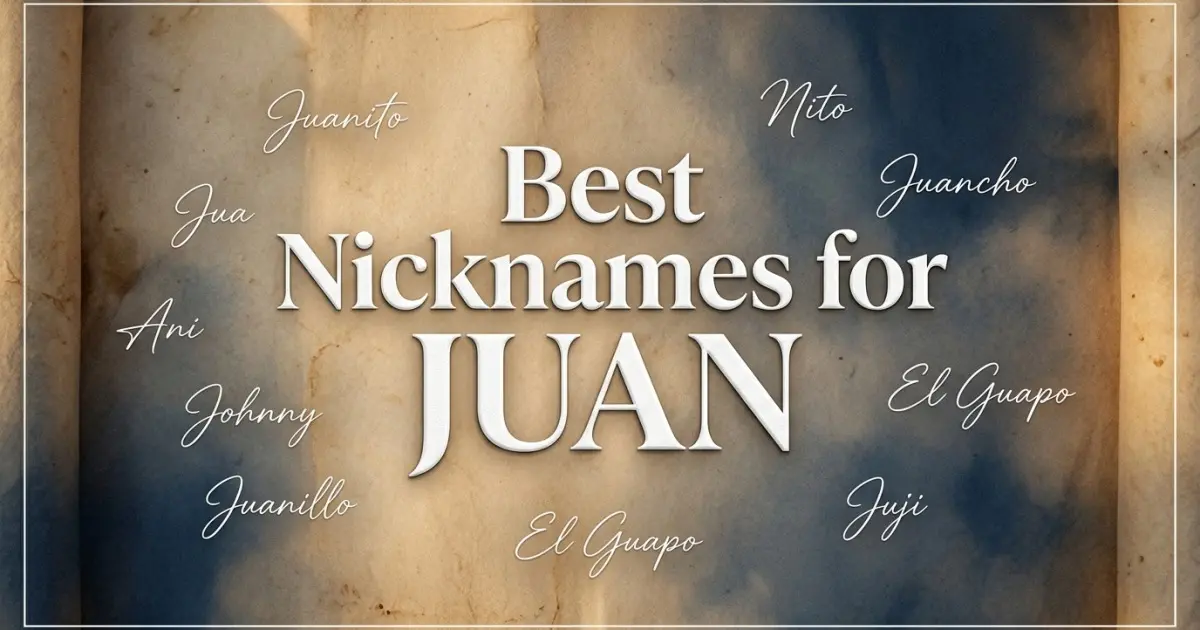
A nickname is never just a smaller name. It is a social signal. It tells you who feels close enough to soften the official form, who wants to make it faster, who is speaking from affection rather than protocol, and what version of a child is being called forward in that moment. Some nicknames stay inside the house forever. Some are born on a schoolyard, in a soccer team, or in a family WhatsApp thread and become the name that real life uses most. Others belong only to childhood and remain in family memory long after the child has outgrown them. That is why nicknames matter. They are one of the earliest places where identity stops being formal and starts becoming personal.
That matters especially with Juan because Juan is already so compact. It is one syllable, clear, and deeply established. Official data shows it remains in active use for boys, which means most people already hear it as a complete, everyday identity rather than as a formal shell waiting to be shortened. That changes the nickname logic. Juan does not really need trimming for convenience. When it gets a nickname, the reason is usually intimacy, heritage, family rhythm, or group belonging. In other words, Juan’s nickname world is less about cutting the name down and more about revealing which social circle is speaking. Nicknames add personality at the surface, but the deeper weight of the name still sits in Juan meaning.
What the Nickname World Around Juan Is Really Revealing
Juan has a smaller nickname field than longer names do, but that is part of its strength. The most believable options are not overengineered. They come either from long-standing affectionate traditions or from the practical shortcuts real people use in daily life.
| Group | Suggested Nicknames | Persona | Use Context |
|---|---|---|---|
| Classic inherited forms | Juanito, Juancho, Juani | Culturally rooted, affectionate, family-linked | Family life, heritage-centered households, Spanish-speaking settings |
| Short social forms | Juan, J, Jay | Direct, easygoing, cross-context | School, sports, bilingual settings, casual everyday use |
| Cute family forms | Juani, Juanito, Juju | Playful, warm, home-centered | Toddler years, parent speech, grandparents, private family life |
| Cool peer forms | J, Jay, Juancho | Relaxed, social, group-shaped | Friends, adolescence, team culture, casual adulthood |
| DIY social variants | JJ, J.R., Big Juan, Little Juan | Situational, personalized, context-led | Duplicate-name settings, middle-name pairings, sibling systems, sports teams |
Juan Often Stays Juan, and That Tells You Something Important
One of the most important truths about this name is that many boys named Juan may simply remain Juan in most public settings. The full name is already one syllable, already familiar, and already socially complete. It sounds natural on a child, but it does not trap him in childhood. It can move into adult life without needing to be toughened, lengthened, or restored to some more formal version. That is a real strength.
This means Juan behaves differently from names that almost force a nickname. The family does not need to invent a shorter form just to make the name feel usable. Teachers can say Juan. Friends can say Juan. Employers can say Juan. Grandparents can say Juan. The full form works everywhere. In many cases, that is exactly why nicknames around Juan become more emotionally meaningful. They are not structural necessities. They are signals of closeness.
That also means parents should not feel pressure to “solve” Juan with a nickname before the child even arrives. The best nickname ecology for Juan is often very simple: the world uses Juan, and a smaller private circle uses something warmer. This is especially common in names that already sound complete in one beat. The full name remains the public identity, while the affectionate forms appear only where intimacy actually exists.
Juan’s Best Nicknames Come More from Culture Than from Cutting
Because Juan is only one syllable, its most believable nicknames often do not come from slicing the name apart the way English speakers might do with a longer form. They come from affectionate traditions, diminutives, and social reshaping. That makes Juan especially interesting. Its nickname life is less mechanical and more cultural.
Juanito is affection, not just length
Juanito is one of the strongest and most recognizable affectionate forms connected with Juan. It does not feel like an artificial extension. It feels lived-in. That matters. Good nicknames do not sound clever from a distance. They sound like something a family or community would actually say with warmth.
Juanito is especially suited to early childhood and family life, but it can also remain meaningful much longer in close circles. Its strength lies in the fact that it preserves the whole identity of Juan while softening it. The child does not stop being Juan. He becomes Juan held more closely.
Juancho shifts the mood more noticeably
Juancho is a different kind of nickname. It feels less purely tender and more socially shaped. In many ears it sounds more rugged, more companionable, and more distinct from the formal name than Juanito does. That can make it especially attractive among friends or in families who like nicknames with a little more edge and personality.
What Juancho does particularly well is prove that a very short formal name can still open into a nickname with its own social identity. It does not simply repeat Juan. It interprets it.
Juani belongs to the softer family lane
Juani is lighter and gentler than Juancho. It tends to feel domestic, affectionate, and easy in the mouth. It is often the kind of nickname that works because someone in the family says it once, then says it again, and it stays. That is usually how the best private nicknames are born.
Juan’s Opening Sound Creates the English-Facing Nickname Lane
Even though Juan’s deepest nickname tradition comes from Spanish-speaking and family-centered forms, the name also has a smaller English-facing social lane. This becomes especially relevant in bilingual environments or in schools and friend groups where short-form English nickname habits are common. Nicknames often grow from the stressed part of a name rather than from spelling alone, so the next useful step is Juan pronunciation guide.
J is the quickest social shortcut
J is the smallest and most universal public shortcut attached to Juan. It works especially well in teams, classrooms, group chats, and sibling systems where single-letter nicknames happen naturally. J is not emotionally rich by itself, but it is highly believable. That matters more than novelty.
Because Juan is already so short, a nickname like J does not replace the name’s full emotional identity. It simply gives peers an even faster way to signal familiarity. In adolescence especially, that can be enough.
Jay is the smoother crossover form
Jay is slightly fuller than J and often easier to use in spoken English. It is especially plausible in bilingual or English-dominant environments where people want a nickname that sounds established rather than abrupt. Jay can work in school, in sports, and later in adult casual settings without sounding childish.
This is a good example of how Juan adapts socially without losing its roots. The formal name remains Juan. The social shorthand becomes Jay in some settings. Both can coexist without conflict.
Why Juan’s Family Nicknames Often Feel More Intimate Than Its Public Ones
The strongest difference in Juan’s nickname world is not really between short and long forms. It is between public and private feeling. Because the formal name is already so concise, the nicknames that emerge inside the family often end up carrying more emotional warmth than the public shortcuts do.
Juju and repetition-based forms belong to the house
Juju is a believable affectionate form in households where repetition and sound-play shape early childhood language. It does not come from formal structure so much as from the way families naturally soften and repeat sounds when speaking to small children. That makes it feel especially appropriate in the toddler years.
This kind of nickname is not designed for school forms or adult introductions. That is not a weakness. It is simply doing a different job. A family nickname can be valuable precisely because it belongs only to the family.
Big Juan and Little Juan are relationship nicknames, not identity nicknames
Some nicknames arise not from sound but from social need. Big Juan and Little Juan are classic examples. They appear when multiple people in the same household or community share the name, or when a father and son carry it together. These forms are not especially lyrical, but they are very real. They solve a practical problem while also revealing how names live inside family systems.
Similarly, forms such as JJ or J.R. may appear when the middle name invites them. These are not traditional Juan nicknames in the cultural sense, but they are absolutely plausible in modern life.
How Juan Nicknames Change with Age and Setting
Nicknames are not fixed. They move as the child moves. Juan makes this especially visible because the full name remains so usable at every age, while the nicknames orbit around it depending on who is speaking.
Early years: tenderness dominates
In infancy and preschool, forms like Juanito, Juani, and Juju make the most sense. These names are driven by affection, repetition, and the warmer speech patterns families use with small children. Their job is comfort, not permanence.
School years: the full name often survives intact
Once the child enters school, many boys named Juan may simply remain Juan. If a nickname appears, it is most likely something simple such as J or Jay, especially in friend groups that favor quick English-style shortcuts. But just as often, the full name remains the easiest option because it is already short.
Teen and adult years: the circle decides
By adolescence and adulthood, nicknames tend to become more group-shaped. Friends may prefer J or Jay. Family may still use Juancho or Juanito. Professional life may use only Juan. This layered arrangement is often exactly what makes the name work so well. It lets intimacy mark itself without forcing the child to abandon a strong full identity.