
How to Pronounce Jonathan: Syllable Guide and Easy Stress Tips

The moment Jonathan is most likely to be tested is not in a naming book. It is in a fluorescent classroom, a pediatric waiting room, a church nursery sign-in line, or a first-day roll call where the speaker has only a second to decide how the name should sound. Jonathan usually survives that moment well because it is deeply familiar, but familiarity can also create overconfidence. People recognize the name so quickly that they sometimes lean on habit instead of rhythm. The result is not usually a dramatic mistake. It is a small shift in stress, an over-pronounced middle, or a vowel sound that makes the name feel stiffer than it really is.
That is worth noticing because Jonathan is one of those names whose everyday strength comes from sounding easier than it looks. On the page, it appears full and formal. In the ear, it is much smoother. The intended form here, JON-uh-thun, moves with one clear stressed opening followed by two lighter syllables. Once that pattern is heard, the name becomes simple to carry. Its dignity comes not from heavy pronunciation, but from controlled ease.
What this Jonathan sound guide clears up about how Jonathan is actually said
| Element | Phonetic Detail | Quick Tip |
|---|---|---|
| Common pronunciation | JON-uh-thun | Put the full stress on the first syllable, then let the last two syllables relax naturally. |
| U.S. IPA | /ˈdʒɑːnəθən/ | In American English, the opening vowel is broader, closer to the sound in “father” than a short clipped “o.” |
| U.K. IPA | /ˈdɒnəθən/ | In British English, the opening vowel is rounder and slightly shorter, but the rhythm stays the same. |
| Syllable count | 3 syllables | Jonathan should not be flattened into two beats or stretched into four. Three is the natural shape. |
| Primary stress | First syllable | Say JON-uh-thun, not jon-AH-thun and not jon-uh-THAN. |
| Middle consonant | /θ/ | The th is the voiceless sound from “thin,” not the voiced th from “this.” |
| Unstressed vowels | /ə/ and /ən/ | The middle and final syllables are soft and reduced, which is why the name sounds smoother than its spelling suggests. |
| Overall flow | Strong start, soft continuation | The name sounds best when the first syllable leads and the rest follows without sounding over-articulated. |
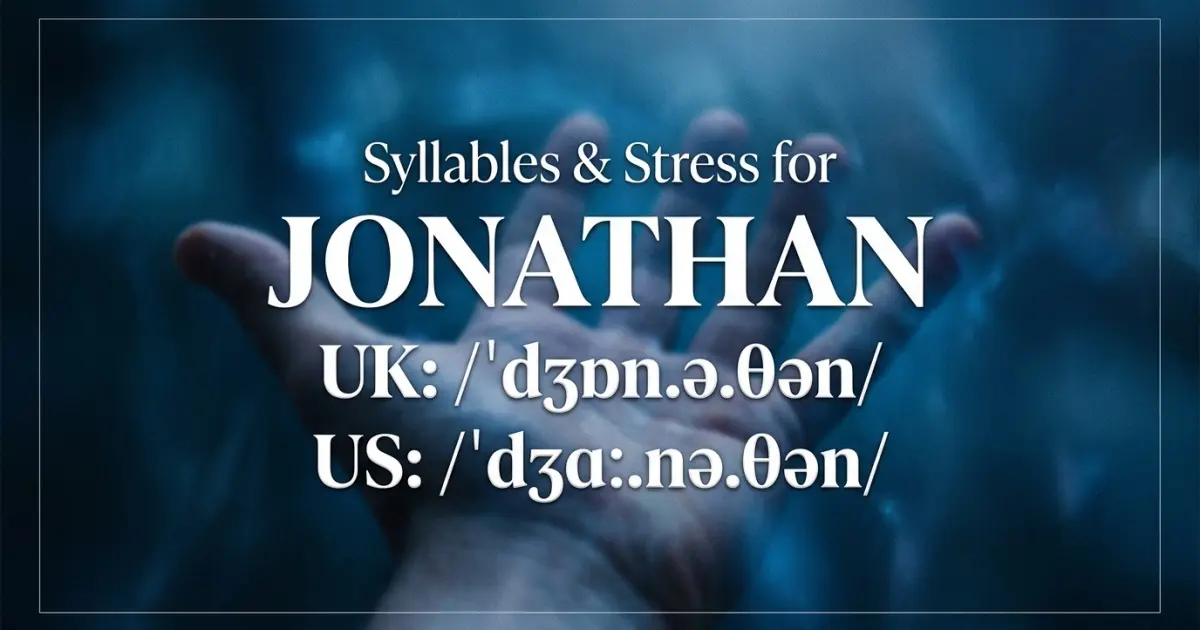
Jonathan begins with weight, but Jonathan stays graceful because the rest softens
The most important thing to hear in Jonathan is that the first syllable carries the whole public identity of the name. Jon is where the listener recognizes it. That is why so many nicknames shorten it there, and it is also why the pronunciation succeeds so easily in fast real-world speech. The opening does most of the work. Before focusing only on syllables and stress, it helps to step back into the fuller frame of Jonathan meaning.
After that, the name relaxes. The second syllable is not meant to be struck with equal force. It reduces to a light schwa-like sound, the neutral vowel heard in countless everyday English words. The final syllable then closes the name gently. This matters because it keeps Jonathan from sounding stiff or ceremonial. A name with this much historical and emotional weight could easily become over-solemn if every syllable were given full emphasis. Jonathan avoids that by allowing two-thirds of the name to soften.
Why the opening of Jonathan matters so much
The beginning of Jonathan starts with /dʒ/, the same affricate sound heard in words like “joy” and “judge.” It is immediately recognizable and gives the name a clear front edge. From there, the opening vowel changes slightly between American and British English, but in both cases it remains the strongest sound in the name. That strength makes Jonathan easy to catch across a room and easy to process on first hearing. Because the strongest energy lands early, the shorter forms often grow from the opening of the name, and that pattern is easier to see in Jonathan nicknames.
This also explains why the name can sound formal on paper but natural in speech. The front is strong enough to carry the identity, so the rest of the name does not need to overperform.
Why the second and third syllables should not be overdone
One of the easiest ways to make Jonathan sound awkward is to pronounce every syllable as though it deserves equal weight. That usually produces a name that feels too careful, almost as if it were being read from a vocabulary exercise rather than spoken in daily life. In natural English, Jonathan sounds much better when the middle softens and the final syllable lands lightly. The name should move, not march.
Jonathan in American and British English: same rhythm, different opening vowel
The helpful thing about Jonathan is that the structure stays stable across major English accents. Both the American and British forms keep the stress on the first syllable, keep three syllables overall, and keep the same voiceless th in the later part of the name. What changes most is the quality of the opening vowel.
How the U.S. and U.K. versions differ
In American English, the IPA here is /ˈdʒɑːnəθən/, which gives the first syllable a broader ah-like color. In British English, /ˈdɒnəθən/ makes that vowel rounder and slightly darker. But these are not changes that alter the identity of the name. They are accent-color differences, not structural differences. Jonathan still sounds like Jonathan in either setting.
This is one reason the name travels so well. A child named Jonathan does not have to manage radically different pronunciations from one English-speaking environment to another. The frame remains stable.
What quick everyday speech does to Jonathan
In faster conversation, the unstressed middle and final vowels may reduce even further. That is normal. English speakers routinely lighten unstressed syllables. As long as the strong opening remains clear and the th stays in place, the pronunciation still sounds natural. Jonathan can therefore sound slightly more compact in ordinary speech than it does in careful teaching pronunciation, without becoming incorrect.
Where people most often get Jonathan wrong
The most common Jonathan mistakes do not come from total unfamiliarity. They come from spelling pressure. Readers see a full, multi-syllable name and assume they need to honor every visible vowel with equal force. That is almost always what creates the problem.
Common Jonathan mistake patterns
One mistake is over-expanding the middle of the name so that it sounds heavier than it should. Another is stressing the last syllable too much, which makes the name feel oddly formal or artificial. A third is hardening the th too aggressively, which can interrupt the smooth flow of the second half. Jonathan should not sound mumbled, but it also should not sound hammered.
The safest mental model is this: one strong opening, then two softened follow-through syllables. Once that pattern is in place, most pronunciation errors disappear.
Why over-careful speech can make Jonathan sound less natural
Jonathan is a name that rewards confidence. If a speaker becomes too careful, the name can stiffen. The goal is not lazy pronunciation, but fluent pronunciation. The middle and end should be audible, just not over-lit. Jonathan sounds best when spoken like a real name in a real life, not like an example in a phonetics lesson.
How to practice Jonathan until it feels automatic
Use Jonathan in real spoken lines
The best way to settle the pronunciation is to place it inside the kinds of lines where people actually use it:
“Jonathan, it’s your turn.”
“Have you met Jonathan?”
“Jonathan is here.”
“I asked Jonathan already.”
In each case, the rhythm should feel the same: strong first beat, then two light follow-up syllables. If the middle begins to swell or the ending becomes too emphatic, the name will start to feel less natural.
Three reminders that solve most Jonathan pronunciation problems
First, stress the opening JON. Second, keep the th soft and voiceless, like the sound in “thin.” Third, let the final two syllables stay reduced and easy. Those three habits are enough to make Jonathan sound polished and correct in ordinary English speech.