
How to Pronounce Jenna: How the Name Is Usually Said
The real pronunciation test for Jenna usually happens in an ordinary place: a teacher reaches her name on the first day of school, a receptionist looks up from a clipboard, or a barista glances at the cup and says it out loud without rehearsal. That is where Jenna proves why it has lasted. It does not ask much of the speaker. The spelling is familiar, the rhythm is immediate, and the sound lands exactly where most English speakers expect it to land: JEN-uh. In real life, that matters more than technical elegance. A name that can be read quickly and spoken comfortably tends to feel easier to inhabit.
Jenna also benefits from belonging to a very recognizable English sound family. Even people who have never studied name origins usually know how names like Jen, Jenny, and Jennifer behave in the mouth. That gives Jenna a head start. It sounds friendly before anyone has even met the person wearing it. But its pronunciation is not flat or careless. It has a clean beginning, a soft release, and just enough shape to keep it from sounding generic. Jenna is one of those names that feels natural in speech because its structure is doing quiet work.
What actually makes Jenna easy to say
| Element | Phonetic Detail | Quick Tip |
|---|---|---|
| Everyday pronunciation | JEN-uh | Say it like “Jen,” then add a soft, quick “uh.” |
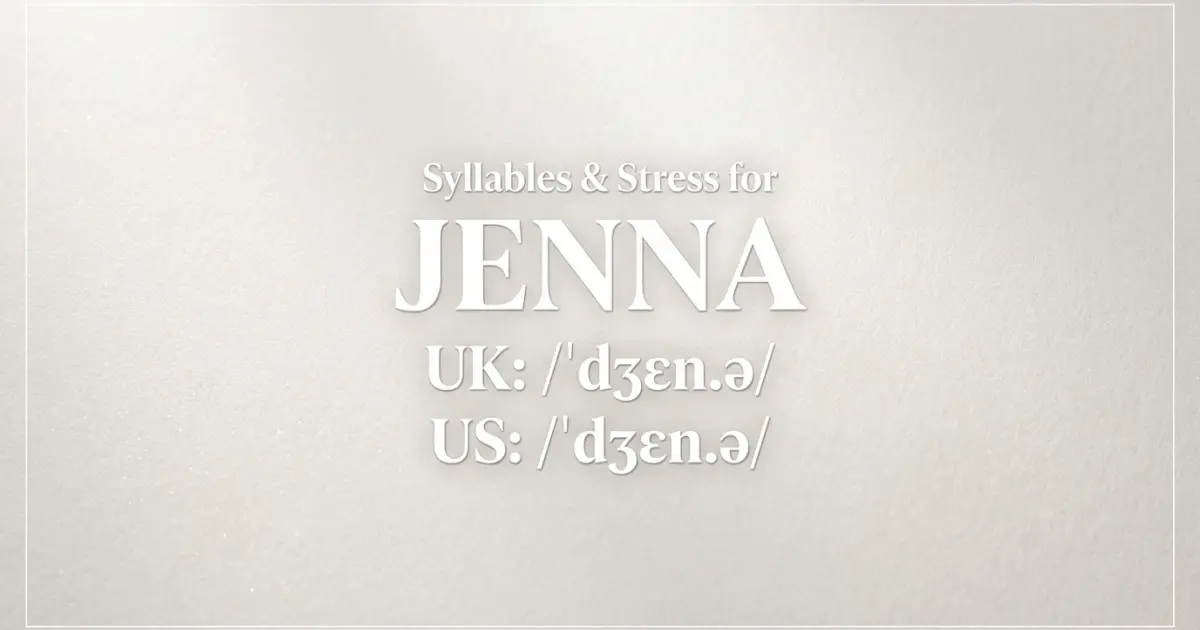
| IPA (US) | /ˈdʒɛnə/ | The stress mark at the front shows the first syllable does the main work. |
| IPA (UK) | /ˈdʒenə/ | The British form is almost identical, with only slight vowel shading. |
| Syllable count | 2 syllables | Break it into “Jen” plus “uh,” not “Jen-na” with two equal beats. |
| Stress pattern | FIRST syllable stressed | Keep the emphasis on JEN, not on the second syllable. |
| Opening consonant | /dʒ/ affricate | Start with the same sound as in “jump” or “judge.” |
| Middle consonant | /n/ nasal consonant | The N keeps the name smooth and helps the first syllable land gently rather than sharply. |
| Final vowel | Schwa /ə/ | The ending is relaxed and unstressed, more “uh” than “ah.” |
Jenna is built on a very English rhythm
Phonetically, Jenna is efficient. It opens with /dʒ/, an affricate consonant that combines a stop and a fricative. In plain speech, that means the name starts with a clean little burst rather than with a soft drift. The first vowel is short and open enough to feel friendly, and the nasal /n/ in the middle prevents the name from sounding clipped. It then ends on an unstressed schwa, the relaxed vowel sound that English uses constantly in ordinary speech. That final detail matters. It is why Jenna sounds natural and unforced instead of over-articulated. Pronunciation lands more fully when the name’s roots and history are already in view, so begin with Jenna meaning.
The first syllable carries Jenna’s identity
The stressed first syllable, Jen, is what makes the name immediately legible. English speakers are especially comfortable with two-syllable names that open strongly and end softly. Jenna fits that pattern perfectly. You hear the identity of the name almost at once, which is why it works so well in classrooms, introductions, and phone conversations. There is very little ambiguity about where the emphasis belongs.
The ending keeps Jenna warm
The second syllable is not supposed to compete with the first. It should stay light. This is where some people accidentally over-pronounce the name, giving the final vowel too much force and making it sound heavier than it needs to. In everyday English, Jenna works best when the second syllable is relaxed. That softness is part of the name’s charm. It rounds off the bright opening and keeps the whole sound approachable. Because the strongest energy lands early, the shorter forms often grow from the opening of the name, and that pattern is easier to see in nicknames for Jenna.
This also explains why Jenna feels easier than it looks in phonetic symbols. The structure is doing something many durable English names do: strong opening, easy landing, no surprise stress shift.
How Jenna sounds in American and British English
The US IPA is commonly given as /ˈdʒɛnə/, while the UK form often appears as /ˈdʒenə/. In practical use, the difference is very small. Both versions put the stress on the first syllable. Both use the same affricate opening. Both end with an unstressed schwa-like sound. The only subtle distinction is the quality of the vowel in the first syllable, and even that difference is minor enough that most listeners would not hear two separate pronunciations.
What stays the same across accents
The important things do not move. Jenna is still two syllables. The first beat still matters most. The ending is still soft. That means the name travels well across English-speaking settings. Parents do not have to worry that the name will radically change shape between American and British speech. It remains stable, which is one of the quiet advantages of choosing a simple English-rooted name.
Why the accent difference rarely matters socially
Because the overall rhythm is so familiar, even speakers with noticeably different accents will usually produce recognizable versions of Jenna without difficulty. This is not a name that needs frequent correction abroad or between regions. It may sound a touch brighter in one accent and a touch flatter in another, but it will still be Jenna. That kind of stability gives a name practical value. It means the child is less likely to spend social energy teaching the name before conversation can even begin.
Where people most often get Jenna slightly wrong
Jenna is not a difficult name, but small mistakes can still happen, especially when people try to over-pronounce it or make the spelling sound more literal than English speech usually would.
The most common mistake is giving the second syllable too much weight
One common slip is to say the name like JEN-nah with a heavier final “ah,” as though both syllables deserve equal attention. That makes the name sound stiffer and slightly more formal than it usually is in en-US speech. The better target is a relaxed ending: JEN-uh. Not swallowed, but not heavily shaped either.
Another mistake is flattening the first syllable too much
Some speakers can drift into a duller, quicker first syllable, especially when reading fast from a list. In that version, Jenna can start sounding almost like a blurred “Jnuh.” The fix is simple: keep the Jen clear. The first syllable is the part the ear holds onto. If it stays distinct, the whole name settles into place.
What usually is not a real problem
Unlike less familiar names, Jenna rarely suffers from major stress confusion or wildly different pronunciation attempts. Most people instinctively know where the name is supposed to go. The errors are usually small matters of emphasis rather than full misreadings. That is a significant advantage. It means Jenna spends very little social energy defending its own pronunciation.
Jenna belongs to a sound family most speakers already know
Part of Jenna’s ease comes from the company it keeps. Even if someone has never met a Jenna before, they almost certainly know names like Jen, Jenny, Jennifer, or even Jemma and Gemma. Those neighboring sounds help the ear settle quickly. Jenna does not arrive as a strange sequence. It arrives as a recognizable pattern.
The related names that make Jenna easier to hear
Jen is the clearest anchor. Jenny also helps because it shares the same strong first syllable and similar pacing. Jennifer, though longer, reinforces the same opening sound family. Once the listener places Jenna among those familiar names, the pronunciation becomes nearly automatic.
What makes Jenna distinct anyway
Even with those neighbors nearby, Jenna still sounds like its own name. It is more compact than Jennifer, less openly diminutive than Jenny, and cleaner in social tone than some alternative spellings. That independence is part of why the pronunciation works so well. The name feels familiar enough to say, but distinct enough to remember.
How to say Jenna naturally in real conversation
The best test for any name’s pronunciation is ordinary speech. Jenna should sound quick, smooth, and lightly upbeat. If it feels over-enunciated, it is probably being treated as more difficult than it actually is.
Three easy practice lines for Jenna
Try the name in real phrases rather than isolation:
“This is Jenna.”
“Jenna will be here soon.”
“Can Jenna take this seat?”
In each sentence, the first syllable should carry the identity of the name. The second should finish it gently. That is the most natural rhythm.
How to correct Jenna without making it seem complicated
If correction is ever needed, the simplest version is the best: “It’s JEN-uh.” That is usually enough. Because the name is so close to familiar English sound patterns, one spoken example almost always solves the problem. Jenna does not need a long explanation. Its pronunciation is one of its quiet strengths precisely because it is so easy to restore once heard correctly.