
How to Pronounce Jedidiah: How the Name Is Usually Said
Imagine Jedidiah being read aloud at a baptism, called from a school attendance sheet, or spoken during a family introduction where everyone can feel the weight of the full name before they know exactly where the stress belongs. The name looks long, biblical, and formal, but its pronunciation follows a clear four-part rhythm: jed-ih-DY-uh. The strongest beat is not at the beginning. It rises near the end, on DY, before softening into the final uh.
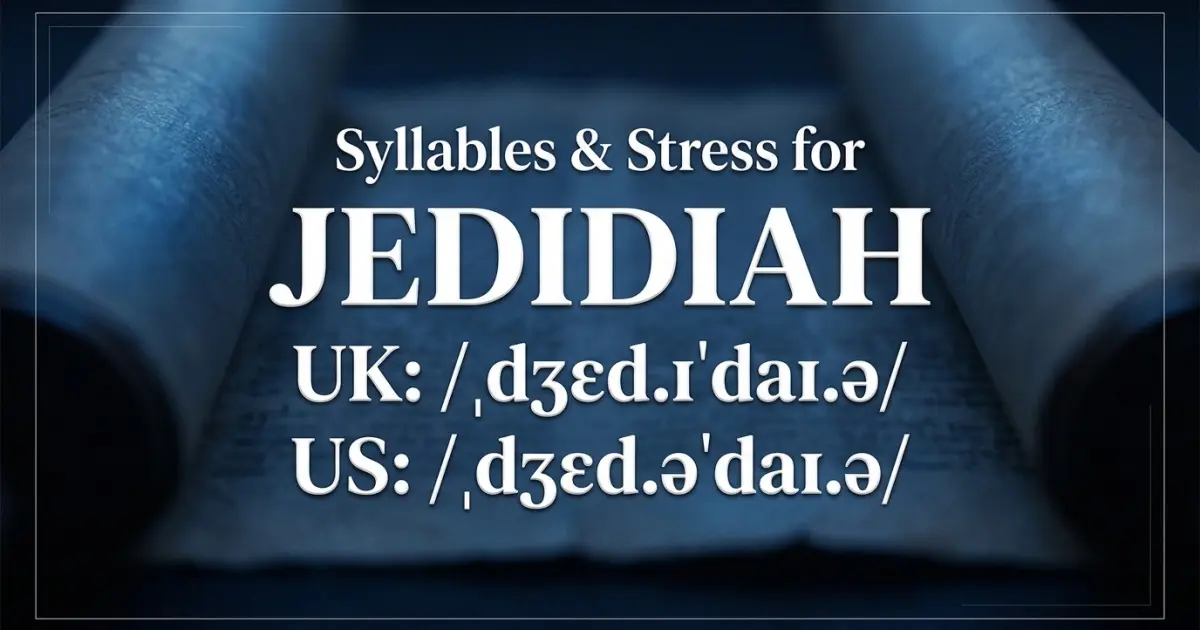
That rising sound matters because Jedidiah means “beloved of the Lord.” The name carries devotion, tenderness, and ceremony, and the pronunciation should let that meaning breathe. Official 2024 U.S. data shows Jedidiah in active use for boys, uncommon but recognizable enough to appear in real classrooms, forms, ceremonies, and introductions. The U.S. IPA is /ˌdʒɛdɪˈdaɪə/, and the U.K. IPA is /ˌdʒedɪˈdaɪə/, both pointing to the same essential guide: four syllables, a soft opening, a strong DY, and a gentle final vowel.
How Jedidiah Is Actually Said When DY Carries the Name
| Element | Phonetic Detail | Quick Tip |
|---|---|---|
| Standard pronunciation | jed-ih-DY-uh | Say it in four syllables, with the strongest emphasis on DY. |
| Syllable count | 4 syllables | Break it as jed + ih + DY + uh. |
| Stress pattern | Main stress on the third syllable | Do not make the opening JED the strongest part of the full name. |
| U.S. IPA | /ˌdʒɛdɪˈdaɪə/ | The U.S. guide uses the short e in Jed and the long eye sound in DY. |
| U.K. IPA | /ˌdʒedɪˈdaɪə/ | The U.K. guide follows the same four-syllable structure and the same main stress. |
| Opening sound | JED | Begin like the nickname Jed, with a clear j sound. |
| Strongest syllable | DY | Use the long eye sound, as in dye or sky. |
| Final sound | uh | Let the ending relax gently; do not make it a hard ah or an extra stressed beat. |
Jedidiah Depends on a Rising Four-Syllable Rhythm
The key to saying Jedidiah well is rhythm. The name is not meant to fall heavily on the first syllable and drag through the rest. It should move: jed-ih-DY-uh. The opening is clear, the second syllable is light, the third syllable rises, and the final syllable releases. Pronunciation lands more fully when the name’s roots and history are already in view, so begin with Jedidiah meaning.
This makes Jedidiah feel more graceful than its length might suggest. A four-syllable name can sound crowded if each syllable receives equal force. Jedidiah avoids that when the stress pattern is handled correctly. The name has a built-in musical shape: a small beginning, a light middle, a strong lift, and a soft close.
The first syllable begins like Jed
The opening syllable is jed, the same sound as the nickname Jed. It begins with the j sound heard in judge, gentle, and Jordan. In linguistic terms, this opening is an affricate, a sound that starts with a stop and releases into a softer friction. In ordinary speech, it simply needs to sound like a clean English j.
The second syllable should stay light
The ih syllable should not become the center of the name. It is a passing syllable, helping the name move toward DY. Say it lightly: jed-ih-DY-uh, not jed-ID-ee-uh.
The DY Sound Gives Jedidiah Its Lift
The most important spoken feature in Jedidiah is the stressed DY syllable. This syllable uses the long eye vowel, the same vowel heard in dye, sky, and my. It is where the name opens up. Without that lift, Jedidiah can sound flat or misdirected.
The full pronunciation is jed-ih-DY-uh, not JED-ih-dee-uh. The third syllable should carry the name’s main energy. That gives Jedidiah its devotional, old-world sound without making it feel stiff.
DY should rhyme with dye
The easiest way to remember the stressed syllable is to connect it with dye. Say DY clearly, then soften into uh. This keeps the four-syllable name from becoming muddled.
The final uh should not be overemphasized
The final syllable is relaxed. It should sound like uh, not a strong separate AH. The ending gives Jedidiah a gentle close after the stressed third syllable.
American and British Jedidiah Share the Same Main Shape
Jedidiah has a nearly identical pronunciation structure in the U.S. and U.K. guides. The U.S. IPA is /ˌdʒɛdɪˈdaɪə/, while the U.K. IPA is /ˌdʒedɪˈdaɪə/. The notation differs slightly in how the first vowel is represented, but the everyday pattern remains the same: jed-ih-DY-uh. Once the sound pattern is clear, some shortenings stop feeling optional and start feeling natural, and the clearest map is in Jedidiah nicknames.
Accent differences may color the first vowel a little, but they do not change the name’s main architecture. Both guides preserve four syllables and stress the third syllable. That consistency helps parents, teachers, and relatives use the name with confidence.
American English pattern
In American English, Jedidiah begins with a short e sound in Jed, moves quickly through ih, and rises on DY. The final syllable stays light.
British English pattern
In British English, the same four-syllable rhythm applies. The first vowel may sound slightly different by accent, but the main guide remains jed-ih-DY-uh.
The Most Common Jedidiah Mistakes Come From Moving the Stress
Jedidiah is not hard once the rhythm is learned, but people may misplace the stress or simplify the ending. The safest correction is always jed-ih-DY-uh.
Do not say JED-ih-dee-uh
The opening syllable should not dominate the whole name. Jed is a natural nickname, but in the full name the main stress belongs on DY.
Do not say jed-ID-ee-uh
The second syllable is not the stressed syllable. Keep ih light and let the name rise later.
Do not lose the long eye sound
The third syllable should sound like dye. If it becomes dee or duh, the name loses its intended shape.
Do not compress it into three syllables
Jedidiah has four syllables. In fast speech, the middle may become light, but the name should not collapse into something like JED-dye-uh. Clear speech keeps the full form graceful.
Practice Lines Help Jedidiah Become Natural
The best way to practice Jedidiah is to let the name rise toward the third syllable. Do not rush the beginning, but do not make every syllable equally heavy.
Slow practice
Jedidiah.
jed-ih-DY-uh.
Four syllables: jed + ih + DY + uh.
Everyday practice
Good morning, Jedidiah.
This is Jedidiah.
Please welcome Jedidiah to the class.
Full-name practice
Jedidiah James.
Jedidiah Luke.
Jedidiah Samuel Cole.
Jedidiah Thomas Reed.
When testing Jedidiah with middle names and surnames, listen for the transition after the final uh. Short middle names such as James, Luke, Paul, Jude, and Cole often give the long first name a clean landing. Two-syllable middles such as Thomas, Samuel, Caleb, and Nathan can also work well, especially with a shorter surname.
Pronouncing Jedidiah: Common Questions
How do you pronounce Jedidiah?
Jedidiah is pronounced jed-ih-DY-uh. It has four syllables, with the main stress on the third syllable.
What is the IPA pronunciation of Jedidiah?
The U.S. IPA pronunciation of Jedidiah is /ˌdʒɛdɪˈdaɪə/, and the U.K. IPA pronunciation is /ˌdʒedɪˈdaɪə/.
Which syllable is stressed in Jedidiah?
The main stress falls on the third syllable: DY. The name should sound like jed-ih-DY-uh, not JED-ih-dee-uh.
What pronunciation mistakes happen with Jedidiah?
The most common mistakes are stressing the first or second syllable, changing DY into dee, or compressing the name into fewer than four syllables. The simplest guide is jed-ih-DY-uh.