
Jean Name Meaning: A Name with History, Grace, and Depth
Jean is a name that changes as soon as it is spoken. On the page in American English, many readers first see a familiar feminine name pronounced “jeen.” But in its French masculine form, Jean becomes ZHAHN: one syllable, soft-edged, resonant, and unmistakably different from the English reading. That shift from page to voice is the center of Jean’s story. It is a name that asks the listener to cross a small cultural bridge before its meaning fully opens.
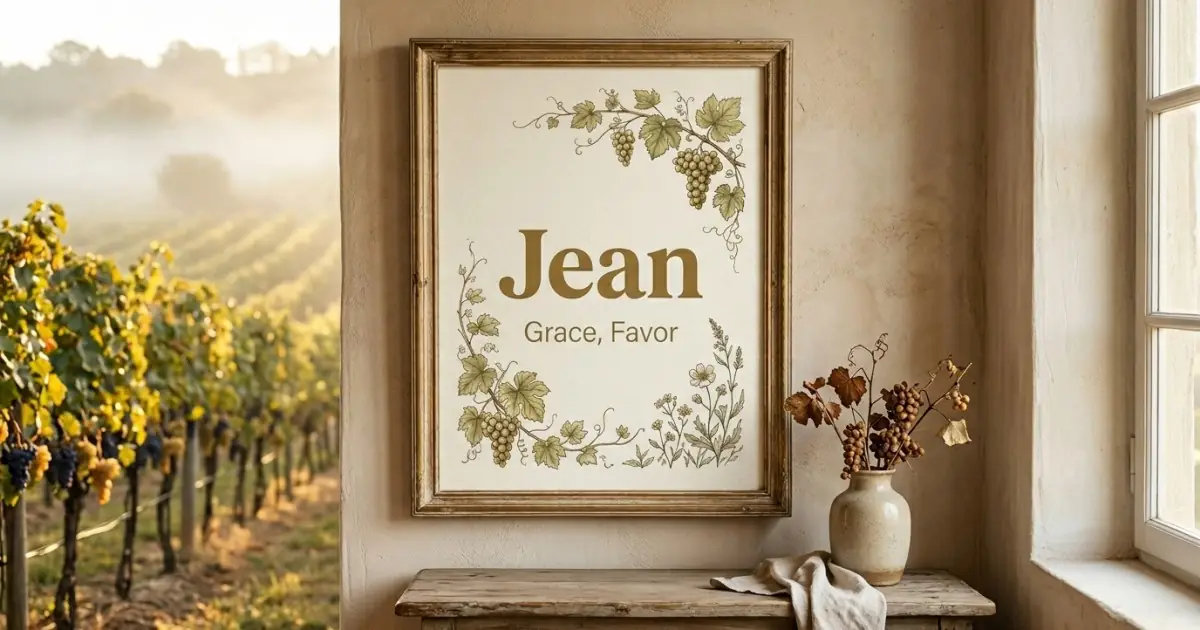
The meaning of Jean is “God is gracious,” a phrase that gives the name spiritual warmth without making it heavy. Grace is not force, conquest, or display. It is generosity that arrives before it is earned, mercy that softens the world, favor that feels both intimate and larger than the self. Official Social Security Administration (SSA) data for 2024 places Jean at No. 1139 for boys and No. 2411 for girls, showing a name with cross-gender history in American use but a current boy-leaning profile in this specific ranking. For parents considering the French masculine Jean, the appeal lies in that compact tension: a one-syllable name with centuries of depth, a soft sound with spiritual strength, and a familiar spelling that becomes quietly sophisticated when pronounced ZHAHN.
Jean's U.S. popularity rank over time, 1880–2024
Popularity statistics are based on official data from the Social Security Administration baby name records.
Jean: A Foundational and Radiant Global Pillar
Jean behaves as a name with a fluid identity, showing meaningful growth across both sides of the chart for over a century. This variation of a perennially popular classic is a genuinely shared favorite, where its structure and French roots make the name feel open across all lanes.
The chart indicates that while the girls’ lane reached massive historical peaks, the name remains a steady track for boys today. Meaning “God is gracious,” its simple structure carries a sense of permanent resonance.
Jean Carries Grace in One French Syllable
| Key Facts | Information | Quick Insight |
|---|---|---|
| Name | Jean | A concise French masculine name whose depth depends on hearing it correctly as ZHAHN. |
| Primary gender usage | Male | Jean is treated here as a masculine French name, though U.S. data also shows feminine use. |
| Primary origin | French | The French origin gives Jean its refined pronunciation and separates it from the English “jeen” reading. |
| Primary meaning | God is gracious | The meaning gives Jean a spiritual center rooted in mercy, generosity, and unearned kindness. |
| Pronunciation | ZHAHN | The sound is soft and compact, with a French-style opening that gives the name elegance. |
| IPA | U.S. /ʒɑːn/; U.K. /ʒɑːn/ | The shared IPA shows a stable one-syllable pronunciation across major English reference forms. |
| Syllable count | 1 | One syllable makes Jean brief and memorable, but its sound still feels layered and international. |
| U.S. boys’ rank (2024) | No. 1139 | Jean sits just outside the boys’ Top 1000, making it uncommon but not invisible. |
| U.S. girls’ rank (2024) | No. 2411 | Its girls’ rank reflects continued cross-gender familiarity, especially in English-speaking contexts. |

The Meaning of Jean Makes Grace the Name’s Quiet Power
Jean means “God is gracious,” a meaning that belongs to one of the deepest emotional currents in naming. Grace is not simply kindness, though kindness is part of it. Grace suggests generosity that comes freely, mercy offered without calculation, and a sense that life can be met with compassion rather than only judgment. As a name meaning, it gives Jean a spiritual warmth that feels both humble and profound.
This matters because Jean is so brief. One-syllable names sometimes rely on force to make an impression: hard consonants, sharp endings, heavy sounds. Jean does something different. Its strength is not blunt. It is carried through softness. The meaning gives the name moral depth, while the French pronunciation gives it restraint. Jean does not need to announce itself loudly; it has the confidence of a name that has meaning behind the sound.
Why “God is gracious” feels more like a blessing than a label
Some name meanings describe the person who bears the name. Others describe a hope, a memory, or a relationship with the divine. Jean belongs to the second group. “God is gracious” is not a claim that the child himself is grace. It is a statement about the source of grace. That gives the name humility. It points beyond the bearer while still surrounding him with a sense of blessing.
For parents, this meaning can feel especially tender. A child may be experienced as a gift, a mercy, a new beginning, or a sign of goodness arriving in the family’s life. Jean can hold that feeling without becoming sentimental. It is short, clean, and composed, but its meaning is full of gratitude.
The grace in Jean is gentle, not fragile
Grace is sometimes mistaken for softness alone, but grace can be remarkably strong. It is the strength to forgive, to remain open, to meet difficulty without becoming hard. Jean’s meaning therefore has a quiet resilience. It does not suggest a passive personality. It suggests a life touched by generosity and shaped by mercy.
The name’s sound supports that reading. ZHAHN begins with a soft, voiced sound and ends with a steady N. It feels smooth but not weak. The name opens gently and closes firmly, echoing the idea that graciousness can have structure, dignity, and endurance.
Jean’s French Masculine Form Changes Everything
Jean’s primary origin here is French, and that is essential to understanding the name. In French masculine usage, Jean is not the English “jeen.” It is ZHAHN, with a soft opening sound similar to the middle sound in “vision” and a broad vowel. The pronunciation transforms the name from a familiar English spelling into something more continental, compact, and refined. To explore the wider naming world around Jean, visit a wider list of French names.
This page-versus-voice tension is one of Jean’s defining features. In the United States, many people have encountered Jean as a feminine English name. But the French masculine Jean has a distinct sound and identity. Parents choosing it for a boy should be aware of that difference, not as a problem, but as part of the name’s character. Jean requires pronunciation confidence. Once heard correctly, it becomes elegant and memorable.
The French sound gives Jean its sophistication
The sound ZHAHN is rare in everyday English names, which gives Jean immediate distinction. It is not difficult once modeled, but it is unfamiliar enough to feel special. The opening zh sound is voiced and smooth, giving the name a polished entrance. The final N gives the name a clean close.
This is why Jean can feel both minimal and sophisticated. It has only one syllable, but that syllable contains a sound English speakers do not use in many common names. The result is a name that feels spare rather than plain.
How Jean differs from the English reading
The English reading “jeen” changes the name completely. It becomes sharper, brighter, and more familiar in American contexts, often associated with feminine usage. The French masculine ZHAHN is lower, warmer, and more fluid. It has a different emotional temperature.
For parents, this means introductions matter. “His name is Jean, pronounced ZHAHN” may be necessary in English-speaking settings. That small explanation preserves the name’s identity. It also gives people a clear way to honor the chosen form.
The Sound of Jean Makes One Syllable Feel Complete
Jean has one syllable, but it does not feel empty. Its IPA form is /ʒɑːn/ in both U.S. and U.K. reference forms, pointing to a stable pronunciation: ZHAHN. The name begins with /ʒ/, a voiced fricative. In accessible terms, it is the soft “zh” sound heard in words like “vision” or “measure.” That opening gives Jean its French character.
After the opening sound, the name moves into a broad vowel and closes with N. The structure is simple, but the effect is rich: soft opening, open center, firm ending. Jean is not long enough to become ornate, yet it has enough sound texture to feel intentional and complete.
The ZH opening gives Jean its rare texture
The first sound in Jean is the key to the name’s elegance. It is not the J sound in “John” or “James.” It is softer and more continuous. This gives Jean a smoothness that many short boy names do not have. The name does not begin with a strike; it begins with a glide of sound.
That opening also helps Jean feel artistic and international. It is easy to imagine the name in literary, musical, academic, and cosmopolitan contexts because its sound has restraint. It does not need extra syllables to feel cultivated.
The final N gives Jean a calm landing
Jean ends with N, a sound that closes the name gently but clearly. This matters because the opening is so soft. Without a firm close, the name might feel too airy. The N gives Jean shape. It helps the name feel grounded even though the first sound is fluid.
Phonetically, this balance is part of Jean’s strength. The name is graceful, but it does not dissolve. It has a beginning, a center, and an ending inside one syllable.
Jean’s Style Lives Between Spiritual Classic and French Minimalism
Jean belongs to a style space that is difficult to imitate. It is spiritual in meaning, French in origin, one syllable in form, and uncommon in current U.S. boys’ use. Official SSA data ranks Jean at No. 1139 for boys in 2024, just outside the Top 1000. That makes it close to wider visibility, but still distinctive.
At the same time, the name ranks 2411 for girls in 2024, which reflects its continued cross-gender familiarity in American naming culture. That dual profile gives Jean complexity. In French masculine form, it is a classic boy’s name. In U.S. English memory, it may also feel feminine to some listeners. Parents should understand both realities and decide whether the French sound and meaning are strong enough to carry the choice in their own community.
Jean beside other French and international boy names
Jean may appeal to parents who also like names such as Luc, Louis, Hugo, Jacques, Jules, Henri, Marcel, and Alain. These names share different pieces of Jean’s appeal: French identity, compact form, literary atmosphere, and understated style. Jean is the most minimal of this group, but also one of the most spiritually resonant because of its meaning.
Compared with Jules, Jean feels more solemn and classic. Compared with Luc, it feels softer and more graceful. Compared with Jacques, it is less sharp. Compared with Marcel, it is far more compact. Jean’s power comes from concentration: one syllable carrying cultural, spiritual, and stylistic weight.
Why Jean feels rare but not unfamiliar
Jean’s spelling is familiar, but the masculine French pronunciation gives it rarity in English-speaking use. This creates an unusual naming effect. People recognize the letters, but may need to learn the sound. Once they do, the name feels both known and new.
This makes Jean different from names that are rare because they are newly invented or visually complex. Jean is rare in a specific pronunciation and gender context, not because it lacks history. It feels established, but underused in the particular way parents may want to use it.
Official Data Shows Jean as Uncommon for Boys, Familiar Across Genders
Official SSA data for 2024 places Jean at No. 1139 for boys and No. 2411 for girls. This tells a nuanced story. As a boy’s name, Jean sits just outside the Top 1000, making it uncommon but not absent. As a girl’s name, it remains present at a lower rank, reflecting continued English-language familiarity. For more names in the same gender group, see baby boy names and meanings.
For parents choosing Jean for a boy, that data can be read in two ways. On one hand, the name has enough current masculine usage to be visible. On the other hand, some listeners may still associate the spelling with feminine English usage. The French pronunciation ZHAHN becomes the key that clarifies the choice.
The boys’ rank gives Jean a quiet modern opening
A 2024 boys’ rank of 1139 places Jean near the edge of broader recognition. It is not a common classroom name, but it is not completely hidden either. That can be attractive for parents who want a name with classic roots and contemporary distinctiveness.
Because Jean is so short, its rarity does not make it cumbersome. It is easy to spell, easy to write, and easy to say once the pronunciation is known. Its uncommon status comes from cultural reading, not from complexity.
The girls’ rank makes pronunciation and context important
The girls’ rank of 2411 means Jean is not exclusively heard as masculine in the United States. In English-speaking contexts, the spelling may carry feminine associations. This does not prevent Jean from working beautifully for a boy, especially in its French form, but it does mean parents should be ready to guide the pronunciation and context.
A middle name can help. Jean Baptiste, Jean Luc, Jean Gabriel, Jean Olivier, or Jean Raphael immediately gives the name a more French or international masculine frame. Even a classic English middle can support the full name if the family consistently uses the ZHAHN pronunciation.
Jean’s Spiritual Meaning Gives the Name More Weight Than Its Size Suggests
Because Jean is only one syllable, its meaning does important work. “God is gracious” gives the name a depth that might not be obvious from its brief form. The name may look small, but it is spiritually expansive. It carries gratitude, mercy, and a sense of blessing.
This is one of the reasons Jean can age well. Short names sometimes risk feeling slight, but Jean’s meaning prevents that. It has inner volume. It can belong to a child, a student, an artist, a scholar, a professional, a father, or an elder without losing dignity.
Grace as a lifelong meaning
Grace is not a meaning that belongs only to infancy or childhood. It grows with the person. In childhood, it can feel like tenderness. In adolescence, it can feel like steadiness and forgiveness. In adulthood, it can feel like wisdom, humility, and generosity.
Jean therefore offers a name story that remains useful over time. It does not lock the bearer into a narrow trait. It surrounds him with a broad spiritual idea: life met with graciousness.
Jean as a name of restraint
Jean’s restraint is part of its beauty. It does not need embellishment. It does not compete for attention through length or novelty. It is a name that becomes stronger the more quietly it is understood.
This restraint may appeal to parents who value simplicity with depth. Jean is not plain when pronounced ZHAHN. It is distilled.
Jean’s Social Impression Is Refined, Brief, and International
Socially, Jean gives a refined impression when pronounced in the French masculine way. It sounds cultured, gentle, and serious. It is not rugged in the usual sense, and it is not trendy. Its strength is elegance. That may make it especially appealing to families who prefer names with quiet sophistication over names that sound overtly powerful.
The name’s brevity also makes it flexible. Jean pairs beautifully with longer middle names and surnames because it does not crowd the full name. It can stand alone, but it often shines in combinations.
Jean in childhood and adolescence
On a child, Jean may require pronunciation correction in English-speaking settings. That can be managed with a simple phrase: “Jean, pronounced ZHAHN.” The name’s shortness helps. Once classmates and teachers learn it, the name is easy to say.
In adolescence, Jean can feel distinctive and stylish. It has a quiet confidence. It may suit a creative, thoughtful, multilingual, athletic, academic, or socially warm personality because it does not impose a narrow image.
Jean in adulthood
As an adult name, Jean has sophistication. It can feel professional, artistic, and international. Its meaning gives it moral warmth; its sound gives it polish. The name may invite occasional clarification, but it also leaves a memorable impression.
For an adult, Jean can be especially strong when paired with a well-chosen middle or surname. The full name can feel literary, French, spiritual, or cosmopolitan depending on the combination.
Three Paths Parents Often Explore After Choosing Jean
Middle names can frame Jean as unmistakably masculine and French
Because Jean is short and cross-gender in American memory, middle names can do important framing work. Jean Luc, Jean Baptiste, Jean Gabriel, Jean Olivier, and Jean Raphael all give the name a distinctly French or international masculine line. Jean Alexander or Jean Thomas can also work when parents want a more English-language anchor. If you want the full pairing logic behind that contrast, see middle names for Jean.
Nicknames can soften Jean, though the full name is already brief
Jean does not need a nickname for convenience, but affectionate forms may arise in family life. Jeannot, J, Jay, or Jean-Jean can work depending on language, household style, and whether parents want to preserve the French pronunciation or create an English-friendly casual form. To see how those different moods shorten in real life, explore Jean nicknames.
Pronunciation is the key to Jean’s whole identity
Jean is pronounced ZHAHN in this French masculine form. The first sound is the soft “zh” heard in words like “vision,” not the English J sound in “jeans.” Saying the name correctly transforms it from a familiar spelling into a refined French given name. If you want the full sound pattern behind that rhythm, read Jean pronunciation guide.
Jean Leaves a Name Story of Grace in a Single Breath
Jean is small only in length. Its meaning, “God is gracious,” gives it spiritual breadth; its French origin gives it elegance; its pronunciation, ZHAHN, gives it a sound that feels soft, serious, and complete. It is a name that asks to be heard carefully, and that careful hearing is part of its beauty.
Its 2024 U.S. data shows Jean at No. 1139 for boys and No. 2411 for girls, a rare but meaningful position. For boys, it sits just outside the Top 1000, distinctive without disappearing. Across genders, it remains familiar enough that parents should guide context and pronunciation. That dual reality makes Jean a thoughtful choice rather than an automatic one.
In the imagination, Jean is not a name of excess. It is a chapel bell heard once, a line of French script, a blessing spoken softly rather than shouted. It carries grace without ornament and faith without heaviness. For parents seeking a boy’s name with spiritual warmth, international refinement, and the discipline of simplicity, Jean offers a rare inheritance: one syllable, one breath, and a meaning that opens like mercy.