
How to Pronounce Jay: A Simple Pronunciation Guide

Picture Jay being called from a classroom doorway, written on a sports roster, or read aloud from a graduation program. There is almost no room for confusion: one letter-like name, one bright vowel, one clean beat. Jay is pronounced JAY, rhyming with day, say, and play. Its simplicity is part of its strength, but that simplicity also means every sound is exposed. There is no extra syllable to hide behind and no second beat to reshape the name.
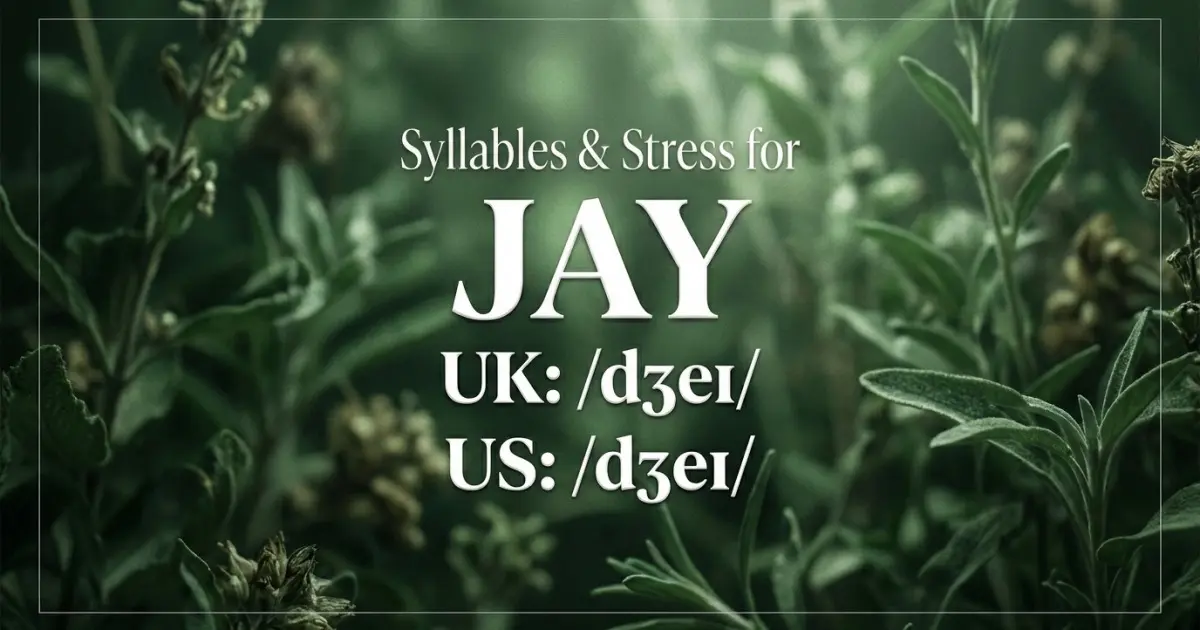
Because Jay means “jaybird; to rejoice,” the sound feels especially fitting. It has the quick lift of a birdcall and the open brightness of a joyful word. The pronunciation is stable in both U.S. and U.K. English, with the same IPA form: /dʒeɪ/. The name should be spoken lightly but clearly, with a soft “j” opening and a long “ay” vowel. It is not “Jai” with a different sound, not “Jah,” and not two syllables. It is simply JAY.
Jay Is Said in One Bright Beat That Leaves No Guesswork
| Element | Phonetic Detail | Quick Tip |
|---|---|---|
| Everyday pronunciation | JAY | Say it exactly like the letter J. |
| Syllable count | 1 syllable | Keep it as one clean beat; do not add a second syllable. |
| Stress pattern | Single stressed syllable | The whole name carries the stress because there is only one syllable. |
| U.S. IPA | /dʒeɪ/ | The pronunciation begins with a soft “j” sound and ends with the long “ay” vowel. |
| U.K. IPA | /dʒeɪ/ | The U.K. form matches the U.S. form, making Jay highly stable across accents. |
| Opening sound | /dʒ/ | Begin like “joy,” “June,” or “gentle,” not with a hard g sound. |
| Vowel sound | Long “a” /eɪ/ | Use the vowel in “day,” “say,” and “play.” |
| Ending | Open vowel finish | Let the name end cleanly on the “ay” sound, without adding a trailing consonant. |
The Everyday Pronunciation of Jay Depends on a Clean Soft J
Jay is pronounced with the same opening sound heard in “joy,” “jump,” and “June.” Linguistically, this sound is often called an affricate: it begins with a brief stop and releases into a softer, friction-like sound. In everyday terms, that means Jay starts with definition, but not harshness. The opening is clear and warm at the same time. The sound matters more once you know what the name is meant to carry, which is why the wider frame starts in Jay meaning.
The first sound should not become a hard G
Jay should never begin like “go,” “gate,” or “give.” The letter J in this name has its ordinary English sound: /dʒ/. That soft “j” gives the name its friendly lift. A hard-g version would sound like a different name entirely, and it would remove the natural brightness that makes Jay so easy to recognize.
A helpful guide is simple: Jay begins like joy. That comparison is especially useful because the name’s meaning includes “to rejoice.” The sound and meaning both lean toward brightness, expression, and emotional lift.
The long “ay” vowel should stay open
The vowel in Jay is /eɪ/, the long “a” sound heard in day, say, play, and gray. It should not become the short “a” in cat, the broad “ah” in father, or the long “ee” in see. The name is not “Jah,” “Jeh,” or “Jee.” It is JAY.
Because the name has only one syllable, the vowel does most of the expressive work. It gives Jay its clean, lifted finish. Spoken naturally, the name should feel bright but not stretched. It is a quick, complete sound.
Jay’s IPA Shows Why the Name Travels So Easily
The IPA pronunciation for Jay is /dʒeɪ/ in both U.S. and U.K. English. That shared form is one of the name’s strongest practical advantages. Many names shift across English accents because of r sounds, vowel changes, or unstressed endings. Jay avoids most of those complications. It has one syllable, one familiar consonant sound, and one familiar vowel sound.
What /dʒeɪ/ means in plain English
The first part, /dʒ/, is the soft “j” sound. The second part, /eɪ/, is the long “ay” vowel. Put them together and the pronunciation is exactly what most English speakers expect from the spelling: JAY. There are no silent letters, hidden sounds, or alternate stress patterns to manage.
This makes Jay unusually easy in daily life. A teacher reading it from a roster, a relative seeing it in a message, or a speaker introducing it at an event will almost always know how to say it immediately.
Accent differences are minimal
Some accents may color the “ay” vowel slightly, making it sound a little narrower or broader. But the structure of the name remains the same. Jay does not become a different name in U.S. or U.K. pronunciation. It stays one syllable and keeps the same IPA form.
That stability is helpful for a name with unisex potential. Whether Jay is used for a boy, a girl, or as a sleek gender-flexible name, the pronunciation remains straightforward and familiar.
Common Jay Pronunciation Mistakes Come From Adding What Is Not There
Jay is simple, so mistakes are usually caused by overthinking. Speakers may add a sound, change the vowel, or treat a stylized spelling as a different pronunciation. The correction is usually quick because the standard pronunciation is so familiar.
Mistake one: adding a second syllable
Jay has one syllable. It should not become “JAY-ee” unless someone is using a deliberately playful nickname such as Jay-Jay. The legal or standard given name is one clean beat. A simple correction is: “Just Jay, like the letter.”
Mistake two: changing the vowel
The name should rhyme with day, not with eye or ah. If someone sees a stylized form such as Jai or Jae, they may wonder whether the sound changes, but Jay itself is clear: JAY. The long “ay” vowel is the core of the name.
Mistake three: making it too clipped
Because Jay is short, some speakers may say it too abruptly. The name does not need to be dragged out, but it should be given its full vowel. Let the “ay” sound open naturally. This keeps Jay from sounding like only an initial and helps it feel complete as a given name.
Jay’s Sound Neighbors Make the Pronunciation Instantly Clear
Jay is easy to explain because it has many familiar sound neighbors. It rhymes with day, say, play, gray, Ray, and May. It also sounds exactly like the letter J. These comparisons make the pronunciation nearly effortless. The way the name resolves at the end often decides which short forms feel natural in speech, and that becomes clearer in nicknames for Jay.
Rhyming words are the fastest guide
If someone needs help, the simplest guide is: “Jay rhymes with day.” That confirms both the vowel and the one-syllable structure. “Jay, like the letter J” is even faster and works in almost every English-speaking context.
Nearby names show Jay’s clean style
Jay sits near names such as Ray, Kay, May, Jace, Jude, and Jack in sound or style, though it remains distinct. Ray and Kay share the same vowel shape. Jace shares the soft J opening and bright vowel. Jude and Jack share the short, strong J-name profile. Jay is the most minimal of the group: one syllable, open ending, no extra consonant after the vowel.
Practice Lines for Saying Jay Naturally
Jay should sound clear, relaxed, and complete. Practice it in ordinary sentences so the name feels natural rather than overly emphasized.
Slow practice
- JAY.
- Jay has one syllable.
- Jay rhymes with day.
- Jay sounds like the letter J.
Everyday practice
- Jay is ready for school.
- Can you call Jay?
- This is Jay Alexander.
- Jay will meet us there.
- We chose the name Jay.
Correction practice
- It’s pronounced JAY.
- One syllable, like the letter J.
- It rhymes with day, say, and play.
- No extra ending—just Jay.
Common Questions About Pronouncing Jay
How do you pronounce Jay?
Jay is pronounced JAY. It has one syllable and sounds exactly like the letter J.
What is the IPA pronunciation of Jay?
The U.S. and U.K. IPA pronunciation of Jay is /dʒeɪ/.
Does Jay have one syllable?
Yes. Jay has one syllable. It should be said as one clean beat, not as “JAY-ee.”
What words rhyme with Jay?
Jay rhymes with day, say, play, gray, Ray, and May. These words are useful pronunciation guides because they share the same long “ay” vowel.