
How to Pronounce Jaxson: An Easy Sound-by-Sound Breakdown

The easiest place to hear whether a name really works is not a baby-name database. It is a real room where someone has to say it on the first try: a teacher pausing over the class list, a pediatric nurse calling a family from the waiting room, a coach reading out a lineup, a graduation announcer moving quickly but hoping to get each student’s name right. Jaxson tends to do well in those rooms. The spelling looks modern, but the pronunciation is far less complicated than the letters might suggest. Most English speakers hear it, place it instantly in the Jackson family of names, and say it without much hesitation.
That practical ease is one of the name’s hidden strengths. Jaxson looks customized, but it does not ask people to learn a brand-new sound system. The everyday spoken form is still straightforward: JAK-sun. The first syllable carries the force, the second drops lightly away, and the whole name moves with the kind of brisk two-beat rhythm that modern English speakers find easy to process. In other words, Jaxson may look updated on paper, but in the mouth it remains stable, familiar, and highly usable.
What this makes clear about how Jaxson is actually said
| Element | Phonetic Detail | Quick Tip |
|---|---|---|
| Common spoken form | JAK-sun | Say the first syllable firmly, then let the second syllable stay quick and light. |
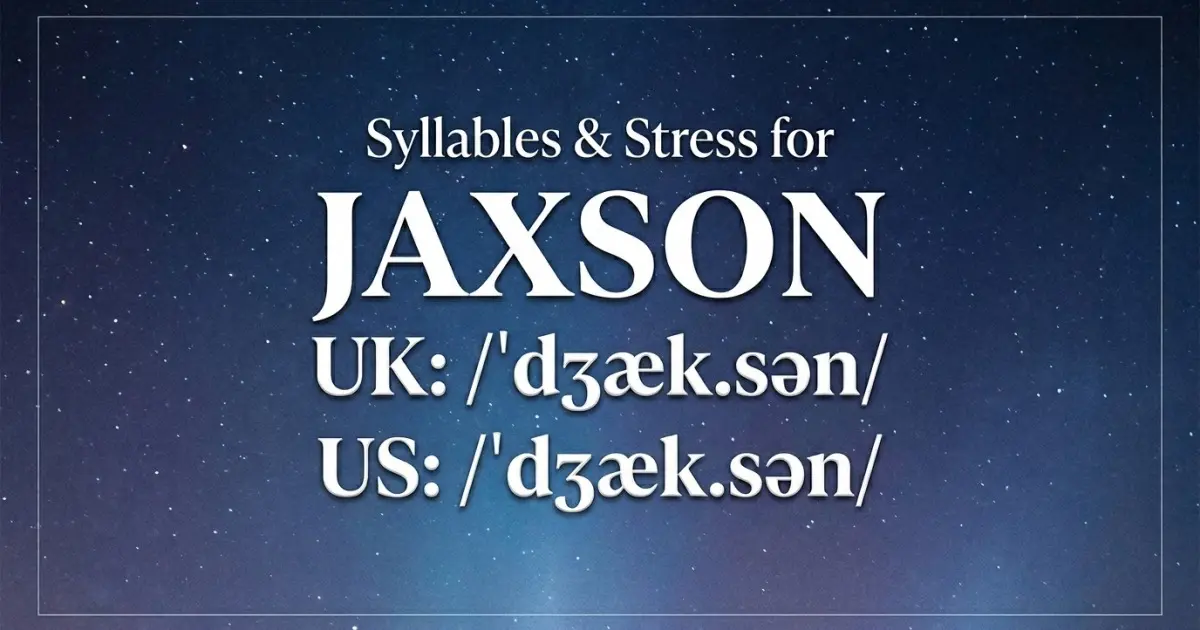
| U.S. IPA | /ˈdʒæksən/ | The opening sounds like the start of “jack,” followed by a soft, reduced ending. |
| U.K. IPA | /ˈdʒæksən/ | The core British and American pronunciation is essentially the same, which helps the name travel well. |
| Syllable count | 2 syllables | Think of the name in two beats, not three: JAK | sun. |
| Stress pattern | Primary stress on the first syllable | If the second syllable becomes too strong, the name starts sounding overcareful rather than natural. |
| Internal consonant sound | /ks/ in the middle | The letter x is doing the work of “cks,” so the sound stays familiar even if the spelling looks sharper. |
| Ending sound | Reduced -sən | The second syllable is usually closer to “sun” with a light schwa than a fully stressed “son.” |
Jaxson works because the first syllable carries the identity
The first rule of pronouncing Jaxson naturally is simple: the opening does most of the work. JAK is where the stress lands, where the ear locks in, and where the name establishes its identity. This is also why the short form Jax feels so inevitable. It comes from the strongest sound zone inside the full name. Once the first syllable is right, the rest of the name usually follows smoothly. Pronunciation lands more fully when the name’s roots and history are already in view, so begin with Jaxson meaning.
Phonetically, the opening begins with /dʒ/, the same affricate heard at the start of words like jump and jam. An affricate begins like a stop and releases into friction, which gives the name a quick burst of energy at the front. After that comes the short a vowel, /æ/, as in cat. Then the internal /ks/ cluster appears, represented by the letter x. This is an important detail. The modern spelling may look distinctive, but the sound is entirely familiar to English speakers. The name is not phonetically experimental. It is visually updated, not vocally difficult.
Why the x does not change the pronunciation much
The letter x often looks dramatic in a name, but here it mainly compresses sounds English speakers already know. Jaxson still behaves like a Jackson-family name in speech. The difference is graphic style, not a radical shift in sound. That is one reason people usually pronounce it correctly even if they have never seen this exact spelling before.
Why the second syllable should stay light
The second half of Jaxson is not meant to compete with the first. In natural English speech, it usually reduces to something close to -sun rather than a fully pronounced, heavily weighted -son. That light ending matters. It keeps the name moving. If the second syllable is made too deliberate, Jaxson can start sounding stiff or overenunciated.
Jaxson in everyday English is simpler than the spelling suggests
One reason Jaxson succeeds publicly is that its spelling invites attention while its pronunciation avoids drama. That balance is rare. Many visually distinctive names either become difficult to say or require constant correction. Jaxson usually does neither. Even when people first encounter the spelling, they tend to map it quickly onto a familiar spoken pattern. The internal x looks new, but the ear still hears a very recognizable structure: Jack + son.
This is where the name’s modern design becomes especially effective. The spelling signals individuality. The pronunciation signals continuity. That means the child gets a name that feels current without having to pay the lifelong social cost of constant mispronunciation. In classrooms, appointment desks, and sports settings, this is a real advantage. Jaxson may look customized, but it behaves like an easy mainstream name when spoken aloud.
Accent notes that matter with Jaxson
The fact that the American and British IPA are the same tells an important story. Jaxson does not shift dramatically across major English accents. Some speakers may make the second syllable slightly lighter or firmer depending on regional speech patterns, but the overall shape remains stable. The stress stays front-loaded, the internal /ks/ remains clear, and the ending stays reduced enough to sound natural.
Jaxson and its sound neighbors
Where confusion can happen is not usually with accent, but with nearby name forms. Jaxson lives close to Jackson, Jaxon, and even Jaxen-type respellings in the visual field. Spoken aloud, though, most of these sit very near the same family. That is why someone hearing the name may not immediately know which spelling is intended. But the pronunciation itself stays remarkably steady. The name is more variable on paper than in the ear. Because the strongest energy lands early, the shorter forms often grow from the opening of the name, and that pattern is easier to see in Jaxson nicknames.
Where people get Jaxson wrong, and how to keep it natural
Most mistakes with Jaxson are small. People rarely destroy the name completely. Instead, they usually make one of three tiny shifts: they overpronounce the second syllable, they flatten the first vowel, or they overreact to the spelling and try to make it sound more unusual than it is.
Mistake pattern one: making the ending too formal
Some speakers look at the spelling and give the second syllable equal force, producing something closer to JAK-SON with a very distinct, heavy ending. That is not disastrous, but it sounds more careful than conversational. In current everyday English, the second syllable usually relaxes to -sun.
Mistake pattern two: blurring the first vowel
The first syllable should sound like jack, not like Jake, Jock, or Jahk. The short a is doing important work. If that vowel shifts too far, the name starts sounding like a different name family altogether.
Mistake pattern three: overcompensating for the x
Because x looks distinctive, some speakers unconsciously treat Jaxson as if it needs a more stylized pronunciation. It does not. The smartest way to say Jaxson is the simplest one: hear the familiar Jackson-family sound pattern and keep moving.
Practising Jaxson until it sounds effortless
The easiest way to practice Jaxson is not to stare at the letters for too long. It is to say the name in short, ordinary sentences where the natural stress pattern can settle into place. The goal is a firm first syllable and a light, reduced second syllable. Clear, not dramatic.
Useful practice lines for Jaxson
- Jaxson is here.
- This is Jaxson Reed.
- Jaxson, your table is ready.
- We named him Jaxson.
If the name feels too sharp, lighten the ending. If it feels too flat, strengthen the first syllable. A very useful memory trick is to begin with the nickname Jax, then add a quick, soft -sun. Because the short form is already embedded inside the full name, it acts like a built-in pronunciation guide.
Why Jaxson sounds best when it is not overmanaged
Short, stylish names can tempt people into pronouncing them with extra force, as if the name’s coolness needs to be announced. Jaxson does not need that. Its strongest spoken form is the calm one: JAK-sun, two clean beats, no strain. The name already has enough edge on the page. In speech, what it needs is fluency.