
How to Pronounce Jax: Syllable Guide and Easy Stress Tips
The real test of Jax usually happens in a place where names have no time to explain themselves: a teacher reading a class list, a coach scanning a team roster, a receptionist calling across a waiting room. Jax tends to pass that test almost instantly. The spelling looks modern and graphic, but the actual sound is far simpler than the letter x may first suggest. In ordinary English speech, Jax is said in one clean beat: JAKS.
That combination of visual punch and spoken simplicity is a large part of the name’s appeal. On paper, Jax looks sharper and more stylized than Jack. In the mouth, though, it is direct, familiar, and easy to repeat. Once heard once, it rarely needs correction. The name’s pronunciation works because it is both crisp and stable: one syllable, one stress, one fast closing cluster. It sounds exactly as energetic as it looks, but not more complicated.
What the Ear Needs to Catch in Jax
| Element | Phonetic Detail | Quick Tip |
|---|---|---|
| Everyday pronunciation | JAKS | Say it like “Jacks” in one quick syllable. |
| U.S. IPA | /dʒæks/ | The name begins with the English “j” sound and ends with a clear ks cluster. |
| U.K. IPA | /dʒæks/ | The British and American pronunciations match here, which makes the name especially stable. |
| Syllable count | 1 syllable | There is no hidden second beat. Jax should land all at once. |
| Stress pattern | Single stressed syllable | Because it is one syllable, the whole name naturally carries the stress. |
| Middle vowel | Short a /æ/ | Use the same vowel you hear in “cat” or “Jack,” not the long A in “Jake.” |
| Ending | Final consonant cluster /ks/ | Let the x sound like “ks,” not like “z” or a second syllable. |
Jax Works Because It Lands Fast and Finishes Cleanly
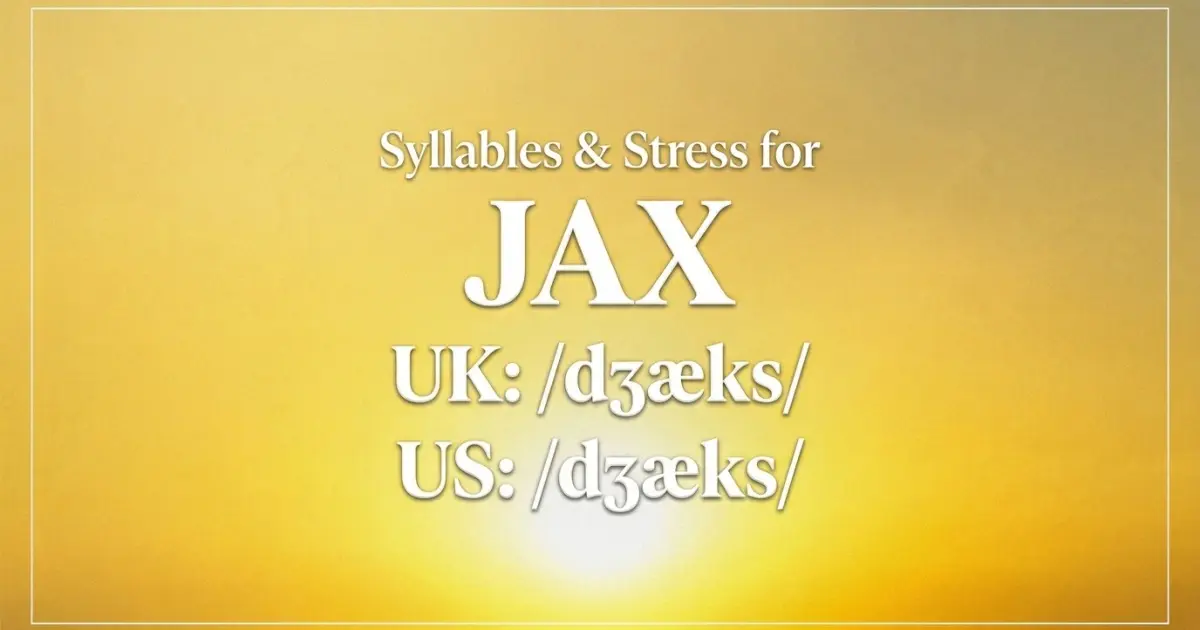
Phonetically, Jax is a compact name built for speed. The IPA in both U.S. and U.K. English is /dʒæks/, and that tells you almost everything important. The name begins with the familiar English j sound, technically an affricate, because it combines a stop and a fricative in one motion. In practice, that means the opening has immediate energy. Jax does not drift into the ear. It arrives. The sound matters more once you know what the name is meant to carry, which is why the wider frame starts in Jax meaning.
Why the vowel matters more than people think
The center of the name uses the short a sound /æ/, the same vowel found in words like cat, back, and Jack. This is important because it keeps Jax sounding grounded and punchy. If that vowel is lengthened by mistake, the name can drift toward something closer to Jakes, which immediately changes the character of the name. Jax needs the shorter, flatter vowel to keep its modern clipped shape.
That short vowel is part of why the name sounds athletic and fast. It gives the name tension and snap. A broader or longer vowel would make the name looser and less controlled.
What the x is actually doing in Jax
The final x is where the name gets much of its edge. In this name, the x is pronounced as the consonant cluster /ks/. That means the name closes with two sounds at once: a hard k-like release followed immediately by a soft fricative s. This ending gives Jax more bite than Jack, which stops more bluntly. Jax feels quicker and more graphic because the ending is more layered.
There is no liquid consonant such as l or r to soften the landing, and no second syllable to stretch the name out. Jax opens, hits, and closes. That is exactly the effect the name is designed to have.
Jax Is Easy to Say, but It Can Still Be Misheard
Jax is not a difficult name, but even simple names can get blurred in noisy or fast-moving situations. The most likely problems come from people hearing a neighboring name instead of the exact one intended, or from reading the spelling too quickly and guessing the wrong vowel shape.
The most common wrong turns
The first likely mistake is hearing Jack instead of Jax, especially if the final s is softened in casual speech. That is understandable because the two names share most of their sound structure. Another possible mistake is drifting toward Jakes, which happens when speakers give the name a long A instead of the intended short a. A third, less common problem is over-explaining the x and making the name feel heavier than it is. Jax should never sound like it has an extra syllable.
What is useful here is that the fixes are easy. Keep the vowel short. Keep the final cluster clean. Say it in one beat. Once those three things are in place, the pronunciation settles almost immediately.
Why the spelling still helps more than it hurts
Although the x makes the name look stylized, it does not actually make the pronunciation hard. In fact, it often helps. The spelling signals that this is not Jack, and that visual difference prompts speakers to pay attention. Once they do, the sound is easy. That is one reason Jax works so well in public life: it is distinctive on the page but manageable in the mouth.
Jax Across Accents Stays Strikingly Stable
One of Jax’s strongest practical advantages is that the pronunciation does not split between major English accents. Both the U.S. and U.K. IPA are /dʒæks/. That means the core structure of the name remains the same whether it is spoken in American or British English. Accent may color the exact sharpness of the vowel or the crispness of the final s, but the identity of the name does not change.
What changes, and what does not
In some voices, the short a may sound slightly tenser or flatter. In others, the final s may be more or less audible depending on speed and emphasis. But those are surface details, not competing pronunciations. The name still begins with the same j sound, keeps the same short vowel, and ends in the same ks cluster.
That stability suits a name like Jax. Its whole social appeal depends on directness. A name meant to feel quick and confident benefits from not changing shape too much across regions.
Why Jax sounds more modern than Jack
The sound difference between Jax and Jack is small but meaningful. Jack ends in a harder stop, while Jax adds the extra s element. That tiny phonetic change gives Jax a more contemporary finish. It sounds slightly more graphic and slightly less traditional. The pronunciation is still easy, but the ear hears a different attitude. Jax is not just Jack in different clothes. The final cluster genuinely changes the feel of the name.
How to Hear Jax Correctly Every Time
The fastest way to lock in Jax is to connect it to sound neighbors you already know. Jax rhymes with backs, tax, and Max. It also sounds like the plural word jacks. Once that connection is made, the pronunciation becomes nearly automatic.
Sound neighbors that make Jax easy
If a speaker can say Max, they are already close. Replace the opening m with a j sound and keep the same short vowel and final ks. That is Jax. It can also help to compare it mentally to Jacks, because that is exactly the spoken shape of the name. The difference lies more on the page than in the ear. The way the name resolves at the end often decides which short forms feel natural in speech, and that becomes clearer in Jax nicknames.
This is useful because the name’s modern styling can sometimes make people think the pronunciation must also be unusual. It is not. Jax is visually sharp, but phonetically straightforward.
Practice lines that make Jax feel natural
Pronunciation settles best when the name is placed in normal sentences rather than isolated repetition. These lines help the rhythm become natural:
Jax is ready.
I spoke with Jax yesterday.
Jax and Miles are on the list.
This is Jax Thomas Miller.
In each case, notice how little effort the name asks for. It arrives quickly, carries its stress easily, and ends with a clear, compact finish. That is exactly why Jax works so well as a modern boys’ name. It looks bold, but it behaves simply.
In the end, Jax is a good example of a name whose pronunciation supports its entire public image. It is crisp without being hard to say, modern without becoming unstable, and distinctive without asking speakers to learn a new phonetic system. Say it like JAKS, keep the vowel short, let the x sound like ks, and the whole name does what it was built to do: land fast and leave a clear impression.