
How to Pronounce Jasper: How to Say It Clearly and Naturally
By 2024, official U.S. data had already placed Jasper high enough in modern use that most people no longer meet it as a rare curiosity. A teacher reading a class list, a pediatric nurse calling from a waiting room, or a wedding officiant glancing at a printed program will usually recognize the name at once. But Jasper still creates a useful little pause. It is familiar, yet it has enough style and texture that speakers want to land it cleanly. In everyday English, that landing is usually the same: JAS-pər.
That matters because Jasper is one of those names whose social impression depends heavily on sound. The meaning may point toward treasure, rarity, and value, but the pronunciation keeps the name grounded. It opens briskly, almost with a snap, and then softens at the end. That combination is why Jasper sounds polished without sounding precious. It does not drift. It does not drag. It has energy, then ease. Once you hear that balance clearly, the pronunciation feels intuitive and very hard to mistake.
What Jasper is really clarifying every time it is said aloud
| Element | Phonetic Detail | Quick Tip |
|---|---|---|
| Standard spoken form | JAS-pər | Say the first syllable like “jass,” then let the second syllable soften and shorten. |
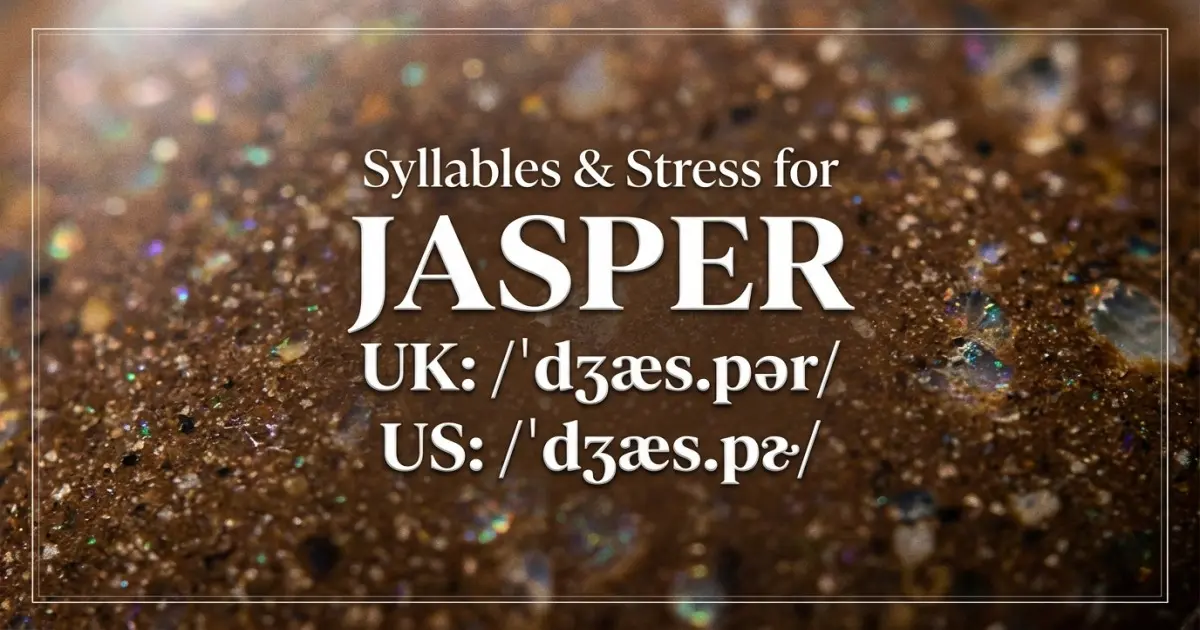
| US IPA | /ˈdʒæspər/ | The opening vowel is the same family of sound heard in “cat” or “glass” for many speakers. |
| UK IPA | /ˈdʒæspə/ | British speech usually keeps the same first syllable and relaxes the final r more strongly. |
| Syllable count | 2 syllables | Think of Jasper as one clear stressed beat followed by one lighter finishing beat. |
| Stress pattern | First syllable stressed | Say JAS-pər, not jas-PER. |
| Key sound character | Bright opening plus softened ending | The name should feel crisp at the start and relaxed at the finish. |
Why Jasper sounds sharper than many vintage names
Jasper belongs to that small class of older names that returned to modern life without becoming fragile. A large part of that success is phonetic. The name begins with the j sound, which in linguistic terms is an affricate. That simply means it starts with energy. There is a slight build and release in the mouth. Then comes the broad short vowel in JAS, which gives the name a confident opening rather than an airy or sleepy one. All of this happens quickly, which is why Jasper feels alert the moment it is spoken. Pronunciation lands more fully when the name’s roots and history are already in view, so begin with Jasper meaning.
The first syllable gives Jasper its polish
The first syllable does almost all the social work. JAS is where the name becomes memorable. It is front-stressed, cleanly shaped, and easy for English speakers to hear on first contact. That strong opening is one reason Jasper feels more current than many other revived names. It does not mumble into the room. It enters with a line around it.
This is also why Jasper avoids sounding overly delicate, even though its meaning is rich and its style can feel literary. The first syllable keeps the name grounded. It says the name knows how to stand up on its own.
The ending keeps Jasper from becoming hard
If the opening supplies the energy, the second syllable provides the grace. In American English, the name often ends with a softened -pər. In non-rhotic British accents, that becomes lighter still, more like -pə. Either way, the ending relaxes the line. This matters because a name that began with Jasper’s crispness and also ended sharply might sound too severe. Instead, the second syllable lets the sound settle.
That settling is what makes Jasper so socially wearable. It can sound stylish, but not brittle. It can sound bright, but not exhausting. A well-built name often combines tension and release. Jasper does exactly that.
How Jasper shifts across accents without losing itself
One of Jasper’s practical strengths is that the core pronunciation remains stable in both American and British English. The supplied IPA differs mainly at the end: American speech commonly keeps a pronounced r in /ˈdʒæspər/, while standard British speech tends toward /ˈdʒæspə/, where the final r is not fully sounded. But the overall identity of the name does not change. The same strong first syllable remains in place, and the rhythm stays intact.
Accent notes that matter, but not too much
In American speech, Jasper may sound slightly firmer because of that final rhotic finish. In British speech, the name often feels a little softer on the tail. But these are refinements, not rival pronunciations. No one is hearing a different name. They are hearing the same name filtered through two common accent systems.
This is useful in practice. Names that travel well across accents tend to feel easier in the long run, especially in multilingual or internationally connected environments. Jasper does not need much adaptation. It keeps its shape wherever it goes.
Why Jasper stays easy even when it stays distinctive
Some names are easy because they are plain. Jasper is easy for a better reason: its sound pattern is clear. The spelling points helpfully toward the spoken form, the stress pattern is natural to English, and the name is short enough to remember after hearing it once. That clarity helps the name feel distinctive without becoming difficult. In daily life, that balance is one of Jasper’s biggest strengths.
Where people most often get Jasper wrong
Mistake pattern: stressing the second syllable
The most obvious slip is to shift the weight too far back and produce something like jas-PER. In standard pronunciation, that sounds unnatural very quickly. Jasper is firmly front-stressed. The opening syllable should carry the main force. Once that happens, the second syllable can relax and the whole name sounds right again.
Mistake pattern: flattening the first vowel
Another mistake is to underplay the opening vowel so much that Jasper loses its brightness. The first syllable needs enough space to sound like JAS, not a swallowed or half-mumbled version of it. If the opening gets too thin, the name can lose the confidence that makes it so appealing.
Mistake pattern: making Jasper too formal in the mouth
Because Jasper can feel vintage, literary, or slightly expensive in style, some speakers unconsciously overhandle it, as though it needs a more ceremonial delivery than it actually does. Usually it does not. Jasper sounds best when spoken naturally and cleanly. The name’s elegance is already built into the sound. It does not need extra emphasis to prove it.
Jasper beside its nearest sound neighbors
It helps to understand Jasper by contrast. It is not Casper, which changes the first consonant and creates a lighter, more ghostly cultural feel. It is not Jasper pronounced with a dramatically rolled or heavy ending, because standard English use keeps the second syllable relaxed. It is not Jasper collapsed into a one-syllable mutter, because the second syllable still matters. It also sits differently from names like Jaxon or Jason. Jasper sounds older, firmer, and more textured than either of those. Once the sound pattern is clear, some shortenings stop feeling optional and start feeling natural, and the clearest map is in Jasper nicknames.
That difference is part of what makes the pronunciation memorable. Jasper has a crisp center of gravity. It sounds intelligent without sounding academic, stylish without sounding airbrushed, and vintage without sounding old-fashioned in a brittle way. Much of that comes from the way the name opens hard enough to catch the ear, then softens enough to stay warm.
How to make Jasper feel natural in your mouth
Practice help: hear Jasper in two clean beats
The easiest way to pronounce Jasper naturally is to hear the name as two linked units: JAS + pər. The first should be stronger, brighter, and more memorable. The second should finish the line gently. Do not clip the end off completely, but do not give it more importance than the opening either.
Practice help: use Jasper inside ordinary speech
Names settle best when spoken in real sentences rather than drilled in isolation. Try lines such as these:
- Jasper, it’s your turn.
- Have you met Jasper yet?
- Jasper is ready to go.
- Come here, Jasper.
- Jasper James sounds clear and balanced.
These lines make the name’s strengths obvious. Jasper moves easily through conversation, stays easy to hear at normal speed, and keeps its shape whether spoken with affection or formality. That is often the clearest sign of a good pronunciation pattern: it works everywhere the name has to live.