
How to Say Isaac Correctly: How to Break It Down and Say It Smoothly
You can hear the real pronunciation of Isaac in places where nobody is trying to perform expertise: a teacher taking attendance on the first day of school, a parent calling across a playground, a nurse stepping into a waiting room, a coach reading a roster out loud. In those settings, the name works because it is both old and easy. It carries biblical depth, but it does not sound ceremonial when spoken. It lands quickly, clearly, and with very little friction. That practical ease is one of the reasons Isaac has remained so durable in modern use.
The name also rewards a closer listen. Isaac is not difficult, but it has a sound pattern that does more subtle work than many parents notice at first. It opens with a strong, bright first syllable, then relaxes into a softer second one. That matters because it keeps the name from sounding stiff. Isaac means “laughter,” and its everyday pronunciation quietly supports that emotional texture. The name sounds clear and grounded, but not severe. It has shape without harshness, which is exactly why it feels so natural in ordinary speech.
How Isaac is actually said in everyday English
| Element | Phonetic Detail | Quick Tip |
|---|---|---|
| Common pronunciation | EYE-zuhk | Start with a full “eye” sound, then let the second syllable fall away lightly. |
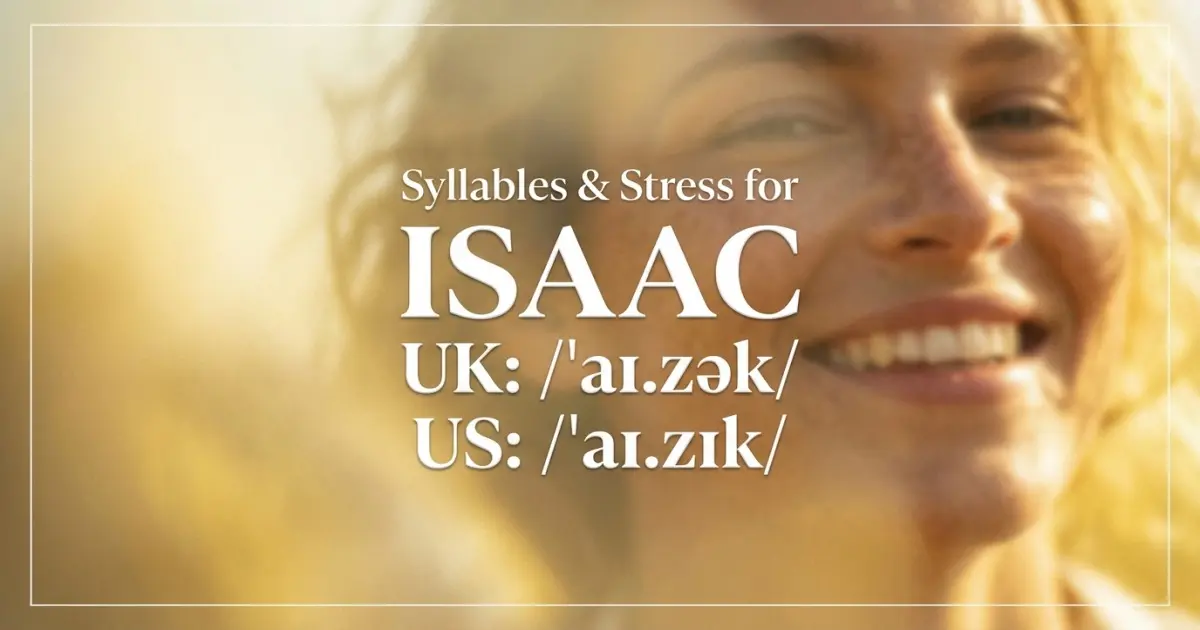
| IPA (US) | /ˈaɪzək/ | The stress mark shows the first syllable carries the main emphasis. |
| IPA (UK) | /ˈaɪzək/ | Standard British and American pronunciations are effectively the same here. |
| Syllable count | 2 syllables | Think of the name in two beats: EYE + zuhk. |
| Stress pattern | Strong-weak | Do not stress both syllables equally, or the name will sound overly deliberate. |
| Middle consonant | Voiced /z/ sound | The center should sound like the z in “music,” not a harsh s. |
| Ending | Reduced vowel plus final /k/ | Keep the second syllable light rather than turning it into a fully punched “zack.” |
Isaac works because the stress falls cleanly at the front
The easiest way to get Isaac right is to trust the first syllable. The name begins with the diphthong /aɪ/, the familiar vowel glide heard in words like eye, sky, and time. That opening gives Isaac brightness and lift. It makes the name easy to catch in conversation, which is especially useful in fast-moving real-life settings where names are heard before they are seen. Pronunciation lands more fully when the name’s roots and history are already in view, so begin with Isaac meaning.
After that opening comes the middle z sound. This is important because it keeps Isaac smooth. The name does not break sharply in the middle; it moves through a voiced consonant, which means the vocal cords stay active. In accessible terms, the sound is humming rather than clipped. That makes Isaac feel more fluid than some other biblical classics, especially those with harder internal stops.
Why the second syllable in Isaac should stay lighter
The second syllable is where pronunciation becomes either natural or overworked. In everyday speech, the last part of Isaac is reduced. It is not meant to carry equal force with the opening syllable. That reduced vowel is close to the neutral sound linguists call a schwa, the relaxed vowel that appears in many unstressed English syllables. In practice, that means the ending should feel easy and slightly softened: zuhk, not an aggressively emphasized zack.
This point is subtle but important. If both syllables are spoken with equal weight, the name can sound stiff or oddly formal. Isaac sounds best when the first syllable leads and the second finishes quietly.
What the rhythm of Isaac should feel like
The rhythm is best understood as strong-weak. Say EYE-zuhk, not eye-ZACK and not EYE-ZACK with the second syllable punched too hard. The stress belongs at the front, and once that stress pattern is right, the rest of the name falls into place very naturally.
Where Isaac gets misread, overpronounced, or drifted off course
Isaac is a familiar name, but it still has a few predictable trouble spots. Most of them come from spelling rather than from genuine complexity. Because the spelling contains two consecutive vowels and a visually strong ending, some speakers instinctively make the second syllable harder than it usually is in spoken English. Others flatten the center too much and lose the smoothness that helps the name sound calm and intelligent.
Common mistake patterns with Isaac
- EYE-zack with a heavy, fully stressed final syllable: understandable, but usually more rigid than everyday speech.
- EE-sak: a pronunciation that may appear in other language traditions, but not the standard English form used here.
- Eye-sak with a clearly hissed s instead of a voiced z: close, but less natural in English.
- Eye-zik: a casual drift that changes the final vowel too much and makes the name sound less grounded.
Why the voiced middle sound matters in Isaac
The middle consonant is a voiced alveolar fricative, the /z/ sound. That may sound technical, but the practical point is simple: Isaac should flow through the middle rather than snap in half. The z helps connect the two syllables. If that sound hardens into an s or gets swallowed, the name loses some of its smoothness.
This is one of the reasons Isaac feels intelligent and composed in speech. It is not only the history of the name that creates that impression. The actual sound structure helps. The bright opening, the voiced middle, and the softened close all contribute to a name that sounds articulate without feeling sharp.
Isaac across accents stays more stable than many classics
One practical strength of Isaac is that the standard U.S. and U.K. forms are the same in IPA: /ˈaɪzək/. That does not mean every speaker sounds identical, but it does mean the basic structure of the name remains highly stable across English-speaking accents. This makes Isaac an easy name to carry in classrooms, workplaces, and families where people may come from slightly different speech backgrounds.
What can shift slightly from accent to accent
The most common difference is not the first syllable, which remains very steady, but the softness of the second. Some speakers let the ending relax more noticeably, while others keep it a touch firmer. These are small shading differences, not different names. The shape of Isaac stays intact.
Isaac’s sound neighbors and why it still stands apart
Isaac can occasionally be heard near names such as Isaiah, Zach, or Ike in fast conversation, especially when only part of the name is caught. But acoustically it remains distinct. It opens with the full eye glide, passes through a voiced fricative, and ends with a soft final consonant rather than a liquid consonant like l or r. That gives it a compact and self-contained identity in speech. Once the sound pattern is clear, some shortenings stop feeling optional and start feeling natural, and the clearest map is in nicknames for Isaac.
It also helps that Isaac is visually and audibly aligned. People who know the name tend to know how it sounds, and once spoken, it is easy to remember. That combination of familiarity and clarity is a major part of its long-term success.
How to practice Isaac until it sounds effortless
The best way to practice Isaac is to hear it as one smooth motion rather than as two separate blocks. Start with the long eye sound, move through the soft voiced z, and let the second syllable fall lightly. Do not over-hit the ending. If you feel the name becoming stiff, it usually means the second syllable is carrying too much weight.
Quick practice lines for Isaac
Try these aloud:
- Isaac is here.
- Come on, Isaac.
- Isaac and Emma.
- This is Isaac Miller.
These lines help because they place the name inside normal spoken English. That matters more than repeating the name by itself. A good pronunciation should work in motion, not only in isolation.
A final spoken check for Isaac
If you want a simple last test, listen for the lead and the release. The first syllable should lead clearly: EYE. The second should release gently: zuhk. When those two parts are balanced, Isaac sounds the way it is meant to sound—steady, human, and easy to say well.