
Ilyas Pronunciation: Sound Breakdown for Confident Speech
Imagine a teacher reading a class list for the first time. The name Ilyas appears on the page, and the reader pauses just long enough to decide whether the opening should sound like “ill,” “eye,” or “eel.” That moment captures the main pronunciation challenge of Ilyas: the spelling is compact and familiar-looking, but English speakers may not immediately know where to place the stress or how open the second vowel should be.
The standard guide is eel-YAHS. Ilyas has two syllables, with the stronger emphasis on the second: eel-YAHS. The first syllable should stay light and quick, while the second carries the name’s weight. Once that stress pattern is understood, Ilyas becomes easy to say, repeat, and remember.
How Ilyas Is Actually Said in Everyday Speech
The table below separates the name into the details that matter most: syllable count, stress, vowel quality, and the final consonant.
| Element | Phonetic Detail | Quick Tip |
|---|---|---|
| Everyday pronunciation | eel-YAHS | Say the first syllable lightly and place the emphasis on YAHS. |
| Syllable count | 2 syllables: eel + YAHS | Do not add a third syllable between the two parts. |
| Stress | Second syllable | The name rises toward the ending rather than starting heavily. |
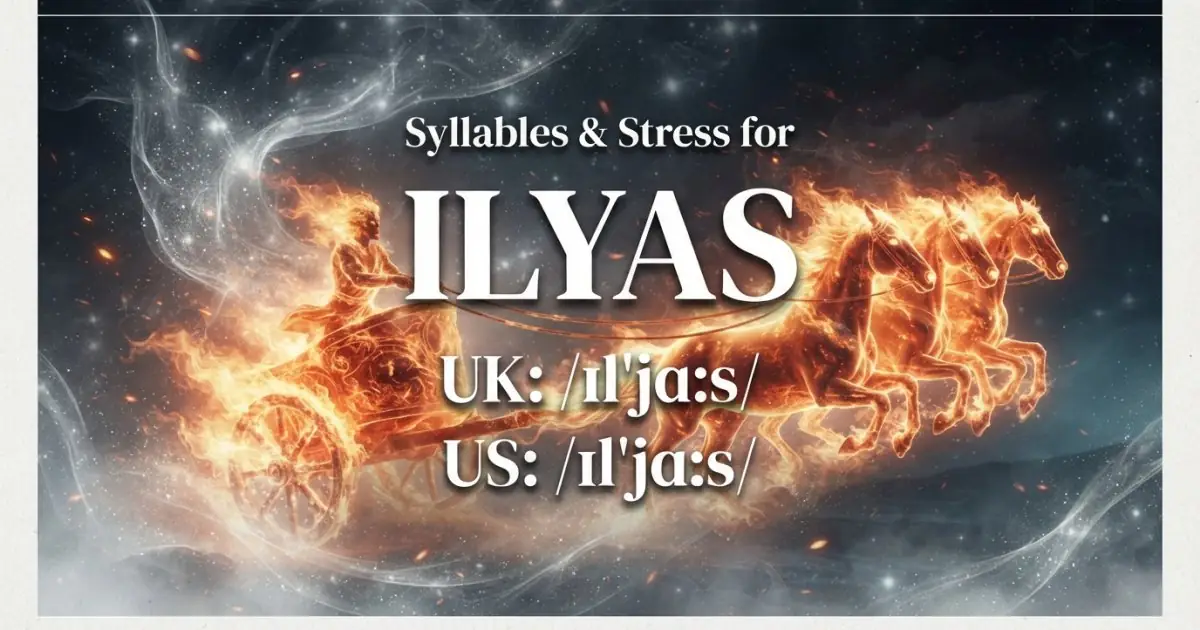
| US IPA | /ɪlˈjɑːs/ | The stressed vowel is broad, similar to the vowel in “father.” |
| UK IPA | /ɪlˈjæs/ | The stressed vowel may sound shorter and more forward. |
| Final sound | Unvoiced /s/ | Finish with a clean hiss-like sound, not a buzzing /z/. |
Ilyas Depends on a Light Opening and a Strong Second Syllable
The rhythm of Ilyas is more important than any single vowel. The first syllable is unstressed, and the second is stressed. In simple terms, the voice should move toward the end: The sound matters more once you know what the name is meant to carry, which is why the wider frame starts in Ilyas meaning.
eel-YAHS
The first part should not be delivered with the same force as the second. Saying EEL-yahs changes the character of the name by making it front-heavy. The more natural pattern lets the opening pass quickly before the voice settles on YAHS.
The opening “Il” stays compact
The first syllable begins with a short vowel followed by l. In the IPA forms, it appears as /ɪl/, although an everyday English guide often represents it as “eel” because that helps many speakers approach the intended flow. The important point is not to stretch the opening dramatically. It should remain a brief lead-in to the stressed second syllable.
The l is a liquid consonant, meaning the airflow moves smoothly around the tongue rather than stopping completely. That smooth quality helps the name glide directly into the following y sound.
The “y” acts like a bridge
In YAHS, the letter y begins with the consonant sound /j/, as in yes or young. It is not a separate syllable. Speakers should move directly from the l into the y: eel-YAHS, not “eel-ee-AHS.”
This bridge is what keeps Ilyas at two syllables. A slight glide is natural, but inserting a full extra vowel makes the name unnecessarily long.
The final “s” is crisp, not voiced
Ilyas ends with /s/, an unvoiced fricative. A fricative is made by narrowing the airflow so that a soft stream of friction is heard. In practical terms, the ending should resemble the final sound in house, not the buzzing ending in rose.
Finish cleanly with -ahs. Avoid turning the name into “eel-YAHZ,” unless a particular family or regional pronunciation deliberately uses that form.
American and British English Shape Ilyas Differently
The American and British IPA forms agree on the name’s structure and stress but differ in the stressed vowel.
American English: /ɪlˈjɑːs/
In the US pronunciation, the second syllable uses a broad /ɑː/ vowel. This is close to the vowel many American speakers use in father. The result sounds like eel-YAHS, with a relatively open mouth and a low vowel.
The stressed syllable may also sound slightly longer in careful speech. In fast conversation, however, the difference is often subtle because speakers naturally shorten names while keeping the stress intact.
British English: /ɪlˈjæs/
In the UK pronunciation, the stressed vowel may be closer to /æ/, the vowel heard in words such as cat, though accent differences can shift it. This can make the second syllable sound brighter and more forward than the American version.
Both pronunciations preserve the same central pattern: two syllables, stress on the second, and a final /s/. Accent variation is therefore less important than maintaining the correct rhythm.
Family pronunciation takes priority
Names travel across languages and communities, and small vowel differences are normal. One family may use a broader “ah,” while another may use a shorter vowel. The respectful approach is to listen to how the bearer or family says Ilyas and reproduce that version rather than insisting on a single accent-specific form.
Common Ilyas Pronunciation Mistakes—and Why They Happen
Most mistakes come from English spelling habits rather than from the name itself. Readers see familiar letter combinations and apply patterns from unrelated words.
Mistake 1: EYE-lee-us
This version treats the initial I like the vowel in ice and separates the ending into additional syllables. It may arise because readers associate Ilyas with names such as Elias. The correction is to keep the name at two syllables: eel-YAHS.
Mistake 2: ILL-ee-us
This pronunciation adds an extra middle vowel and weakens the final stress. It becomes three syllables instead of two. A useful correction is to join the final part immediately: Il-yas, not “Il-ee-as.”
Mistake 3: EEL-yus
This is closer, but it reduces the stressed vowel too much. The second syllable should remain clear and open: YAHS, not an unstressed “yus.”
Mistake 4: EEL-YAZ
This changes the final /s/ into a voiced /z/. English speakers often voice final s automatically, but Ilyas should end with a clean, unvoiced s in the supplied pronunciation.
Mistake 5: stressing the first syllable
EEL-yahs sounds noticeably different because the name loses its rising rhythm. To correct it, make the first syllable quieter and let the voice land on the second: eel-YAHS.
Sound Neighbors Can Help, but Ilyas Has Its Own Rhythm
English speakers sometimes approach unfamiliar names by comparing them with known sounds. Ilyas contains a beginning similar to “ill” or “eel,” followed by a stressed syllable beginning with the y sound from yes. Still, it should not be collapsed into Elias or another nearby name. When the stress sits in the center, the nickname logic often follows that same center of gravity, which is why Ilyas nicknames is the natural next step.
A useful sound-building exercise is:
- Say eel lightly.
- Say YAHS with clear emphasis.
- Bring them together without a pause: eel-YAHS.
The first part is preparation; the second is the destination. Thinking of the name this way usually produces the correct stress automatically.
Practice Ilyas in Natural Sentences
Repeating a name by itself is useful, but placing it into everyday sentences makes the rhythm more stable. Keep the stress on the second syllable each time.
Slow practice
- “This is Ilyas.”
- “The name is eel-YAHS.”
- “Ilyas will be here soon.”
- “Please welcome Ilyas.”
Conversational practice
- “Did Ilyas bring his book?”
- “I spoke with Ilyas yesterday.”
- “Ilyas is joining us for lunch.”
- “Can you send that message to Ilyas?”
Introducing the pronunciation politely
- “It’s Ilyas, pronounced eel-YAHS.”
- “The stress is on the second syllable: eel-YAHS.”
- “It has two syllables—Il-yas.”
When correcting someone, one calm repetition is usually enough. Most speakers remember the name once they hear the strong second-syllable stress.
Getting Ilyas Right Means Letting the Name Rise
Ilyas is pronounced eel-YAHS: two syllables, with the emphasis on the second. The opening remains light, the y forms a smooth bridge, and the name ends with a crisp /s/. American and British accents may shape the stressed vowel differently, but both preserve the same essential rhythm.
The simplest memory cue is to let the voice rise toward YAHS. Once that movement becomes natural, Ilyas no longer feels unfamiliar on the page. It becomes what it is in speech: compact, clear, and easy to carry.
Pronouncing Ilyas: Common Questions
How do you pronounce Ilyas?
Ilyas is pronounced eel-YAHS, with two syllables and the stress on the second syllable.
Is Ilyas pronounced like Elias?
No. Ilyas is pronounced in two syllables, eel-YAHS. Elias is commonly pronounced with three syllables in English, so the names should not be treated as phonetic equivalents.
Which syllable is stressed in Ilyas?
The second syllable is stressed: eel-YAHS. The first syllable should remain lighter.
Does the final letter in Ilyas sound like S or Z?
It ends with an unvoiced s sound, like the final sound in “house,” rather than a buzzing z sound.
Is Ilyas difficult for English speakers to pronounce?
It may require one correction because readers sometimes add an extra syllable or stress the beginning. Once they hear eel-YAHS, the two-syllable pattern is usually easy to remember.