
How to Pronounce Ila: A Simple Pronunciation Guide
The most revealing moment in a name’s life is often not the birth announcement or the beautifully chosen meaning. It is the first time a stranger has to say it out loud with no help. A receptionist looks at a form. A teacher pauses over attendance. A barista glances at the cup label and makes a decision in less than a second. That is where Ila proves it is stronger than its spare spelling suggests. On paper, the name can invite a flicker of uncertainty because it is so short and visually close to other familiar names. In speech, though, it resolves quickly and elegantly: EYE-luh.
That real-life contrast matters. Ila is not a difficult name in the mouth. It is a name that sometimes needs one small moment of visual clarification before it becomes easy. Research on baby-name usability consistently points in the same direction: names that are short, rhythmically clear, and stress-forward tend to settle into memory fast once heard. Ila fits that pattern well. It has two syllables, the emphasis lands immediately, and the second syllable relaxes gently rather than demanding another strong beat. That is why the name often sounds more intuitive than it first looks.
What saying Ila correctly actually comes down to
| Element | Phonetic Detail | Quick Tip |
|---|---|---|
| Everyday pronunciation | EYE-luh | Say it like “eye,” then finish with a soft “luh.” |
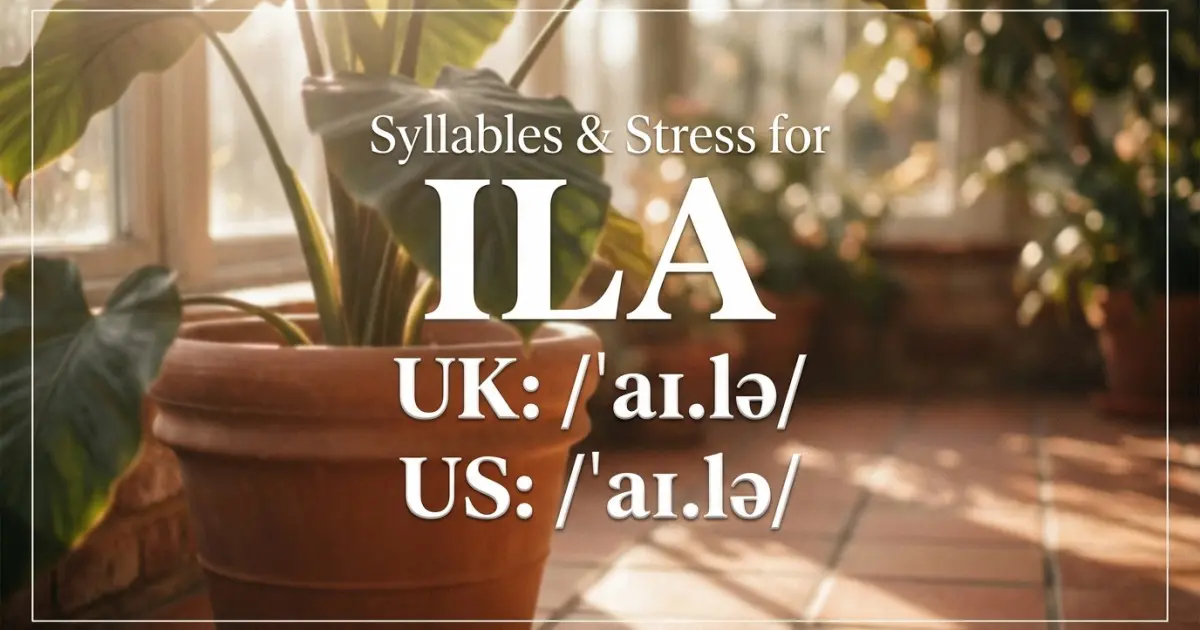
| IPA (US) | /ˈaɪlə/ | The stress mark at the front shows the first syllable carries the emphasis. |
| IPA (UK) | /ˈaɪlə/ | US and UK pronunciation align neatly here, which makes the name unusually stable across accents. |
| Syllable count | 2 syllables | Break it cleanly into “eye” plus “luh.” |
| Stress pattern | FIRST syllable stressed | Do not push the emphasis onto the ending. |
| Middle consonant | Liquid consonant /l/ | The “l” should glide, not stop the name abruptly. |
| Final vowel sound | Schwa /ə/ | The ending is soft and relaxed, more “luh” than “lah.” |
| Closest sound neighbors | Isla, Aila | The sound will feel familiar to many English speakers even if the spelling is new to them. |
Ila is easier in the mouth than it is on the page
Phonetically, Ila is a very efficient name. It begins with the diphthong /aɪ/, the same opening sound heard in words like “eye” or “my.” That gives the name brightness immediately. From there it moves into /l/, a liquid consonant. Linguists call l a liquid because it lets air and sound flow rather than snap shut. That is one reason Ila feels smooth. It does not hit a hard stop in the middle. It glides from the opening vowel into the softer ending. The sound matters more once you know what the name is meant to carry, which is why the wider frame starts in Ila meaning.
The two parts you actually need to hear
The easiest way to teach the pronunciation is simply to divide it into two audible units: eye + luh. The first part is bright and fully voiced. The second part is lighter and less dramatic. Because the second syllable uses a schwa sound, written in IPA as /ə/, it is not supposed to sound emphatic. English naturally reduces many unstressed vowels this way. So even though some people may be tempted to say “eye-LAH,” the more natural English target is gentler: EYE-luh.
Why Ila sounds polished without sounding formal
Many names feel usable because they are familiar. Ila feels usable because its sound structure is familiar. It follows a pattern English speakers already know how to say. That matters more than many parents realize. A name does not have to be common to be easy. It only needs to move through the mouth in an expected way. Ila does exactly that. Once heard once, it is usually easy to repeat.
Ila puts the stress where English speakers expect it
Stress is one of the biggest hidden factors in whether a name feels natural. Many naming guides mark the stressed syllable clearly, sometimes by capitalizing it in a phonetic spelling. With Ila, the stressed syllable comes first. That alone makes the name more accessible in American and British English. English speakers are very comfortable with two-syllable names that open strong and end light.
The IPA for Ila is simple and stable
The American and British IPA both appear as /ˈaɪlə/. That shared form is a quiet advantage. Some names shift dramatically between regions, but Ila stays remarkably stable. The stress mark before the first syllable tells you where the emphasis belongs. The /aɪ/ tells you the opening is the same sound as “eye.” The /l/ gives the liquid center. The final /ə/ shows that the ending is reduced and relaxed.
What this stress pattern does to the feel of the name
Because the weight lands immediately, Ila sounds decisive without sounding severe. Then the name softens. That is a very attractive balance. It gives the name clarity at the front and warmth at the finish. In social use, this often makes Ila feel both gentle and competent, which is one reason short two-syllable names with first-syllable stress tend to wear well over time.
Where Ila gets misread in everyday life
The most common pronunciation issues with Ila do not come from the sound itself. They come from spelling expectations. English readers often rely on visual analogy, so they see a short unfamiliar name and try to match it to patterns they already know. That is why pronunciation slips around Ila are usually understandable rather than alarming.
The vowel mistakes people make first
One predictable mistake is reading Ila as EE-luh. This happens when someone treats the initial I as a simple short or long ee-style vowel rather than the diphthong /aɪ/. Another possible slip is ILL-uh, especially from readers who move quickly and flatten the opening. Both mistakes are easy to correct because the name’s intended sound is clean once spoken aloud.
A smaller variation is EYE-lah with a fully open final “ah.” That version is not wildly far from the target, but in en-US speech it usually sounds slightly heavier than the preferred form. The more natural ending is the lighter schwa, which gives Ila its easy finish.
The stress mistake that changes the whole rhythm
Less common, but still possible, is pushing the stress onto the second syllable: eye-LAH. That changes the character of the name immediately. It makes Ila sound more elongated and less English-natural in daily use. If you are correcting someone gently, the fastest fix is not a linguistic explanation. It is just repeating the name in context: “It’s EYE-luh.” Most people adjust right away.
What is not really a mistake at all
Because Ila sounds so close to names like Isla and Aila, some listeners may initially think they are hearing one of those names. In spoken conversation, that is not really a pronunciation problem. It is a spelling-identification issue. The useful part is that the sound itself already feels familiar to many people. So even when the spelling needs clarification, the pronunciation usually does not remain a long-term obstacle.
Ila lives beside familiar sounds, which helps more than it hurts
No name is heard in total isolation. People understand new names partly by comparing them to names they already know. Ila benefits from sitting near a well-established cluster of soft, vowel-led girls’ names in English. That neighborhood makes it easier to pronounce and easier to remember.
The closest sound neighbors to Ila
The most obvious sound neighbors are Isla and Aila, both of which lead many English speakers toward the correct spoken form. There is also some looser overlap with Lila and Ione in the sense that these names train the ear to expect bright opening vowels and gentle endings. This does not erase Ila’s distinctiveness. It simply gives listeners a usable map. Once the sound pattern is clear, some shortenings stop feeling optional and start feeling natural, and the clearest map is in Ila nicknames.
What keeps Ila from sounding interchangeable
What makes Ila different is not the basic rhythm but the visual and structural simplicity. It has no extra consonant, no decorative ending, no multi-letter clue built into the spelling. That means it reaches the same sound destination by a cleaner route. In pronunciation terms, that often makes it feel elegant. In practical terms, it means the child may occasionally spell it out while rarely having to repeat the actual sound more than once.
Saying Ila out loud until it feels natural
The best test for any pronunciation is real speech, not isolated phonetic theory. Ila should feel quick, smooth, and lightly lifted at the front. If it sounds choppy, over-emphasized, or overly exoticized, it has probably drifted away from its strongest everyday form.
Three easy practice lines for Ila
Try the name in complete phrases rather than alone:
“This is Ila.”
“Ila is almost here.”
“Can you save a seat for Ila?”
In each sentence, the first syllable should catch the ear immediately, while the second syllable stays light. If you find yourself slowing down too much, that is usually a sign you are overthinking it. Ila works best at conversational speed.
How to correct people without making the name feel difficult
The cleanest correction is short and calm: “It’s EYE-luh.” Nothing more is usually needed. Long explanations can accidentally make an easy name sound harder than it is. Ila is not one of those names that requires a pronunciation lecture. It typically needs one demonstration and then settles in.