
How to Pronounce Icelynn: Clear Pronunciation Help for Everyday Use

The real pronunciation test for Icelynn does not happen in a naming book. It happens in ordinary public life: a teacher reading a class roster aloud for the first time, a receptionist checking an appointment, a coach calling attendance, a relative seeing the name in print before hearing the family say it. That kind of moment matters because Icelynn is visually striking. People can see the word ice at the front and briefly wonder whether the name will be longer, sharper, or more complicated than it actually is. In practice, the spoken form is much cleaner than the spelling may first suggest.
Said naturally, Icelynn is ICE-lin. It is a two-syllable name with the full stress on the opening syllable, and that early stress gives it confidence. The sound begins with brightness and edge, then softens quickly into the second syllable. That is why the name works. It does not drift. It lands fast. The meaning behind it may evoke ice and water, but the spoken name is not fragile or airy. It is crisp, compact, and much easier to carry in real life than some listeners might expect at first glance.
How Icelynn is actually said when someone gets it right immediately
| Element | Phonetic Detail | Quick Tip |
|---|---|---|
| Everyday pronunciation | ICE-lin | Think of it as two beats only, with the full weight on “ICE.” |
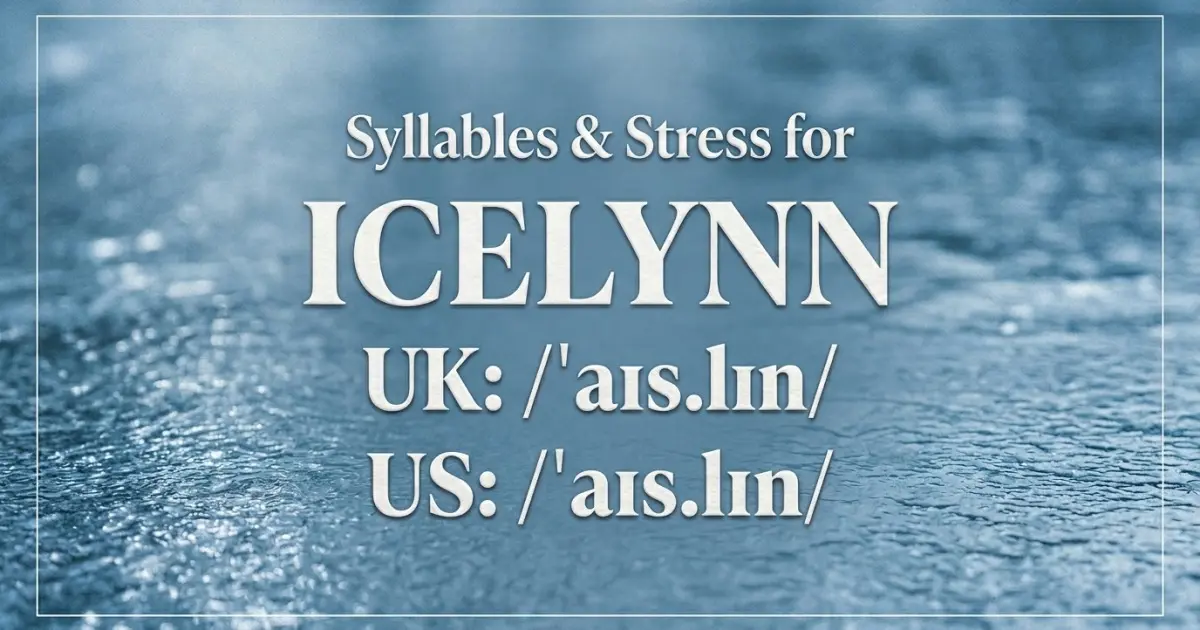
| US IPA | /ˈaɪslɪn/ | The opening uses the long “eye” sound, followed immediately by an s sound. |
| UK IPA | /ˈaɪslɪn/ | The U.K. form matches the U.S. form, so the name stays unusually stable across accents. |
| Syllable count | 2 syllables | Do not stretch it into three. There is no extra vowel between “ice” and “lin.” |
| Primary stress | First syllable: ICE | The first syllable carries the whole name’s identity and keeps it crisp. |
| Ending sound | -lin /lɪn/ | Keep the ending short and light. It should soften the name, not slow it down. |
Icelynn keeps the stress at the front, and that is the whole point
The first syllable is where Icelynn becomes itself
In both the U.S. and U.K. IPA, the stress marker appears before the first syllable: /ˈaɪslɪn/. That means the name should open decisively on ICE. This is important because many visually distinctive names invite people to search for the stress, but Icelynn does not really want that kind of hesitation. The name is built to declare itself immediately. The opening syllable carries the image, the edge, and the memory value all at once. Before focusing only on syllables and stress, it helps to step back into the fuller frame of Icelynn meaning.
That early stress also keeps the name from sounding flimsy. If speakers try to distribute the emphasis more evenly or slide into the second syllable, Icelynn loses the brisk, bright quality that makes it distinctive. A strong first beat is what gives the name shape. It lets the second syllable do what it is supposed to do: close the name softly and quickly.
Why Icelynn is only two syllables, not three
The main pronunciation trap here is visual. Because the name begins with a full English word and then moves into a familiar ending, some people may expect an extra bridging sound in the middle. But the pronunciation does not add one. Icelynn is not “Eye-suh-lin” or “Ice-uh-lynn.” It is simply ICE-lin. The s sound at the end of the first syllable runs directly into the l at the start of the second.
This is one reason the IPA matters. It confirms that the name is compact. The cluster /sl/ belongs inside the spoken name. Once people hear that, the pronunciation tends to settle quickly.
Why Icelynn sounds sharper than it looks on paper
The opening diphthong and consonant cluster do most of the work
Phonetically, Icelynn is stronger than its soft ending might suggest. The name begins with /aɪ/, the same diphthong heard in words like eye or ice. A diphthong is simply a vowel sound that moves as it is spoken. Here, that movement gives the opening brightness and momentum. Then comes the s, which sharpens the line, followed immediately by the l of the second syllable. That /sl/ transition is what keeps the name feeling brisk instead of dreamy. Once the sound pattern is clear, some shortenings stop feeling optional and start feeling natural, and the clearest map is in nicknames for Icelynn.
The ending /lɪn/ then does the balancing work. It is short, familiar, and easy for English speakers to produce. In plain terms, Icelynn starts like a flash and ends like a name. That is why it feels more socially usable than a purely image-driven spelling might suggest.
The second syllable keeps Icelynn from becoming too hard
If the name were only the opening sound, it would risk sounding too severe. The second syllable prevents that. Lin is softer, more familiar, and easier to place inside everyday naming patterns. It links Icelynn to a wider family of names with -lyn or -lin endings, which makes the full form feel more wearable. The opening gives the name its distinctiveness. The ending gives it social ease.
This balance matters. It is what keeps Icelynn from sounding like a concept word instead of a person’s name. The sound design tells listeners that although the name contains a strong image, it still belongs in daily speech.
Where speakers are most likely to trip over Icelynn
The biggest mistake is adding a vowel that is not there
The most common issue with Icelynn is likely to be over-reading the spelling. Because the eye sees multiple meaningful parts, some speakers may try to smooth the transition with an extra vowel. That makes the name longer and blurrier than intended. The cleanest correction is also the easiest one: “It’s ICE-lin.” The name works best when spoken quickly and clearly, not when dissected.
Another common drift is overemphasizing the ending
Some people may also give too much weight to the -lynn portion because that ending is familiar in many other names. But in Icelynn, the ending should not dominate. It is /lɪn/, short and light. If it becomes too heavy, the name can start to sound dragged down or disconnected from its opening image. The stress belongs up front.
Accent differences are minimal with Icelynn
One of the name’s practical strengths is that the U.S. and U.K. IPA are the same: /ˈaɪslɪn/. That is unusually helpful. Many modern names shift slightly across English-speaking accents, but Icelynn stays stable. Individual voices may color the vowels a little, but the rhythm, stress, and syllable count remain intact. In real life, that means fewer pronunciation surprises when the name moves across regions or countries.
Icelynn in real sentences is easier than Icelynn on a blank page
Practice it in full phrases, not as a spelling puzzle
The best way to internalize the pronunciation is to hear the name in ordinary speech. These kinds of lines help:
- “Icelynn is here.”
- “This is Icelynn.”
- “Can Icelynn come to the front, please?”
- “Icelynn, your table is ready.”
If the voice lands firmly on ICE and then closes lightly on -lin, the pronunciation is in the right place. The name should feel brisk, not stretched.
Consistency teaches the name faster than explanation does
For families using the name, the best strategy is usually simple consistency. Say it clearly as ICE-lin, and most people will adjust quickly. Icelynn is the kind of name that can look more complicated than it sounds, so confident repetition is more useful than a long technical explanation. Once someone hears the rhythm once or twice, they usually understand what the spelling is doing.